
Catalogue Search | MBRL


Are you sure you want to remove the book from the shelf?

{{itemTitle}}
19
result(s) for
"Greece History Peloponnesian War, 431-404 B.C. Historiography."
Sort by:


Thucydides’ War Narrative
As a sustained analysis of the connections between narrative structure and meaning in the History of the Peloponnesian War, Carolyn Dewald's study revolves around a curious aspect of Thucydides' work: the first ten years of the war's history are formed on principles quite different from those shaping the years that follow. Although aspects of this change in style have been recognized in previous scholarship, Dewald has rigorously analyzed how its various elements are structured, used, and related to each other. Her study argues that these changes in style and organization reflect how Thucydides' own understanding of the war changed over time. Throughout, however, the History's narrative structure bears witness to Thucydides' dialogic efforts to depict the complexities of rational choice and behavior on the part of the war's combatants, as well as his own authorial interest in accuracy of representation. In her introduction and conclusion, Dewald explores some ways in which details of style and narrative structure are central to the larger theoretical issue of history's ability to meaningfully represent the past. She also surveys changes in historiography in the past quarter-century and considers how Thucydidean scholarship has reflected and responded to larger cultural trends.
eBook

The Cambridge companion to Thucydides
\"Thucydides' History of the Peloponnesian War is one of the earliest and most influential works in the western historiographical tradition. It provides an unfinished account of the war between Athens and her allies and Sparta and her allies which lasted from 431 to 404 BC, and is a masterpiece of narrative art and of political analysis. The twenty chapters in this Companion offer a wide range of perspectives on different aspects of the text, its interpretation and its significance. The nature of the text is explored in detail, and problems of Thucydides' historical and literary methodology are examined. Other chapters analyse the ways in which Thucydides' work illuminates, or complicates, our understanding of key historical questions for this period, above all those relating to the nature and conduct of war, politics, and empire. Finally, the book also explores the continuing legacy of Thucydides, from antiquity to the present day\"-- Provided by publisher.
BOOK
Thucydides and Internal War
In this 2001 book Jonathan Price attempts to demonstrate that Thucydides consciously viewed and presented the Peloponnesian War in terms of a condition of civil strife - stasis, in Greek. Thucydides defines stasis as a set of symptoms indicating an internal disturbance in both individuals and states. This diagnostic method, in contrast to all other approaches in antiquity, allows an observer to identify stasis even when the combatants do not or cannot openly acknowledge the nature of their conflict. The words and actions which Thucydides chooses for his narrative meet his criteria for stasis: the speeches in the History represent the breakdown of language and communication characteristic of internal conflict, and the zeal for victory led to acts of unusual brutality and cruelty, and overall disregard for genuinely Hellenic customs, codes of morality and civic loyalty. Viewing the Peloponnesian War as a destructive internal war had profound consequences for Thucydides' historical vision.
eBook


A New History of the Peloponnesian War
A New History of the Peloponnesian Waris an ebook-only omnibus edition that includes all four volumes of Donald Kagan's acclaimed account of the war between Athens and Sparta (431-404 B.C.):The Outbreak of the Peloponnesian War, The Archidamian War, The Peace of Nicias and the Sicilian Expedition, andThe Fall of the Athenian Empire. Reviewing the four-volume set inThe New Yorker, George Steiner wrote, \"The temptation to acclaim Kagan's four volumes as the foremost work of history produced in North America in the twentieth century is vivid. . . . Here is an achievement that not only honors the criteria of dispassion and of unstinting scruple which mark the best of modern historicism but honors its readers.\"
All four volumes are also sold separately as both print books and ebooks.
eBook

Thucydides and Political Order : Concepts of Order and the History of the Peloponnesian War
\"The analysis of Thucydides as a joint effort of both ancient historians and political scientists found a welcome audience in the context of Cold War scholars in the 1980s and 1990s. Since the close of the Cold War, however, there has been little in the way of a concentrated scholarship renewing this interdisciplinary dialogue. This book, the first of two monographs exploring Thucydides, consists of contributions by world-class scholars on political order, using the framework of the Peloponnesian War to explore the historiography and political development of the ancient world. Analyzing both the original source material of the Athenian order as well as various interpretations of such material, this book will appeal to historians and political scientists alike in their re-examinations of Thucydides and his world\"-- Provided by publisher.
BOOK


Thucydides and Political Order. Lessons of Governance and the History of the Peloponnesian War
\"The analysis of Thucydides as a joint effort of both ancient historians and political scientists found a welcome audience in the context of Cold War scholars in the 1980s and 1990s. Since the close of the Cold War, however, there has been little in the way of a concentrated scholarship renewing this interdisciplinary dialogue. This book, the second of two monographs exploring Thucydides, consists of contributions by world-class scholars on Thucydides' legacy to the political process as understood by both ancient and modern historians and political scientists. It also includes a careful examination of the usefulness and efficacy of the interdisciplinary approach to political order in the ancient world and proposes new paths for the future of such study\"-- Provided by publisher.
BOOK
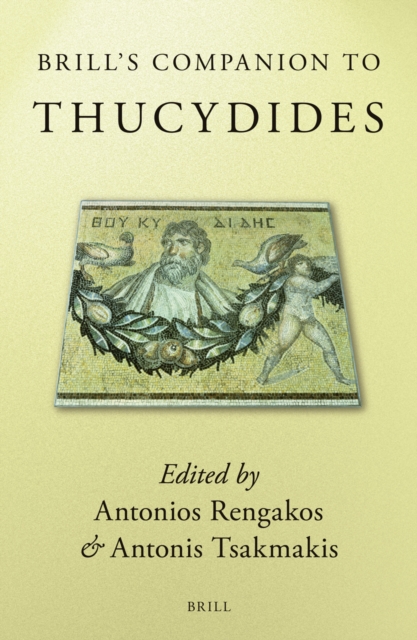
Brill’s Companion To Thucydides
This volume on Thucydides, the most important historian of the ancient world, comprises articles by thirty leading international scholars. The contributions cover a wide range of issues, including Thucydides' life, intellectual milieu and predecessors, Thucydides and the act of writing, his rhetoric, historical method and narrative techniques, narrative unity in the History, the speeches, Thucydides' reliability as a historian, and his legacy through the centuries. Other topics dealt with include warfare, religion, individuals, democracy and oligarchy, the invention of political science, Thucydides and Athens, Sparta, Macedonia/Thrace, Sicily/South Italy, Persia, and the Argives.The volume aims to provide a survey of current trends in Thucydidean studies which will be of interest to all students of ancient history.Brill's Companion to Thucydides was awarded Choice Outstanding Academic Title 2007.
eBook