
Catalogue Search | MBRL


Are you sure you want to remove the book from the shelf?

{{itemTitle}}
15,135
result(s) for
"Greek literature"
Sort by:

Hades speaks! : a guide to the underworld by the Greek god of the dead
\"Hades, the Greek god of the dead, is waiting to take you on a tour of his kingdom in this riveting introduction to Greek mythology. Here you will learn about might gods, terrifying monsters, ancient rites, magic spells, and Furies with bloody talons that can tear a mortal to shreds\"--Page 4 of cover.
Book

Beyond the Second Sophistic
The \"Second Sophistic\" traditionally refers to a period at the height of the Roman Empire's power that witnessed a flourishing of Greek rhetoric and oratory, and since the 19th century it has often been viewed as a defense of Hellenic civilization against the domination of Rome. This book proposes a very different model. Covering popular fiction, poetry and Greco-Jewish material, it argues for a rich, dynamic, and diverse culture, which cannot be reduced to a simple model of continuity. Shining new light on a series of playful, imaginative texts that are left out of the traditional accounts of Greek literature, Whitmarsh models a more adventurous, exploratory approach to later Greek culture. Beyond the Second Sophistic offers not only a new way of looking at Greek literature from 300 BCE onwards, but also a challenge to the Eurocentric, aristocratic constructions placed on the Greek heritage. Accessible and lively, it will appeal to students and scholars of Greek literature and culture, Hellenistic Judaism, world literature, and cultural theory.
eBook

Gods and goddesses of ancient Greece
\"Do you enjoy going to theatres? Or cheering for your favorite Olympians? You probably don't realize it, but these and many other aspects of your daily life started in ancient Greece! Step into the world of the ancient Greeks and learn about their daily life, their beliefs, and some of their leaders' amazing achievements. Deeply religious, the ancient Greeks honoured many gods and goddesses. The ancient Greeks believed these gods and goddesses had great power over the weather and Earth. But they weren't all-powerful, and they had flaws. From Zeus to Athena, read abou the family of gods and goddesses that the ancient Greeks believed watched over them.\"--Back cover.
Book

Greece and Mesopotamia
This book proposes a new approach to the study of ancient Greek and Mesopotamian literature. Ranging from Homer and Gilgamesh to Herodotus and the Babylonian-Greek author Berossos, it paints a picture of two literary cultures that, over the course of time, became profoundly entwined. Along the way, the book addresses many questions of crucial importance to the student of the ancient world: how did the literature of Greece relate to that of its eastern neighbours? What did ancient readers from different cultures think it meant to be human? Who invented the writing of universal history as we know it? How did the Greeks come to divide the world into Greeks and 'barbarians', and what happened when they came to live alongside those 'barbarians' after the conquests of Alexander the Great? In addressing these questions, the book draws on cutting-edge research in comparative literature, postcolonial studies and archive theory.
eBook


Money and the Early Greek Mind
How were the Greeks of the sixth century BC able to invent philosophy and tragedy? In this book Richard Seaford argues that a large part of the answer can be found in another momentous development, the invention and rapid spread of coinage which produced the first ever thoroughly monetised society. By transforming social relations, monetisation contributed to the ideas of the universe as an impersonal system (presocratic philosophy) and of the individual alienated from his own kin and from the gods (in tragedy). Seaford argues that an important precondition for this monetisation was the Greek practice of animal sacrifice, as represented in Homeric Epic, which describes a premonetary world on the point of producing money. This book combines social history, economic anthropology, numismatics and the close reading of literary, inscriptional, and philosophical texts. Questioning the origins and shaping force of Greek philosophy, this is a major book with wide appeal.
eBook


THE SIMILES OF TRIPHIODORUS
This article attempts the first systematic look at the use of similes in the poetry of the imperial Greek poet Triphiodorus. It proposes that Triphiodorus, having access to a vast repository of epic poetry (and similes), draws on existing formulas, mechanisms and vocabulary, which he slightly modifies to make his mark. It concludes that similes i) are used to humorous effect, ii) occasionally defy Homeric rules and categorization, iii) offer a stage for emulation, competition or rivalry with predecessors, and iv) reflect key tenets of the poem’s programme.
Journal Article

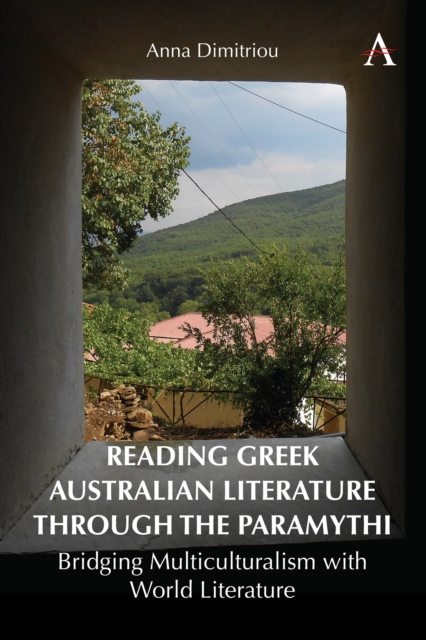
Reading Greek Australian Literature Through the Paramythi
This is a comparative textual analysis of a body of relatively neglected works by Greek Australian writers Dimitris Tsaloumas, Antigone Kefala, Stylianos Charkianakis, Dean Kalimnios, Christos Tsiolkas, Fotini Epanomitis and Helen Koukoutsis. The focus is on reading their texts as a bridge between multiculturalism and world literature given each writer identifies in various ways with peripheral cosmopolitanism as they merge high-brow literary forms with the quotidian paramythi, or the storytelling oral tradition. The different ways they do this registers the writers' ambivalent relationship with their origins through their transculturally mediated expression. Discovering new possibilities in literary texts which have oral traces becomes a productive way to look at the question of translatability as posed by scholars of multiculturalism and world literature, such as Sneja Gunew, Emily Apter and Pheng Cheah.
eBook