
Catalogue Search | MBRL


Are you sure you want to remove the book from the shelf?

{{itemTitle}}
53
result(s) for
"Greek manner"
Sort by:

Maniera Greca in Europe's Catholic East
How and why does vernacular art become foreign? What does 'Greek manner' mean in regions far beyond the Mediterranean? What stories do images need? How do narratives shape pictures? The study addresses these questions in Byzantine paintings from the former Grand Duchy of Lithuania, contextualized with evidence from Poland, Serbia, Russia, and Italy. The research follows developments in artistic practices and the reception of these images, as well as distinguishing between the Greek manner - based on visual qualities - and the style favoured by the devout, sustained by cults and altered through stories. Following the reception of Byzantine and pseudo-Byzantine art in Lithuania and Poland from the late fourteenth through the early eighteenth centuries, Maniera Greca in Europe's Catholic East argues that tradition is repetitive order achieved through reduction and oblivion, and concludes that the sole persistent understanding of the Greek image has been stereotyped as the icon of the Mother of God.
eBook

Honorific culture at Delphi in the Hellenistic and Roman periods
This book brings Hellenistic and Roman Delphi to life. By addressing a broad spectrum of epigraphic topics, theoretical and methodological approaches, it provides readers with a first comprehensive discussion of the Delphic gift-giving system, its regional interactions, and its honorific network.
eBook

The theatrical cast of Athens : interactions between ancient Greek drama and society
This study explores the numerous different ways in which we can understand the relationship between the real, social world in which the Athenians lived and the theatrical roles that they invented. In twelve studies of role types and the theatrical conventions that contributed to their creation — including women in childbirth, drowning barbarians, horny satyrs, allegorical representations of Comedy, peasant farmers, tragic masks, and solo sung arias — the argument is advanced that the interface between ancient Greek drama and social reality must be understood as a complicated and incessant process of mutual cross-pollination.
eBook

Polytheism and Society at Athens
This book makes use of recently discovered archaeological and epigraphical evidence to give an account of the religious life of ancient Athens. The city's many festivals are discussed in detail, with attention to recent anthropological theory; so too, for instance, are the cults of households and of smaller groups, the role of religious practice and argumentation in public life, the authority of priests, the activities of religious professionals such as seers and priestesses, magic, and the place of theatrical representations of the gods within public attitudes to the divine. A final section considers the sphere of activity of the various gods, and takes Athens as a uniquely detailed test case for the structuralist approach to polytheism.
eBook

Enmity and Feuding in Classical Athens
Much has been written about the world’s first democracy, but no book so far has been dedicated solely to the study of enmity in ancient Athens. Enmity and Feuding in Classical Athens is a long-overdue analysis of the competitive power dynamics of Athenian honor and the potential problems these feuds created for democracies.The citizens of Athens believed that harming one’s enemy was an acceptable practice and even the duty of every honorable citizen. They sought public wins over their rivals, making enmity a critical element in struggles for honor and standing, while simultaneously recognizing the threat that personal enmity posed to the community. Andrew Alwine works to understand how Athenians addressed this threat by looking at the extant work of Attic orators. Their speeches served as the intersection between private vengeance and public sanction of illegal behavior, allowing citizens to engage in feuds within established parameters. This mediation helped support Athenian democracy and provided the social underpinning to allow it to function in conjunction with Greek notions of personal honor.Alwine provides a framework for understanding key issues in the history of democracy, such as the relationship between private and public realms, the development of equality and the rule of law, and the establishment of individual political rights. Serving also as a nuanced introduction to the works of the Attic orators, Enmity and Feuding in Classical Athens is an indispensable addition to scholarship on Athens.
eBook
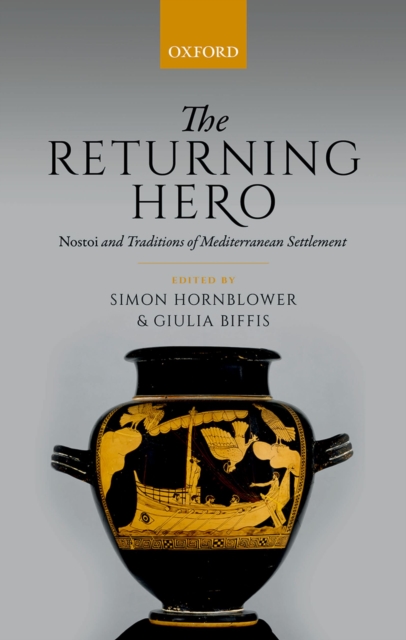
The returning hero : nostoi and traditions of Mediterranean settlement
This interdisciplinary book, which takes its origin from an international conference held in Oxford, brings together experts in ancient Greek (and Roman) history, literature, archaeology, and religion. It is about ancient Greek returns and returning, chiefly—but by no means only—of mythical Greek heroes from Troy. One main, and certainly the most ‘marked’, ancient Greek word for ‘return’ is nostos, plural nostoi, as in the English derivative ‘nostalgia’. The nostos theme runs through Greek literature (prose and poetic) and history from Homer’s Odyssey to Lykophron’s Alexandra, and nostoi were archaeologically and epigraphically commemorated. nostos-related traditions were important ingredients of colonial foundation myths, and helped to define Greek ethnicity, and to crystallize personal and communal identities: two chapters are concerned in different ways with emotions and personal identity, making use of the theoretical tool of place attachment. The special problems and vocabulary of exile are explored in the long Introduction. One chapter shows that failed nostoi can be more interesting than successful ones. Evidential absence (notably that of women) can be as important and illuminating as presence: mythical women are the main subject of another chapter, and they feature extensively in several more. The chapters in this book explore both literary and material evidence so as to achieve a better understanding of the nature of Greek settlement in the Mediterranean zone, and of Greek and Roman perceptions of home, displacement, and returning.
eBook

Greek Whisky
In many contexts of Greek social life, Scotch whisky has coincidentally become a symbol of \"Greekness,\" national identity, modernity, and the middle class. This ethnographic study follows the social life of Scotch in Greece through three distinct trajectories in time and space in order to investigate how the meanings of the beverage are projected, negotiated, and acquired by various different networks. By examining the mediascapes of the Greek cultural industry, the Athenian nightlife and entertainment, and the North Aegean drinking habits, the study illustrates how Scotch became associated with modernity, popular music and culture, a lavish style, and an antidomestic masculine mentality.
eBook
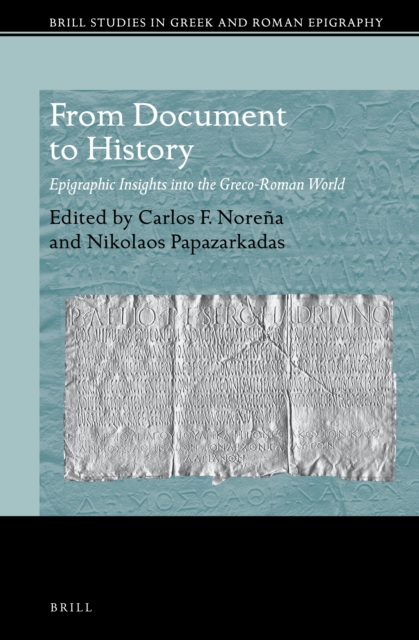
From document to history : epigraphic insights into the Greco-Roman world
From Document to History, edited by Carlos Noreña and Nikolaos Papazarkadas, presents a series of new studies in Greek and Roman epigraphy, highlighting the contribution of documentary evidence to our understanding of ancient Greek and Roman history.
eBook

Games of Venus
Recent attacks on contemporary art have portrayed the erotic content of works by Robert Mapplethorpe and others as if it were a deviation from the Western artistic tradition. On the contrary, there is a rich tradition of eroticism in the arts beginning with the erotic verse of ancient Greek and Roman poets. Games of Venus, the first comprehensive anthology in English of ancient Greek and Roman erotic verse, revives this tradition for the modern reader. Games of Venus presents the whole spectrum of erotic poetry from Sappho to Ovid in translations which evoke the full range of styles and tones present in the original Greek and Latin. Brief biographical sketches accompany the work of each poet as do notes referring to the myths, geography, historical events, personages, and sexual and social customs mentioned in the verse.
eBook

The Athenian Adonia in Context
Ancient sources and modern scholars have often represented the Athenian festival of Adonis as a marginal and faintly ridiculous private women’s ritual. Seeds were planted each year in pots and, once sprouted, carried to the rooftops, where women lamented the death of Aphrodite’s youthful consort Adonis. Laurialan Reitzammer resourcefully examines a wide array of surviving evidence about the Adonia, arguing for its symbolic importance in fifth- and fourth-century Athenian culture as an occasion for gendered commentary on mainstream Athenian practices. Reitzammer uncovers correlations of the Adonia to Athenian wedding rituals and civic funeral oration and provides illuminating evidence that the festival was a significant cultural template for such diverse works as Aristophanes’ drama
Lysistrata and Plato’s dialogue
Phaedrus . Her fresh approach is a timely contribution to studies of the ways gender and sexuality intersect with religion and ritual in ancient Greece.
eBook