
Catalogue Search | MBRL


Are you sure you want to remove the book from the shelf?

{{itemTitle}}
32,322
result(s) for
"Groundwater Management."
Sort by:


Assessing the Groundwater Reserves of the Udaipur District, Aravalli Range, India, Using Geospatial Techniques
Population increase has placed ever-increasing demands on the available groundwater (GW) resources, particularly for intensive agricultural activities. In India, groundwater is the backbone of agriculture and drinking purposes. In the present study, an assessment of groundwater reserves was carried out in the Udaipur district, Aravalli range, India. It was observed that the principal aquifer for the availability of groundwater in the studied area is quartzite, phyllite, gneisses, schist, and dolomitic marble, which occur in unconfined to semi-confined zones. Furthermore, all primary chemical ingredients were found within the permissible limit, including granum. We also found that the average annual rainfall days in a year in the study area was 30 from 1957 to 2020, and it has been found that there are chances to receive surplus rainfall once in every five deficit rainfall years. Using integrated remote sensing, GIS, and a field-based spatial modeling approach, it was found that the dynamic GW reserves of the area are 637.42 mcm/annum, and the total groundwater draft is 639.67 mcm/annum. The deficit GW reserves are 2.25 mcm/annum from an average rainfall of 627 mm, hence the stage of groundwater development is 100.67% and categorized as over-exploited. However, as per the relationship between reserves and rainfall events, surplus reserves are available when rainfall exceeds 700 mm. We conclude that enough static GW reserves are available in the studied area to sustain the requirements of the drought period. For the long-term sustainability of groundwater use, controlling groundwater abstraction by optimizing its use, managing it properly through techniques such as sprinkler and drip irrigation, and achieving more crop-per-drop schemes, will go a long way to conserving this essential reserve, and create maximum groundwater recharge structures.
Journal Article

Integrated groundwater management : concepts, approaches and challenges
From the Forward: \"Contemporary groundwater management has moved well beyond a concern with how much water is stored underground or can be extracted from aquifers. Today we recognise that integrated, effective and efficient groundwater management relies on pulling together work in a variety of disciplines such as climate science, ecology, socioeconomics, public policy and law, as well as hydrogeology. However, whilst we realise the importance of multiple perspectives and a diversity of contexts and data, the challenge of integrating and organising all of this information into a decision making framework remains. It is also abundantly clear that sharing and access to water is a fundamentally political issue and that solutions depend on full engagement of stakeholders as well as mobilisation of knowledge and technologies.\"
Book

A review on the climate-induced depletion of Iran’s aquifers
Few studies have examined the impact of climate change on groundwater resources worldwide, especially in developing countries. The objective of this study is to review the effects of climate change on groundwater resources in Iran in order to assess the present conditions and challenges and future directions. To this end, the related studies, especially the peer-reviewed national and international articles, were surveyed. Only the responses of 40 aquifers have been estimated toward climate change in Iran, such that a large gap occurs in this perspective. This is in reference to the alluvial aquifers, and even fewer studies have evaluated the impact of climate change on hard-rock and karst groundwater systems despite their being highly vulnerable to the existing stresses. The conducted studies are primarily small-scale, and inadequate research has been conducted on the effect of climate change on aquifers at national and even regional scales. The impact of climate change on groundwater quality and coastal aquifers has not hitherto been adequately assessed. An ever-increasing temperature and ever-decreasing precipitation over the country have been forecasted, resulting in induced stresses on aquifers, including the decline of groundwater level, storage and recharge. If the current managerial approaches are maintained, the failure threshold of most aquifers will certainly be exceeded, making the looming crisis of water in Iran even worse. Finally, it is recommended to reevaluate the groundwater management policies across the country thoroughly and, thence, propose and execute the new adaptation strategies.
Journal Article

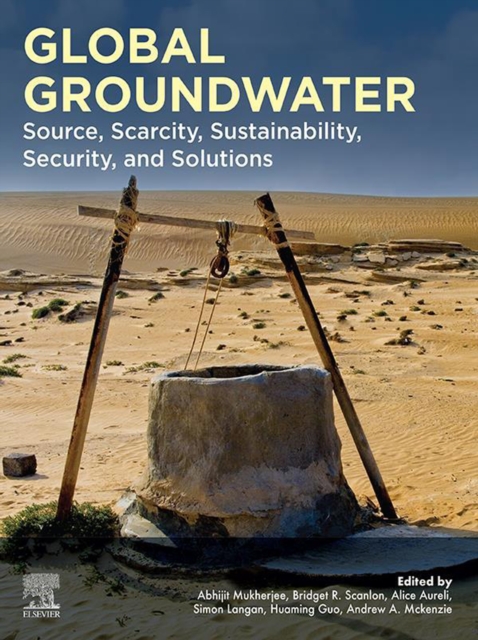
Global Groundwater
Global Groundwater: Source, Scarcity, Sustainability, Security, and Solutions presents a compilation of compelling insights into groundwater scenarios within all groundwater-stressed regions across the world.Thematic sub-sections include groundwater studies on sources, scarcity, sustainability, security, and solutions.
eBook

The present challenges and policy for sustainable management of groundwater resources in Iran: putting emphasis on Lorestan province as an example in the country
Iran is performing an unsustainable groundwater management plan, causing depletion of the aquifers and deterioration of their quality. To grapple with the prevailing challenges, the groundwater resources sustainability management plan (GRSMP) was instigated in 2014. The objective of this study is to represent the challenges encountered when performing the plan, including social, cultural, demographic, economic, institutional, inter-organizational, technical, technological, political, legal, juridical, environmental, agricultural, and hydrological perspectives, in order to propose adaptation strategies for maintaining invaluable groundwater resources in Iran. Lorestan province, in west Iran, is a representative region that includes plentiful aquifers, and its challenges and proposed strategies can be generalized to the whole country. Results highlighted that despite performing GRSMP, groundwater levels are declining, primarily due to anthropogenic influences, in all basins over the province, so that the aquifers may not sustain themselves for the next generations if conditions remain business as usual. In addition, climate change is exacerbating the situation, especially in the karst groundwater systems. Therefore, GRSMP cannot be applied anymore, and in fact, it is highly recommended to promptly initiate a new practical groundwater resources management plan by considering different related factors so as to expect a resilient and sustainable future with hydrogeoethics and prevent potential negative environmental repercussions that are already occurring, such as land subsidence.
Journal Article
Environmental isotopes (δ2H, δ13C, δ18O, 3H, and 14C) as a diagnostic tool in the appraisal of mineral water management and protection: two case studies—Portugal
Groundwater management and protection must be confronted under ethical and moral concerns, with regulations and water policies for proper and sustainable civilization development. Approximately half of the world population relies on groundwater as the main source of supply, representing a vital requirement for human life and progress. Often in many regions of the world, water authorities are facing scarcity and over-exploitation of the available fresh water reserves. In these circumstances, geoethical aims to represent a way to reach the entire community (water authorities, stakeholders, scientists, and the population in general), focusing on the importance and awareness of water sustainability. In this paper, two case studies from Portugal will be reviewed and discussed aiming to highlight the importance of isotope hydrology as a way to obtain a unique characterization of groundwater resources foreseeing a proper management and sustainability of the groundwater systems. The first case study, Melgaço-Messegães CO
2
-rich mineral waters, is located in a granitic environment (NW Portugal). The study allowed to establish the preferential recharge altitude (delimitation of protection limits) based on the δ
2
H and δ
18
O content; the
3
H data indicates a mean residence time of 40 years; the carbon isotopes (δ
13
C and
14
C values) highlight methanogenesis and/or mantle-derived carbon as the main carbon source. In the second case study, Moura−Ficalho aquifer (carbonate formations, SE of Portugal), the combined use of geochemical and isotopic (stable and radioactive) data allowed the identification of different (much smaller) flow velocities in the deepest layers of the Moura−Ficalho aquifer and the δ
18
O data indicates recharge under different climate conditions.
Journal Article

Groundwater availability and water demand sustainability over the upper mega aquifers of Arabian Peninsula and west region of Iraq
The current research is devoted to highlight the past, present and future status of groundwater characteristics over the Arabian Peninsula (AP) and west region of Iraq. The Umm er Radhuma, Rus Dammam and Neogene deposits are the major hydrostratigraphic units supplying the main groundwater resources in the AP. Water shortage is still a major problem for many countries in the world, including oil-producing countries such as Iraq, Saudi Arabia (SA), the United Arab Emirates (UAE), Qatar, Oman and Bahrain. The withdrawal of groundwater has been reflected in salinization of agricultural soils, leading to an increase in high-cost technologies such as desalination of seawater to provide suitable water for diverse sectors. Hence, the use of seawater desalination as a major source of water is unavoidable, and country development requires the use of renewable energy as protection of the environment. The need to conserve and use groundwater resources efficiently is highly essential owing to the fact that it is the only natural source of water in such developing countries of global importance. The review comprises various essential components related to groundwater variability including the hydrogeological aspects, climate change, drawdown and abstraction, rainwater harvesting, desertification and population increment. Based on the reviewed perspectives, various practical visions are discussed for better groundwater management and sustainability. This research is presented as a milestone for diverse future works and investigation that might be conducted for better water resources management over the AP region.
Journal Article

Forecasting Future Groundwater Recharge from Rainfall Under Different Climate Change Scenarios Using Comparative Analysis of Deep Learning and Ensemble Learning Techniques
Groundwater is the most reliable source of freshwater for household, industrial, and agricultural usage. However, anthropogenic interventions in the water cycle have disrupted sustainable groundwater management. This research aims to comprehend the future of groundwater recharge predominantly due to rainfall under changing climate. In this study, predictors of groundwater recharge such as precipitation, land use land cover (LULC), soil type, land slope, temperature, potential evapotranspiration, and aridity index (ArIn) were used for the Punjab region of India over the duration of 34 years, from 1986 to 2019. To simulate future conditions, various climate change scenarios from the CMIP6 report have been incorporated. Different Artificial Intelligence and Deep Learning models, ranging from the straightforward Linear Regression model to the intricate Extreme Gradient Booting (XGBoost), used these parameters as input. Statistical analysis of the models showed that XGBoost is most effective in predicting the groundwater recharge phenomena. Correlation studies revealed precipitation to be the primary contributor to recharge, followed by the ArIn, while soil type and slope are found to have the strongest inverse correlation. The models’ resilience and performance were investigated by conducting a k-fold cross-validation analysis. The pattern of groundwater recharge is forecasted for the years 2020 to 2035 across Punjab with different climate change scenarios. The study demonstrates how the Punjab area is mirroring its current status around Shared Socioeconomic Pathway (SSP) 370. Groundwater level estimates confirmed its strong correlation with and dependence on groundwater recharge. The analysis is strengthened by comparing the AI-predicted groundwater recharge with the Central Ground Water Board (CGWB) Punjab’s annual estimate.Key points• Data-driven deep learning models can model groundwater recharge with high accuracy without extensive aquifer parameter data requirement.• Pronounced effect of climate change on groundwater recharge in the future pertaining to the different climate change scenarios (SSPs).• Forecasted groundwater recharge and level data shows significant match with the CGWB, Govt. of India’s estimates and observed data.
Journal Article