
Catalogue Search | MBRL


Are you sure you want to remove the book from the shelf?

{{itemTitle}}
2,867
result(s) for
"Groundwater Purification."
Sort by:

Treatment technologies for groundwater
In the past, it seemed as if groundwater treatment regulations were an afterthought to surface water regulations. Today, water treatment professionals have a much better understanding of the vulnerability of groundwater supplies to various contaminant threats. This understanding is reflected in a broader regulatory framework for groundwater. This handbook is designed to answer many operational questions regarding groundwater treatment. Written in a question-and-answer format, the book provides all the information needed to choose appropriate treatment and operate a groundwater treatment plant. It provides a handy information source on regulations, commonly used treatment technologies, disinfection, and corrosion control. Additionally, it provides best practices and procedures for removing various substances from groundwater: iron, manganese, arsenic, hydrogen sulfide, nitrate, uranium, radium and gross alpha, barium, and organic compounds.
eBook

Alternatives for ground water cleanup
There may be nearly 300,000 waste sites in the United States where ground water and soil are contaminated. Yet recent studies question whether existing technologies can restore contaminated ground water to drinking water standards, which is the goal for most sites and the result expected by the public.
How can the nation balance public health, technological realities, and cost when addressing ground water cleanup? This new volume offers specific conclusions, outlines research needs, and recommends policies that are technologically sound while still protecting health and the environment.
Authored by the top experts from industry and academia, this volume:
Examines how the physical, chemical, and biological characteristics of the subsurface environment, as well as the properties of contaminants, complicate the cleanup task.
Reviews the limitations of widely used conventional pump-and-treat cleanup systems, including detailed case studies.
Evaluates a range of innovative cleanup technologies and the barriers to their full implementation.
Presents specific recommendations for policies and practices in evaluating contamination sites, in choosing remediation technologies, and in setting appropriate cleanup goals.
eBook

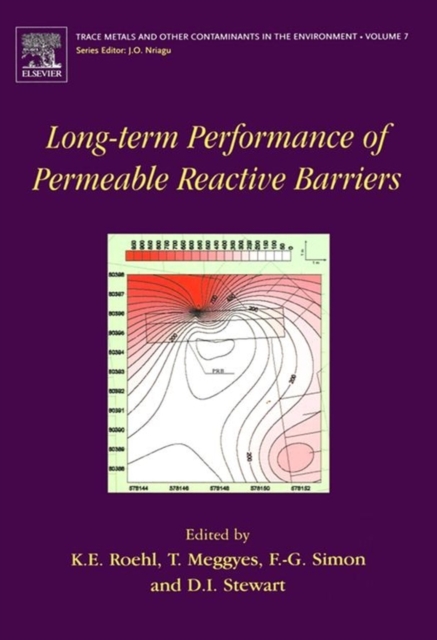
Long-term performance of permeable reactive barriers
While extensive research has been performed on many technological aspects of permeable reactive barriers and a number of contaminants have so far been successfully treated by PRB systems, long-term performance has not been extensively considered and little is known about the processes influencing long-term behaviour. This gap in our knowledge is all the more disadvantageous as design life has a decisive influence on the economic viability of PRBs. The book describes methods for evaluation and enhancement of the long-term performance of PRB systems, especially of those targeting heavy metals, specifically uranium, and organic contaminants by sorption and/or precipitation mechanisms. Major topics in the book are: Selection and characterisation of suitable reactive materials Characterisation of the relevant contaminant attenuation processes Developing new contaminant-binding chemical compounds (\"ligands\") Accelerated testing methods to assess the long-term performance of the attenuation mechanisms in PRBs Evaluation of the influence of site characteristics on PRB performance Monitoring of existing and new field installations Coupling of electrokinetic techniques and PRB systems Large-scale laboratory and field tests and their results It addresses the long-term performance of PRBs, an important feature of this novel remediation technology, systematically. It deals extensively with heavy metal removal, with special emphasis on uranium. A number of case studies, experiences with large-scale modelling and test site experiments provide insight into the practical application of the results. This volume will contribute to the science underpinning groundwater remediation, and this will result in the improvement of quality of life and health and safety. * A systematic approach to investigating the long-term performance of permeable reactive barriers* Development of new contaminant-binding chemical compounds (\"ligands\"), accelerated testing methods to assess the long-term performance, and efficiency enhancing electrokinetic techniques* Extensive data and information on a Hungarian uranium mining facility; once a carefully kept secret of the Soviet Union
eBook

Alternatives for Managing the Nation's Complex Contaminated Groundwater Sites
Across the United States, thousands of hazardous waste sites are contaminated with chemicals that prevent the underlying groundwater from meeting drinking water standards. These include Superfund sites and other facilities that handle and dispose of hazardous waste, active and inactive dry cleaners, and leaking underground storage tanks; many are at federal facilities such as military installations. While many sites have been closed over the past 30 years through cleanup programs run by the U.S. Department of Defense, the U.S. EPA, and other state and federal agencies, the remaining caseload is much more difficult to address because the nature of the contamination and subsurface conditions make it difficult to achieve drinking water standards in the affected groundwater.
Alternatives for Managing the Nation's Complex Contaminated Groundwater Sites estimates that at least 126,000 sites across the U.S. still have contaminated groundwater, and their closure is expected to cost at least $110 billion to $127 billion. About 10 percent of these sites are considered \"complex,\" meaning restoration is unlikely to be achieved in the next 50 to 100 years due to technological limitations. At sites where contaminant concentrations have plateaued at levels above cleanup goals despite active efforts, the report recommends evaluating whether the sites should transition to long-term management, where risks would be monitored and harmful exposures prevented, but at reduced costs.
eBook
Natural attenuation for groundwater remediation
In the past decade, officials responsible for clean-up of contaminated groundwater have increasingly turned to natural attenuation-essentially allowing naturally occurring processes to reduce the toxic potential of contaminants-versus engineered solutions. This saves both money and headaches. To the people in surrounding communities, though, it can appear that clean-up officials are simply walking away from contaminated sites.
When is natural attenuation the appropriate approach to a clean-up? This book presents the consensus of a diverse committee, informed by the views of researchers, regulators, and community activists. The committee reviews the likely effectiveness of natural attenuation with different classes of contaminants-and describes how to evaluate the \"footprints\" of natural attenuation at a site to determine whether natural processes will provide adequate clean-up. Included are recommendations for regulatory change.
The committee emphasizes the importance of the public's belief and attitudes toward remediation and provides guidance on involving community stakeholders throughout the clean-up process.
The book explores how contamination occurs, explaining concepts and terms, and includes case studies from the Hanford nuclear site, military bases, as well as other sites. It provides historical background and important data on clean-up processes and goes on to offer critical reviews of 14 published protocols for evaluating natural attenuation.
eBook
Filtration Materials for Groundwater - A Guide to Good Practice
Ground water is a source for drinking and industrial water supply and pollution created by active industrial sites which often cause social, health, and environmental problems. This groundwater eventually drains into adjacent water sources. Filtration Materials for Groundwater: A Guide to Good Practice presents the up-to-date technology of purification of polluted ground water, its treatment for industrial and human needs and the remediation of polluted sites. The book examines: Types of pollutants in ground water including the main inorganic and organic pollutants and their behaviour. Filtration materials for water treatment and principles of their choice. How to choose suitable filtration materials according to targeted compounds and estimate its efficiency. Technologies for ground water treatment. Cost and risks estimation of treatment facilities. Lifetime, risks and cost estimation of technology. Examples of modern ongoing facilities for ground water treatment and polluted sites remediation. This book is of interest to scientists and engineer who deal with the problem of purification of ground water for different purposes and the remediation of polluted sites.
eBook