
Catalogue Search | MBRL


Are you sure you want to remove the book from the shelf?

{{itemTitle}}
47
result(s) for
"Group 13 elements."
Sort by:

Aluminum
Presents the properties of the element and its components while providing readers with resources to learn more about aluminum and how it is mined, recycled, and used in our society.
Book

Reactivity of Ammonia in 1,2-Addition to Group 13 Imine Analogues with G13–P–Ga Linkages: The Electronic Role of Group 13 Elements
Using density functional theory (M06-2X-D3/def2-TZVP), we investigated the 1,2-addition reactions of NH3 with a series of heavy imine analogues, G13=P-Rea (where G13 denotes a Group 13 element; Rea = reactant), featuring a mixed G13–P–Ga backbone. Theoretical analyses revealed that the bonding nature of the G13=P moiety in G13=P-Rea molecules varies with the identity of the Group 13 center. For G13=B, Al, Ga, and In, the bonding is best described as a donor–acceptor (singlet–singlet) interaction, whereas for G13=Tl, it is characterized by an electron-sharing (triplet–triplet) interaction. According to our theoretical studies, all G13=P-Rea species—except the Tl=P analogue—undergo 1,2-addition with NH3 under favorable energetic conditions. Energy decomposition analysis combined with natural orbitals for chemical valence (EDA–NOCV), along with frontier molecular orbital (FMO) theory, reveals that the primary bonding interaction in these reactions originates from electron donation by the lone pair on the nitrogen atom of NH3 into the vacant p-π* orbital on the G13 center. In contrast, a secondary, weaker interaction involves electron donation from the phosphorus lone pair of the G13=P-Rea species into the empty σ* orbital of the N–H bond in NH3. The calculated activation barriers are primarily governed by the deformation energy of ammonia. Specifically, as the atomic weight of the G13 element increases, the atomic radius and G13–P bond length also increase, requiring a greater distortion of the H2N–H bond to reach the transition state. This leads to a higher geometrical deformation energy of NH3, thereby increasing the activation barrier for the 1,2-addition reaction involving these Lewis base-stabilized, heavy imine-like G13=P-Rea molecules and ammonia.
Journal Article
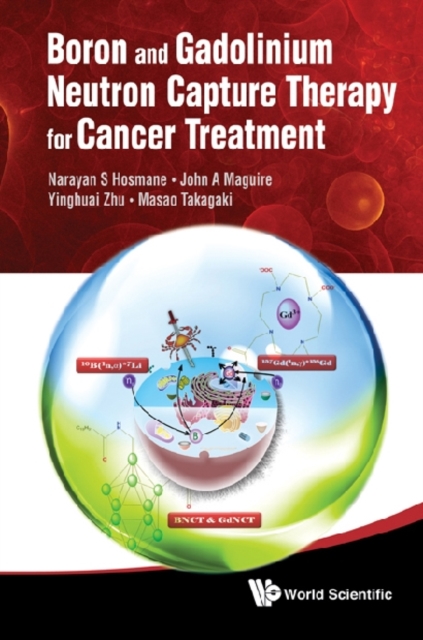
Boron and gadolinium neutron capture therapy for cancer treatment
The book focuses on two concurrent experimental therapies in cancer treatment known as boron neutron capture therapy (BNCT) and gadolinium neutron capture therapy (GdNCT) using a variety of boron- and gadolinium-based compounds. Some of the gadolinium compounds serve the dual purpose as being MRI contrast agents and GdNCT agents. The book describes why BNCT & GdNCT were not at the forefront of the clinical trials during the past seven to eight decades since the discovery of neutrons by John Chadwick in 1932 and how the latest development in the synthesis of target boron- and gadolinium-based drugs has turned the area into the hottest one worthy of further investigation with the new clinical trials in the USA and elsewhere.
eBook

Transformation of Indium and Gallium Metal into Mixed Group 11/13 Ternary Sulfide Nanoparticles by Using a Dithioic Acid
Heterobimetallic Group 11/13 sulfide nanoparticles (AgInS2, CuInS2, Ag9GaS6, and CuGaS2) are formed by treatment of [M(S2CAr)3] (M=Ga or In) with either AgNO3 or CuCl under mild conditions. The intermediary gallium or indium tris(aryldithioate) complexes are easily prepared by stirring the appropriate metal and aryldithioc acid at room temperature. Overall, this two‐step process is a simple solution‐based method for transforming Ga and In metal into valuable ternary metallosulfide nanoparticles at relatively low temperatures. Two‐step transformation: Heterobimetallic Group 11/13 sulfide nanoparticles (AgInS2, CuInS2, Ag9GaS6, and CuGaS2) are generated from metallic indium or gallium in two steps. The first reaction with 4‐methoxybenzodithioic acid (p‐MBDTH; see figure) generates the [M(p‐MBDT)3] (M=Ga, In) intermediate, which is then treated with either AgNO3 or CuCl under mild conditions to generate valuable ternary metallosulfide nanoparticles.
Journal Article
Entwicklung keramischer Schutzschichtsysteme auf den niedrigschmelzenden Leichtmetallen Aluminium und Magnesium mittels Laserbestrahlung
Vor dem Hintergrund wachsender Klimaschutzanstrengungen liegt im Bereich der Automobil- Luft- und Raumfahrtindustrie ein besonderer Schwerpunkt auf der Reduzierung der Emissionen. Dies kann u.a. durch Gewichtseinsparrungen erreicht werden. Für strukturtragende Leichtbauanwendungen sind eine hohe spezifische Festigkeit und Steifigkeit die geforderten Haupteigenschaften. Vor allem die Leichtmetalle Aluminium und Magnesium besitzen bei Raumtemperatur diese Eigenschaften. Allerdings sind Aluminium und Magnesium wenig korrosions- und verschleißbeständig. Daher wurden im Rahmen dieser Arbeit keramische Schutzschichtsysteme auf den beiden Leichtmetallen entwickelt, die zum Ziel hatten, die Substrate vor Korrosion und Verschleiß zu schützen. Die entwickelten Systeme basieren auf einer Al?O? und YSZ gefüllten Silazanbeschichtung, die mittels einem Nd: YVO?-Laser thermisch behandelt wurde. Die Laserbehandlung führte zu einem Aufschmelzen der keramischen Füllstoffpartikel. Nach der Erstarrung hat sich ein dichte und harte vollkeramische Schicht ausgebildet, welche einen exzellenten Verschleiß- und Korrosionsschutz aufweist. Durch die optimale Anpassung der Laserparameter und auf Grund der hohen Wärmeleitfähigkeit der beiden Leichtmetalle konnten Diffusionsvorgänge und eine thermische Schädigung der Aluminium- und Magnesiumsubstrate vermieden werden. Die Herstellung keramischer Schutzschichtsysteme auf niedrigschmelzenden Leichtmetallen mittels der Laserbestrahlung gefüllter silazanbasierten Schichten stellt ein völlig neuartiges Verfahren dar.
eBook

Estimation of the Dissociation Energies of Donor–Acceptor Complexes of Group 13–15 Element Compounds within the Framework of the Statistical EC Model
The parameters of 18 Lewis bases of group 13–15 elements E'H
2
EH
2
⋅LB (E' = P, As, Sb; E = B, Al, Ga; LB = SMe
2
, NMe
3
) and 18 Lewis acids of group 13 elements ER
3
(R = H, F, Cl, Br, Me, C
6
F
5
) were optimized using a statistical approach within the electrostatic-covalent (EC) model. The EC model allows prediction of dissociation energies of donor-acceptor complexes with an absolute median deviation of ±4 kJ mol
–1
, but this approach is not applicable to estimation of donor-acceptor bond energies.
Journal Article


Aluminum Dreams
Aluminum shaped the twentieth century. It enabled high-speed travel and gravity-defying flight. It was the material of a streamlined aesthetic that came to represent modernity. And it became an essential ingredient in industrial and domestic products that ranged from airplanes and cars to designer chairs and artificial Christmas trees. It entered modern homes as packaging, foil, pots and pans and even infiltrated our bodies through food, medicine, and cosmetics. In Aluminum Dreams , Mimi Sheller describes how the materiality and meaning of aluminum transformed modern life and continues to shape the world today. Aluminum, Sheller tells us, changed mobility and mobilized modern life. It enabled air power, the space age and moon landings. Yet, as Sheller makes clear, aluminum was important not only in twentieth-century technology, innovation, architecture, and design but also in underpinning global military power, uneven development, and crucial environmental and health concerns. Sheller describes aluminum's shiny utopia but also its dark side. The unintended consequences of aluminum's widespread use include struggles for sovereignty and resource control in Africa, India, and the Caribbean; the unleashing of multinational corporations; and the pollution of the earth through mining and smelting (and the battle to save it). Using a single material as an entry point to understanding a global history of modernization and its implications for the future, Aluminum Dreams forces us to ask: How do we assemble the material culture of modernity and what are its environmental consequences? Aluminum Dreams includes a generous selection of striking images of iconic aluminum designs, many in color, drawn from advertisements by Alcoa, Bohn, Kaiser, and other major corporations, pamphlets, films, and exhibitions.
eBook

Essential Readings in Light Metals, Electrode Technology for Aluminum Production
This compilation is the most comprehensive historical collection of papers written on primary aluminum science and technology. It is a definitive reference in the field of aluminum production and related light metals technologies and contains a strong mix of materials science and practical, applied technology. Written for materials scientists and engineers, metallurgists, mechanical engineers, aerospace and automobile engineers, electrical and electronics engineers, this volume is a valuable resource for the global aluminum and light metals industries.
eBook

Fire Resistance of Aluminum and Aluminum Alloys and Measuring the Effects of Fire Exposure on the Properties of Aluminum Alloys
Containing valuable information about the fire resistance of aluminum and aluminum alloys, this detailed resource describes what occurs when aluminum is in a fire and how the effects of fire damage are evaluated. --
eBook