
Catalogue Search | MBRL


Are you sure you want to remove the book from the shelf?

{{itemTitle}}
164
result(s) for
"Group identity Taiwan."
Sort by:


The Construction of National Identity in Taiwan's Media, 1896-2012
The Construction of National Identity in Taiwan's Media, 1896-2012 provides the most comprehensive analysis of the development of Taiwan's media and the formation of national identity in Taiwan's media from 1896 to 2012.
eBook

Taiwan's struggle : voices of the Taiwanese
This comprehensive book explores contemporary Taiwan from the perspective of the Taiwanese themselves. In a unique set of original essays, leading Taiwanese figures consider the country's history, politics, society, economy, identity, and future prospects. The volume provides a forum for a diversity of local voices, who are rarely heard in the power struggle between China and the United States over Taiwan's future. Whether it will be absorbed by China, continue in its current limbo as an unrecognized state, or seek outright independence and national sovereignty remains an open question. Reflecting the deep ethnic and political differences that are essential to understanding Taiwan today, this work provides a nuanced introduction to its role in international politics. --Provided by publisher.
Book

Taiwan's struggle
This comprehensive book explores contemporary Taiwan from the perspective of the Taiwanese themselves. In a unique set of original essays, leading Taiwanese figures consider the country’s history, politics, society, economy, identity, and future prospects. The volume provides a forum for a diversity of local voices, who are rarely heard in the power struggle between China and the United States over Taiwan’s future. Whether it will be absorbed by China, continue in its current limbo as an unrecognized state, or seek outright independence and national sovereignty remains an open question. Reflecting the deep ethnic and political differences that are essential to understanding Taiwan today, this work provides a nuanced introduction to its role in international politics.
eBook

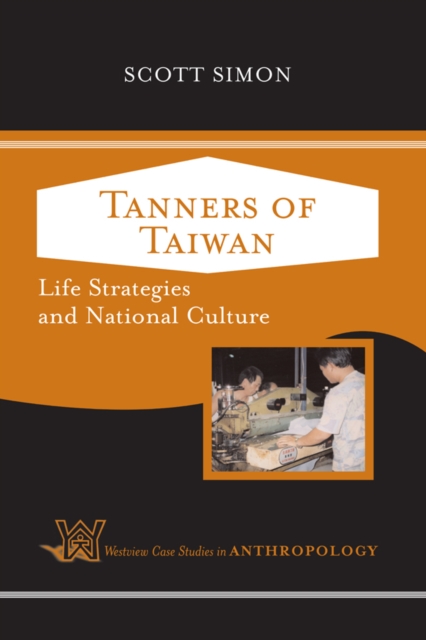
Tanners of Taiwan
Tanners of Taiwan is an ethnography of identity construction set in the leather-tanning communities of Southern Taiwan. Through life history analysis and ethnographic observation, author Scott Simon examines what it means to be Chinese-or alternatively Taiwanese-in contemporary Taiwan. Under forty years of martial law from 1947 to 1987, the Chinese Nationalist Party tried to create a Chinese identity in Taiwan through ideological campaigns that reached deep into families, schools and workplaces. They justified their rule through a development narrative that Chinese culture and good policy contributed to the prosperity of the Taiwan miracle. These ideological claims and cultural identities, however, have never been fully accepted in Southern Taiwan. This ethnography is the first to document from the ground level how those claims have been contested, and how a new Taiwanese identity has been constructed since democratization. Tanners of Taiwan provides more than a description of workplaces in Taiwan. Looking at the different perspectives of tanners, women managers, and workers, it demonstrates how cultural and other identities are constructed through dynamics of power and political economy.
eBook

Is Taiwan Chinese?
The \"one China\" policy officially supported by the People's Republic of China, the United States, and other countries asserts that there is only one China and Taiwan is a part of it. The debate over whether the people of Taiwan are Chinese or independently Taiwanese is, Melissa J. Brown argues, a matter of identity: Han ethnic identity, Chinese national identity, and the relationship of both of these to the new Taiwanese identity forged in the 1990s. In a unique comparison of ethnographic and historical case studies drawn from both Taiwan and China, Brown's book shows how identity is shaped by social experience—not culture and ancestry, as is commonly claimed in political rhetoric.
eBook

Convergence or Conflict in the Taiwan Strait
Years of rapprochement between Taiwan and China had convinced many that the Taiwan issue had been resolved, and that it was only a matter of time before the two former opponents would reunite under One China. But a reenergized civil society, motivated by civic nationalism and a desire to defend Taiwan’s liberal-democratic way of life, has dashed such hopes and contributed to the defeat of the China-friendly Kuomintang in the 2016 presidential elections.
This book draws on years of on-the-ground research and reporting to shed light on the consolidation of identity in Taiwan that will make peaceful unification with China a near impossibility. It traces the causes and evolution of Taiwan’s new form of nationalism, which exploded in the form of the Sunflower Movement in 2014, and analyses how recent developments in China and Hong Kong under \"one country, two systems\" have reinforced a desire among the Taiwanese to maintain their distinct identity and the sovereignty of their nation. It also explores the instruments at China’s disposal, from soft power to coercion, as well as the limits of its influence, as it attempts to prevent a permanent break-up between the two sides of the Taiwan Strait. Finally, the book argues against abandonment and suggests that international support for Taiwan as it negotiates its complex relationship with China is not only morally right but also conducive to regional and global stability.
Acting as both a sequel and a rebuttal to earlier publications on Taiwan-China relations, this book takes an intimate and anthropological look at Taiwan’s youth and civil society, and applies this to traditional analyses of cross-strait politics. It will appeal to students and scholars of Taiwanese Politics, Chinese Politics, International Relations and Sociology.
J. Michael Cole is Senior non-resident Fellow at the China Policy Institute, University of Nottingham, UK, Associate Researcher at the French Center for Research on Contemporary China in Taipei, Taiwan, and a former analyst with the Canadian Security Intelligence Service.
Introduction PART 1: The Convenient Illusion 1. Orphaned and Forgotten 2. Chen the ‘Troublemaker,’ Ma the ‘Peacemaker’ 3. Peace on Whose Terms? PART 2: Taiwan’s Democratic Firewall 4. The Democratic Pendulum 5. China’s Assault on Taiwan’s Democracy 6. Hong Kong: The Canary in the Mineshaft 7. Crossing the Red Line: The Sunflower Phenomenon 8. A New Age: Civic Nationalism, Resilience, and Legitimacy PART 3: Convergence or Conflict? 9. No Turning Back: What Taiwanese Want vs. Beijing’s Expectations 10. The Trap that China Set for Itself 11. The Myth of Inevitability 12. Is War the Only Option? 13. The 2016 Elections: A Return to Uncertainty? PART 4: Why Taiwan Matters 14. The Last Free Refuge 15. The Folly of Abandonment 16. What Can Taiwan Do?
eBook

Two Signatures of Implicit Intergroup Attitudes: Developmental Invariance and Early Enculturation
Long traditions in the social sciences have emphasized the gradual internalization of intergroup attitudes and the putatively more basic tendency to prefer the groups to which one belongs. In four experiments (N = 883) spanning two cultures and two status groups within one of those cultures, we obtained new evidence that implicit intergroup attitudes emerge in young children in a form indistinguishable from adult attitudes. Strikingly, this invariance from childhood to adulthood holds for members of socially dominant majorities, who consistently favor their in-group, as well as for members of a disadvantaged minority, who, from the early moments of race-based categorization, do not show a preference for their in-group. Far from requiring a protracted period of internalization, implicit intergroup attitudes are characterized by early enculturation and developmental invariance.
Journal Article

Compressed Modernity in Taiwan: Fathers as the Sole Influencers on National Identity
Many studies point to the importance of parents in shaping the ethnic and/or political identity of their offspring. However, there is a lack of consensus on the pattern of influence of fathers and mothers in the process of political socialization. While studies in the United States and Japan show the mother to be more influential than the father in transferring political identity to children, studies in China show that both parents have equal importance. We suggest that these differences are owing to different trajectories of modernization. Using Taiwan as a case study and drawing on the theory of compressed modernity, we demonstrate how compressed modernization generates a different shift in the pattern of parental political socialization. We show that before Taiwan's experience of compressed modernization, both parents influenced children's sense of Taiwanese-ness, while only the father was influential after compressed modernization. We also show the significance of a macro-level perspective for explaining differences in the micro-level socialization perspective.
Journal Article