
Catalogue Search | MBRL


Are you sure you want to remove the book from the shelf?

{{itemTitle}}
25,466
result(s) for
"Group reading."
Sort by:


Reading Beyond the Book
Literary culture has become a form of popular culture over the last fifteen years thanks to the success of televised book clubs, film adaptations, big-box book stores, online bookselling, and face-to-face and online book groups. This volume offers the first critical analysis of mass reading events and the contemporary meanings of reading in the UK, USA, and Canada based on original interviews and surveys with readers and event organizers.
The resurgence of book groups has inspired new cultural formations of what the authors call \"shared reading.\" They interrogate the enduring attraction of an old technology for readers, community organizers, and government agencies, exploring the social practices inspired by the sharing of books in public spaces and revealing the complex ideological investments made by readers, cultural workers, institutions, and the mass media in the meanings of reading.
eBook

Exploring structured reading groups: case studies on classroom conversation and engagement
In the higher education classroom, one significant challenge students face is grappling with primary literature. They often need guidance not just to understand the content but to actively engage with it. This article presents a practitioner-based curriculum report featuring three illustrative cases of Structured Reading Groups (SRGs) implemented across undergraduate psychology courses at a regional university. SRGs are designed to foster deeper comprehension and collaborative engagement with academic texts by assigning students rotating roles that promote active discussion. Rather than reporting formal research findings, this report outlines delivery models across multiple course types and modalities including face-to-face, HyFlex, and discussion-enhanced, with attention to structure, logistics, and instructional flexibility. This preliminary publication serves as a proof-of-concept guide for instructors seeking to adopt SRGs to support critical reading, community-building, and accountable discourse in the classroom.
Journal Article


Exploration of Potential Reading Interest Groups in Social Sciences of Undergraduates Based on Social Network Analysis: A Case Study of China Pharmaceutical University
[Purpose/Significance] The government work report mentioned nationwide reading for six consecutive years, and reading promotion has been carried out in the whole society. As an important place to carry out the national reading programs, in the context of the rapid development of modern technologies, colleges and universities are in urgent need of innovative practice of reading promotion to adapt to the development of the times, so as to provide useful reference for the research and practice of accurate promotion of reading.[Method/Process] Based on the social network analysis technology, this paper downloads the book loan data of undergraduates from China Pharmaceutical University from Huiwen system, calculates the distribution status of the network with UCINET, and explores the potential reading interest groups of undergraduates in social sciences.[Results/Conclusions] The application of the social network analysis technology to the analysis of undergraduate reading data discovers a reading group with undergraduate interest as the core. On this basis, this paper puts forward the promotion strategy of accurate reading, proposes the establishment of the complex network theory to mine the potential reading team model, and studies the internal dynamic mechanism of undergraduate reading teams.
Journal Article

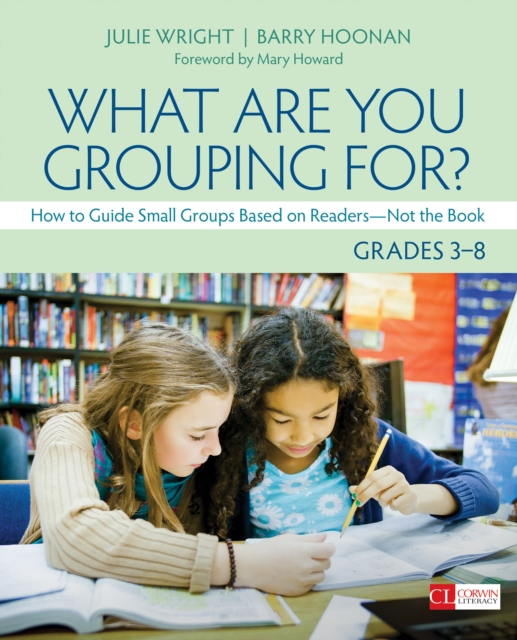
What Are You Grouping for?, Grades 3-8
From must-have beginning-of-the-year strategies to step-by-step advice for implementation, this guide breaks down the processes that support small groups and help create effective instructional reading programs. Based on more than 45 years of combined experience in the classroom, this resource will empower you with tools to ensure that your readers are doing the reading, thinking, and doing - not you.
eBook

The Impact of Interactive Shared Book Reading on Children's Language Skills: A Randomized Controlled Trial
Purpose: Research has indicated that interactive shared book reading can support a wide range of early language skills and that children who are read to regularly in the early years learn language faster, enter school with a larger vocabulary, and become more successful readers at school. Despite the large volume of research suggesting interactive shared reading is beneficial for language development, two fundamental issues remain outstanding: whether shared book reading interventions are equally effective (a) for children from all socioeconomic backgrounds and (b) for a range of language skills. Method: To address these issues, we conducted a randomized controlled trial to investigate the effects of two 6-week interactive shared reading interventions on a range of language skills in children across the socioeconomic spectrum. One hundred and fifty children aged between 2;6 and 3;0 (years;months) were randomly assigned to one of three conditions: a pause reading, a dialogic reading, or an active shared reading control condition. Results: The findings indicated that the interventions were effective at changing caregiver reading behaviors. However, the interventions did not boost children's language skills over and above the effect of an active reading control condition. There were also no effects of socioeconomic status. Conclusion: This randomized controlled trial showed that caregivers from all socioeconomic backgrounds successfully adopted an interactive shared reading style. However, while the interventions were effective at increasing caregivers' use of interactive shared book reading behaviors, this did not have a significant impact on the children's language skills. The findings are discussed in terms of practical implications and future research.
Journal Article

Bloomsbury Essential Guide for Reading Groups
Reading groups allow you to share your passion for literature, gain new insight and discover new friends. But how do you create your own group and how do you keep discussionslively and focussed? This book offers readers guides for 75 of the verybest reads, that are guarenteed to provoke spirited debate!.
eBook