
Catalogue Search | MBRL


Are you sure you want to remove the book from the shelf?

{{itemTitle}}
9
result(s) for
"Guerre israélo-arabe, 1948-1949 Réfugiés."
Sort by:

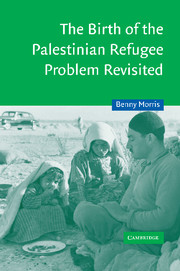
The Birth of the Palestinian Refugee Problem Revisited
Benny Morris' The Birth of the Palestinian Refugee Problem was published in 1988. Its startling revelations about how and why 700,000 Palestinians left their homes and became refugees during the Arab-Israeli war in 1948 undermined traditional interpretations as to whether they left voluntarily or were expelled as part of a systematic plan. This 2004 book represents a revised edition of the earlier work, compiled on the basis of newly-opened Israeli military archives. While the focus remains the 1948 war and the analysis of the Palestinian exodus, the new material contains more information about what happened in Jerusalem, Jaffa and Haifa, and how events there led to the collapse of Palestinian urban society. It also sheds light on the battles and atrocities that resulted in the disintegration of rural communities. The story is a harrowing one. The refugees now number four million and their existence remains a major obstacle to peace.
eBook

One State, Two States
\"What is so striking about Morris's work as a historian is that it does not flatter anyone's prejudices, least of all his own,\" David Remnick remarked in aNew Yorkerarticle that coincided with the publication of Benny Morris's1948: A History of the First Arab-Israeli War.With the same commitment to objectivity that has consistently characterized his approach, Morris now turns his attention to the present-day legacy of the events of 1948 and the concrete options for the future of Palestine and Israel.
The book scrutinizes the history of the goals of the Palestinian national movement and the Zionist movement, then considers the various one- and two-state proposals made by different streams within the two movements. It also looks at the willingness or unwillingness of each movement to find an accommodation based on compromise. Morris assesses the viability and practicality of proposed solutions in the light of complicated and acrimonious realities. Throughout his groundbreaking career, Morris has reshaped understanding of the Israeli-Arab conflict. Here, once again, he arrives at a new way of thinking about the discord, injecting a ray of hope in a region where it is most sorely needed.
eBook

1948
This history of the foundational war in the Arab-Israeli conflict is groundbreaking, objective, and deeply revisionist. A riveting account of the military engagements, it also focuses on the war's political dimensions. Benny Morris probes the motives and aims of the protagonists on the basis of newly opened Israeli and Western documentation. The Arab side-where the archives are still closed-is illuminated with the help of intelligence and diplomatic materials.
Morris stresses thejihadicharacter of the two-stage Arab assault on the Jewish community in Palestine. Throughout, he examines the dialectic between the war's military and political developments and highlights the military impetus in the creation of the refugee problem, which was a by-product of the disintegration of Palestinian Arab society. The book thoroughly investigates the role of the Great Powers-Britain, the United States, and the Soviet Union-in shaping the conflict and its tentative termination in 1949. Morris looks both at high politics and general staff decision-making processes and at the nitty-gritty of combat in the successive battles that resulted in the emergence of the State of Israel and the humiliation of the Arab world, a humiliation that underlies the continued Arab antagonism toward Israel.
eBook
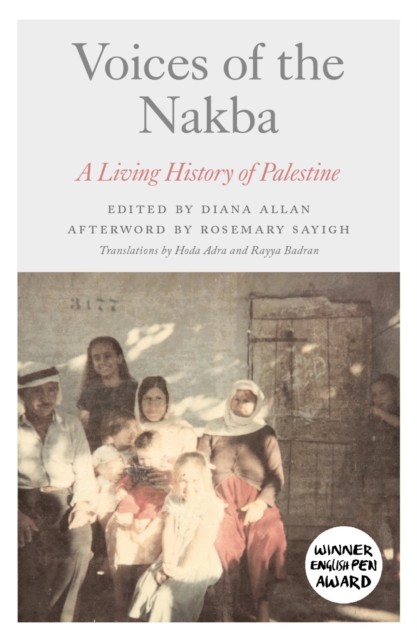
Voices of the Nakba
***Winner of an English PEN Award 2021*** During the 1948 war more than 750,000 Palestinian Arabs fled or were violently expelled from their homes by Zionist militias. The legacy of the Nakba - which translates to ‘disaster’ or ‘catastrophe’ - lays bare the violence of the ongoing Palestinian plight. Voices of the Nakba collects the stories of first-generation Palestinian refugees in Lebanon, documenting a watershed moment in the history of the modern Middle East through the voices of the people who lived through it. The interviews, with commentary from leading scholars of Palestine and the Middle East, offer a vivid journey into the history, politics and culture of Palestine, defining Palestinian popular memory on its own terms in all its plurality and complexity.
eBook

Co-memory and melancholia
The 1948 war that led to the creation of the State of Israel also resulted in the destruction of Palestinian society when some 80 per cent of the Palestinians who lived in the major part of Palestine upon which Israel was established became refugees. Israelis call the 1948 war their 'War of Independence' and the Palestinians their 'Nakba', or catastrophe. After many years of Nakba denial, land appropriation, political discrimination against the Palestinians within Israel and the denial of rights to Palestinian refugees, in recent years the Nakba is beginning to penetrate Israeli public discourse. This book explores the construction of collective memory in Israeli society, where the memory of the trauma of the Holocaust and of Israel's war dead competes with the memory claims of the dispossessed Palestinians. Taking an auto-ethnographic approach, Ronit Lentin makes a contribution to social memory studies through a critical evaluation of the co-memoration of the Palestinian Nakba by Israeli Jews. Against a background of the Israeli resistance movement, Lentin's central argument is that co-memorating the Nakba by Israeli Jews is motivated by an unresolved melancholia about the disappearance of Palestine and the dispossession of the Palestinians, a melancholia that shifts mourning from the lost object to the grieving subject. Lentin theorises Nakba co-memory as a politics of resistance, counterpoising co-memorative practices by internally displaced Israeli Palestinians with Israeli Jewish discourses of the Palestinian right of return, and questions whether return narratives by Israeli Jews, courageous as they may seem, are ultimately about Israeli Jewish self-healing rather than justice for Palestine.
eBook

Refugees of the revolution : experiences of Palestinian exile
Some sixty-five years after 750,000 Palestinians fled or were expelled from their homeland, the popular conception of Palestinian refugees still emphasizes their fierce commitment to exercising their \"right of return.\" Exile has come to seem a kind of historical amber, preserving refugees in a way of life that ended abruptly with \"the catastrophe\" of 1948 and their camps—inhabited now for four generations—as mere zones of waiting. While reducing refugees to symbols of steadfast single-mindedness has been politically expedient to both sides of the Arab-Israeli conflict it comes at a tremendous cost for refugees themselves, overlooking their individual memories and aspirations and obscuring their collective culture in exile. Refugees of the Revolution is an evocative and provocative examination of everyday life in Shatila, a refugee camp in Beirut. Challenging common assumptions about Palestinian identity and nationalist politics, Diana Allan provides an immersive account of camp experience, of communal and economic life as well as inner lives, tracking how residents relate across generations, cope with poverty and marginalization, and plan––pragmatically and speculatively—for the future. She gives unprecedented attention to credit associations, debt relations, electricity bartering, emigration networks, and NGO provisions, arguing that a distinct Palestinian identity is being forged in the crucible of local pressures. What would it mean for the generations born in exile to return to a place they never left? Allan addresses this question by rethinking the relationship between home and homeland. In so doing, she reveals how refugees are themselves pushing back against identities rooted in a purely nationalist discourse. This groundbreaking book offers a richly nuanced account of Palestinian exile, and presents new possibilities for the future of the community.
eBook

The politics of denial : Israel and the Palestinian refugee problem
Explores historical roots and controversies surrounding the 1948 Palestinian exodus, the Zionist position on refugee status and right of return, Israel's moral and legal responsibility and refugee policy since 1948, resettlement schemes, the 1967 exodus, internally displaced Palestinians in Israel, and revisionist Israeli historians'views.
eBook
Israel and the Palestinian refugee issue
Examining the development of Israel's policy toward the Palestinian refugee issue, this book spans the period following the first Arab-Israeli War until the mid-1950s, when the basic principles of Israel's policy were finalized.
Israel and the Palestinian Refugee Issue outlines and analyzes the various aspects that, together, created the mosaic of the \"refugee problem\" with which Israel has since had to contend. These aspects include issues of repatriation, resettlement, compensation, blocked bank accounts, internal refugees and family reunification.
Drawing on extensive archival research, this book uses documents from Israeli government meetings, from the Foreign Affairs and Defense Committee and files from the office of the Prime Minister's advisor on Arab affairs to address the many diverse aspects of this topic, and will be essential reading for academics and researchers with an interest in Israel, the Middle East, and political science more broadly.
eBook