
Catalogue Search | MBRL


Are you sure you want to remove the book from the shelf?

{{itemTitle}}
1,930,941
result(s) for
"HEALTH SERVICES"
Sort by:


Effect on maternal and child health services in Rwanda of payment to primary health-care providers for performance: an impact evaluation
Evidence about the best methods with which to accelerate progress towards achieving the Millennium Development Goals is urgently needed. We assessed the effect of performance-based payment of health-care providers (payment for performance; P4P) on use and quality of child and maternal care services in health-care facilities in Rwanda.
166 facilities were randomly assigned at the district level either to begin P4P funding between June, 2006, and October, 2006 (intervention group; n=80), or to continue with the traditional input-based funding until 23 months after study baseline (control group; n=86). Randomisation was done by coin toss. We surveyed facilities and 2158 households at baseline and after 23 months. The main outcome measures were prenatal care visits and institutional deliveries, quality of prenatal care, and child preventive care visits and immunisation. We isolated the incentive effect from the resource effect by increasing comparison facilities' input-based budgets by the average P4P payments made to the treatment facilities. We estimated a multivariate regression specification of the difference-in-difference model in which an individual's outcome is regressed against a dummy variable, indicating whether the facility received P4P that year, a facility-fixed effect, a year indicator, and a series of individual and household characteristics.
Our model estimated that facilities in the intervention group had a 23% increase in the number of institutional deliveries and increases in the number of preventive care visits by children aged 23 months or younger (56%) and aged between 24 months and 59 months (132%). No improvements were seen in the number of women completing four prenatal care visits or of children receiving full immunisation schedules. We also estimate an increase of 0·157 standard deviations (95% CI 0·026–0·289) in prenatal quality as measured by compliance with Rwandan prenatal care clinical practice guidelines.
The P4P scheme in Rwanda had the greatest effect on those services that had the highest payment rates and needed the least effort from the service provider. P4P financial performance incentives can improve both the use and quality of maternal and child health services, and could be a useful intervention to accelerate progress towards Millennium Development Goals for maternal and child health.
World Bank's Bank-Netherlands Partnership Program and Spanish Impact Evaluation Fund, the British Economic and Social Research Council, Government of Rwanda, and Global Development Network.
Journal Article


Community-Partnered Cluster-Randomized Comparative Effectiveness Trial of Community Engagement and Planning or Resources for Services to Address Depression Disparities
ABSTRACT
BACKGROUND
Depression contributes to disability and there are ethnic/racial disparities in access and outcomes of care. Quality improvement (QI) programs for depression in primary care improve outcomes relative to usual care, but health, social and other community-based service sectors also support clients in under-resourced communities. Little is known about effects on client outcomes of strategies to implement depression QI across diverse sectors.
OBJECTIVE
To compare the effectiveness of
Community Engagement and Planning (CEP)
and
Resources for Services (RS)
to implement depression QI on clients’ mental health-related quality of life (HRQL) and services use.
DESIGN
Matched programs from health, social and other service sectors were randomized to community engagement and planning (promoting inter-agency collaboration) or resources for services (individual program technical assistance plus outreach) to implement depression QI toolkits in Hollywood-Metro and South Los Angeles.
PARTICIPANTS
From 93 randomized programs, 4,440 clients were screened and of 1,322 depressed by the 8-item Patient Health Questionnaire (PHQ-8) and providing contact information, 1,246 enrolled and 1,018 in 90 programs completed baseline or 6-month follow-up.
MEASURES
Self-reported mental HRQL and probable depression (primary), physical activity, employment, homelessness risk factors (secondary) and services use.
RESULTS
CEP was more effective than RS at improving mental HRQL, increasing physical activity and reducing homelessness risk factors, rate of behavioral health hospitalization and medication visits among specialty care users (i.e. psychiatrists, mental health providers) while increasing depression visits among users of primary care/public health for depression and users of faith-based and park programs (each
p
< 0.05). Employment, use of antidepressants, and total contacts were not significantly affected (each
p
> 0.05).
CONCLUSION
Community engagement to build a collaborative approach to implementing depression QI across diverse programs was more effective than resources for services for individual programs in improving mental HRQL, physical activity and homelessness risk factors, and shifted utilization away from hospitalizations and specialty medication visits toward primary care and other sectors, offering an expanded health-home model to address multiple disparities for depressed safety-net clients.
Journal Article

Systems-level barriers to treatment in a cervical cancer prevention program in Kenya: Several observational studies
To identify health systems-level barriers to treatment for women who screened positive for high-risk human papillomavirus (hrHPV) in a cervical cancer prevention program in Kenya.
In a trial of implementation strategies for hrHPV-based cervical cancer screening in western Kenya in 2018-2019, women underwent hrHPV testing offered through community health campaigns, and women who tested positive were referred to government health facilities for cryotherapy. The current analysis draws on treatment data from this trial, as well as two observational studies that were conducted: 1) periodic assessments of the treatment sites to ascertain availability of resources for treatment and 2) surveys with treatment providers to elicit their views on barriers to care. Bivariate analyses were performed for the site assessment data, and the provider survey data were analyzed descriptively.
Seventeen site assessments were performed across three treatment sites. All three sites reported instances of supply stockouts, two sites reported treatment delays due to lack of supplies, and two sites reported treatment delays due to provider factors. Of the 16 providers surveyed, ten (67%) perceived lack of knowledge of HPV and cervical cancer as the main barrier in women's decision to get treated, and seven (47%) perceived financial barriers for transportation and childcare as the main barrier to accessing treatment. Eight (50%) endorsed that providing treatment free of cost was the greatest facilitator of treatment.
Patient education and financial support to reach treatment are potential areas for intervention to increase rates of hrHPV+ women presenting for treatment. It is also essential to eliminate barriers that prevent treatment of women who present, including ensuring adequate supplies and staff for treatment.
Journal Article

Just Doctoring
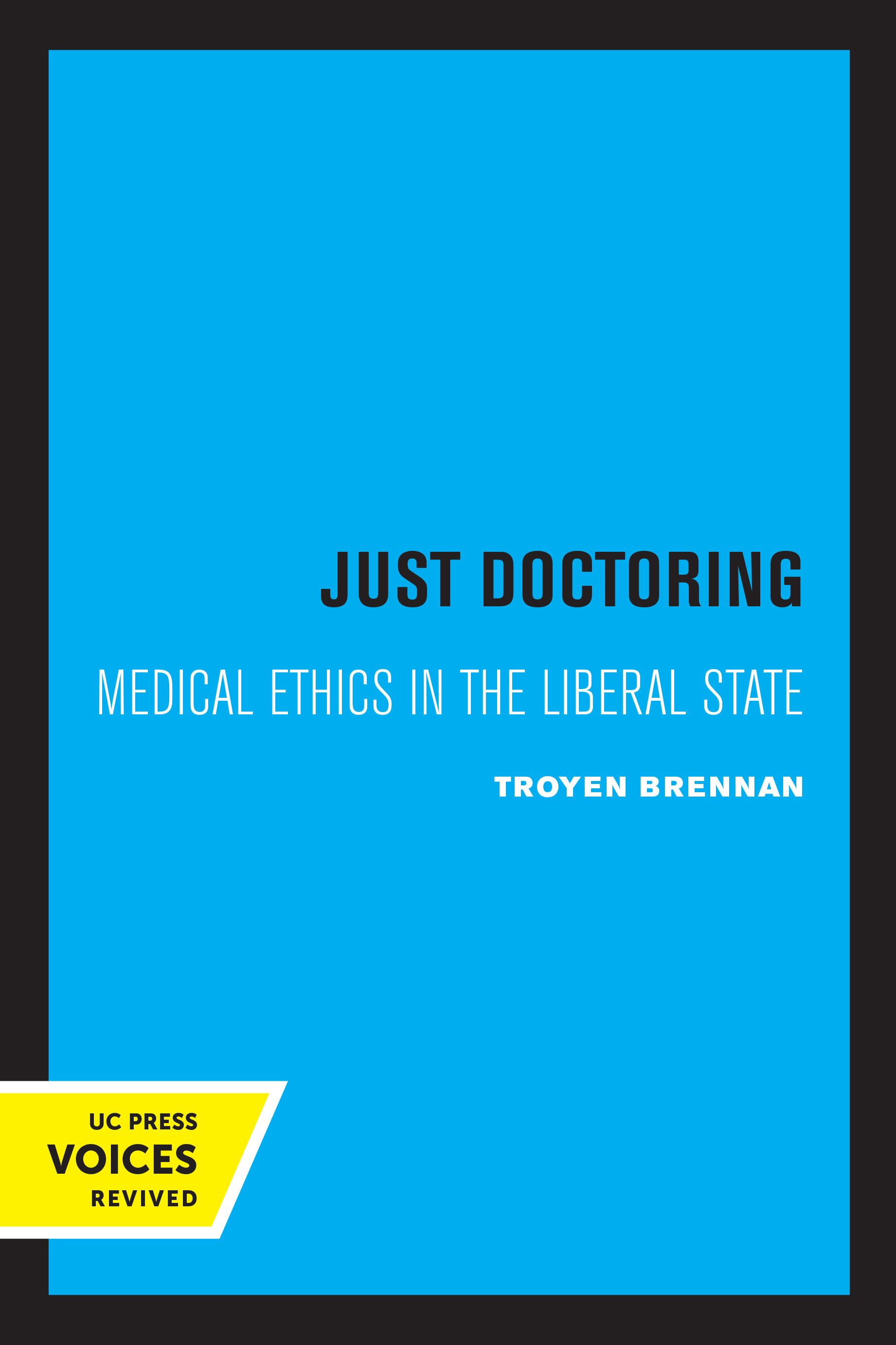
Just Doctoring draws the doctor-patient relationship out of the consulting room and into the middle of the legal and political arenas where it more and more frequently appears. Traditionally, medical ethics has focused on the isolated relationship of physician to patient in a setting that has left the physician virtually untouched by market constraints or government regulation. Arguing that changes in health care institutions and legal attention to patient rights have made conventional approaches obsolete, Troyen Brennan points the way to a new, more aware and engaged medical ethics. The medical profession is no longer isolated, even theoretically, from the liberal, market-dominated state. Old ideas of physician beneficence and altruism must make way for a justice-based medical ethics, assuming a relationship between equals more compatible with liberal political philosophy. Brennan offers clinical examples of many of today's most challenging medical problems--from informed consent to care rationing and the repercussions of the HIV epidemic--and gives his recommendation for a new ethical perspective. This lively and controversial plea for a rethinking of medical ethics goes right to the heart of medical care at the end of the twentieth century. This title is part of UC Press's Voices Revived program, which commemorates University of California Press's mission to seek out and cultivate the brightest minds and give them voice, reach, and impact. Drawing on a backlist dating to 1893, Voices Revived makes high-quality, peer-reviewed scholarship accessible once again using print-on-demand technology. This title was originally published in 1991. Many titles in the Voices Revived program are also newly available as ebooks, offered at a discounted price to support wider access to scholarly work.
eBook

Preventing childhood obesity
Children's health has made tremendous strides over the past century. In general, life expectancy has increased by more than thirty years since 1900 and much of this improvement is due to the reduction of infant and early
childhood mortality. Given this trajectory toward a healthier childhood, we
begin the 21st-century with a shocking development-an epidemic of obesity
in children and youth. The increased number of obese children
throughout the U.S. during the past 25 years has led policymakers to rank
it as one of the most critical public health threats of the 21st-century.
Preventing Childhood Obesity provides a broad-based examination of the
nature, extent, and consequences of obesity in U.S. children and youth,
including the social, environmental, medical, and dietary factors responsible
for its increased prevalence. The book also offers a prevention-oriented
action plan that identifies the most promising array of short-term and
longer-term interventions, as well as recommendations for the roles and
responsibilities of numerous stakeholders in various sectors of society to
reduce its future occurrence. Preventing Childhood Obesity explores the
underlying causes of this serious health problem and the actions needed to
initiate, support, and sustain the societal and lifestyle changes that can
reverse the trend among our children and youth.
eBook