
Catalogue Search | MBRL


Are you sure you want to remove the book from the shelf?

{{itemTitle}}
54,402
result(s) for
"HISTORY / Essays"
Sort by:

Thank you M. Monnet
This book collects contributions by Richard T. Griffiths on the history of European integration, some published for the first time in English. The essays range in chronology from the early experiences with the Marshall Plan to the difficulties and opportunities for the EFTA countries afforded by association with the EEC in the 1970s and 80s. The book interprets European integration far wider than simply the current European Union and its forerunners. Thus, it devotes chapters to EFTA, the OECD, and to issues as agriculture, cartels and monetary problems. The volume also contains the essay in the title which poses the question of what would have happened had there been no Schuman Plan back in 1950. This book should appeal to students of contemporary history, especially those interested in EU history, and to political scientists who will discover a rich palette of case studies upon which to test their theories. Its constructively critical slant on developments provides interesting perspectives to those general readers seeking a nuanced approach between the extremes of the current pro- or anti- in the debates on Europe.
eBook

Nazi soundscapes
Following the formation of the German National Socialist Party in the 1920s, various forms of sound (popular music, voice, noise and silence) and media technology (radio and loudspeaker systems) were configured as useful to the party's political programme. Focusing on the urban \"soundscape\" of Düsseldorf, the author makes a persuasive case for investigating such sound events and technological devices in their specific contexts of production and reception. Nazi Soundscapes identifies strategies for controlling space and reworking identity patterns, but also the ongoing difficulties in manipulating mediated sounds and the spaces of listening reception, whether in the home, workplace, the cinema, public rituals or with wartime siren systems. The study revises visualist notions of social control, and reveals the disciplinary functions of listening (as eavesdropping) as well as the sonic dimensions to exclusion and violence during Nazism. An essential title for everyone interested in the links between German political culture, audiovisual media and urban history, Nazi Soundscapes provides a fascinating analysis of the cultural significance of sound between the 1920s and early 1940s. Click \"http://soundclips.humanities.uva.nl/\">here for the sound clips discussed in the book. This title is available in the OAPEN Library - http://www.oapen.org.
eBook

Shipbuilding and Ship Repair Workers around the World
Maritime trade is the backbone of the world’s economy. Around ninety percent of all goods are transported by ship, and since World War II, shipbuilding has undergone major changes in response to new commercial pressures and opportunities. Early British dominance, for example, was later undermined in the 1950s by competition from the Japanese, who have since been overtaken by South Korea and, most recently, China. The case studies in this volume trace these and other important developments in the shipbuilding and ship repair industries, as well as workers’ responses to these historic transformations.
eBook

An indispensable liberty : the fight for free speech in nineteenth-century America
Most Americans today view freedom of speech as a bedrock of all other liberties, a defining feature of American citizenship. During the nineteenth century, the popular concept of American freedom of speech was still being formed. In An Indispensable Liberty: The Fight for Free Speech in Nineteenth-Century America , contributors examine attempts to restrict freedom of speech and the press during and after the Civil War.
The eleven essays that make up this collection show how, despite judicial, political, and public proclamations of support for freedom of expression, factors like tradition, gender stereotypes, religion, and fear of social unrest often led to narrow judicial and political protection for freedom of expression by people whose views upset the status quo. These views, expressed by abolitionists, suffragists, and labor leaders, challenged rigid cultural mores of the day, and many political and cultural leaders feared that extending freedom of expression to agitators would undermine society. The Civil War intensified questions about the duties and privileges of citizenship. After the war, key conflicts over freedom of expression were triggered by Reconstruction, suffrage, the Comstock Act, and questions about libel.
The volume’s contributors blend social, cultural, and intellectual history to untangle the complicated strands of nineteenth-century legal thought. By chronicling the development of modern-day notions of free speech, this timely collection offers both a valuable exploration of the First Amendment in nineteenth-century America and a useful perspective on the challenges we face today.
eBook

Thinking Impossibilities
Intellectuals rarely make a significant impact on one field of scholarship let alone several, yet Amos Funkenstein (1937-1995) displayed an intellectual range that encompassed several disciplines and broke new ground across seemingly impenetrable scholarly boundaries. The philosophy of history from antiquity to modernity, medieval and early modern history of science, medieval scholasticism, Jewish history in all of its periods - these are all areas in which he made lasting contributions.Thinking Impossibilitiesbrings together Funkenstein's colleagues, friends, and former students to engage with important aspects of his intellectual legacy.
Funkenstein's diverse interests were bound together by common figures of thought, especially the search for pre-modern intellectual groundings of modern ideas and how the seeming 'impossibilities' of one historical moment might become positive resources of conceptual construction and development in another. The essays in this volume take up major themes in European intellectual history, and examine them through the unique lens that Funkenstein himself employed during his career. Of particular interest are ways in which topics of Jewish history are engaged with the larger field of the history of ideas in the West. Richly interdisciplinary and full of fresh insights,Thinking Impossibilitiesis a fitting tribute to an important twentieth-century scholar.
eBook

Lincoln, the law, and presidential leadership
From his early years as a small-town lawyer through his rise to the presidency, Abraham Lincoln respected the rule of law.Secession and the Civil War, however, led him to expand presidential power in ways that, over time, transformed American society.
eBook
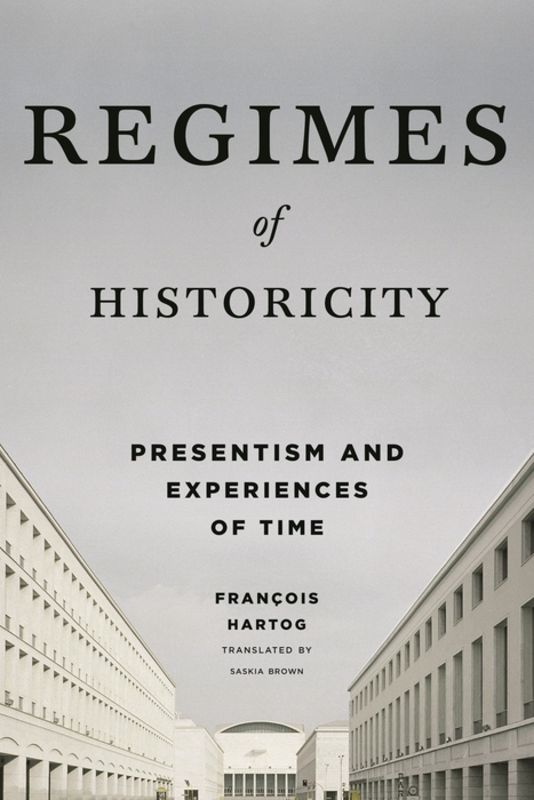
Regimes of historicity
François Hartog explores crucial moments of change in society's \"regimes of historicity,\" or its ways of relating to the past, present, and future. Inspired by Hannah Arendt, Reinhart Koselleck, and Paul Ricoeur, Hartog analyzes a broad range of texts, positioning The Odyssey as a work on the threshold of historical consciousness and contrasting it with an investigation of the anthropologist Marshall Sahlins's concept of \"heroic history.\" He tracks changing perspectives on time in Chateaubriand's Historical Essay and Travels in America and sets them alongside other writings from the French Revolution. He revisits the insights of the French Annales School and situates Pierre Nora's Realms of Memory within a history of heritage and today's presentism, from which he addresses Jonas's notion of our responsibility for the future. Our presentist present is by no means uniform or clear-cut, and it is experienced very differently depending on the position we occupy in society. We are caught up in global movement and accelerated flows, or else condemned to the life of casual workers, living from hand to mouth in a stagnant present, with no recognized past, and no real future either (since the temporality of plans and projects is inaccessible). The present is therefore experienced as emancipation or enclosure, and the perspective of the future is no longer reassuring, since it is perceived not as a promise, but as a threat. Hartog's resonant readings show us how the motor of history(-writing) has stalled and help us understand the contradictory qualities of our contemporary presentist relation to time.
eBook

Visual texts, ceremonial texts, texts of exploration : collected articles on the representation of Russian monarchy
Visual Texts, Ceremonial Texts, Texts of Exploration continues the work begun in Russian Monarchy: Representation and Rule, which analyzed the interplay between the symbolic representations of Russian monarchs and the legal and institutional instruments of their rule. The articles in this volume examine the texts that, through various media, revealed the myths and scenarios conveying the goals and ideals the monarchy sought to elevate before the elite of the empire and, later, the public at large. Russian monarchy inhabited a highly visual culture, comprising court ceremonials, parades, public festivities, and celebrations. It mobilized the arts through painting, prints, popular pictures (lubki), and even opera. This book examines that artistic culture, focusing on several aspects.
eBook

Waddenland Outstanding: History, Landscape and Cultural Heritage of the Wadden Sea Region
The Wadden Sea Region is comprised of the embanked coastal marshes and islands in the Wadden Sea near Denmark, Germany, and the Netherlands, and this area retains an exceptional common history in all its aspects: archaeologically, economically, socially, and culturally. Its settlement history of more than two thousand years is unrivalled and still mirrored in the landscape and even though it has never constituted a political unity, it still shares a landscape and cultural heritage. For example, the approaches to water management and associated societal organisation developed in the region during the last millennium have set significant world standards, values which were recognised by UNESCO in inscribing the Wadden Sea on its World Heritage List. This book encompasses the contributions presented at the scientific symposium of prominent scientists who gathered in 2016 in Husum, Germany, a landmark event in sharing knowledge on the common history, landscape, cultural heritage of the Wadden Sea Region.
eBook

Shipbuilding and Ship Repair Workers around the World
Maritime trade is the backbone of the world’s economy. Around ninety percent of all goods are transported by ship, and since World War II, shipbuilding has undergone major changes in response to new commercial pressures and opportunities. Early British dominance, for example, was later undermined in the 1950s by competition from the Japanese, who have since been overtaken by South Korea and, most recently, China. The case studies in this volume trace these and other important developments in the shipbuilding and ship repair industries, as well as workers’ responses to these historic transformations.
eBook