
Catalogue Search | MBRL


Are you sure you want to remove the book from the shelf?

{{itemTitle}}
1,374
result(s) for
"HISTORY / Europe / Great Britain / General"
Sort by:

Pharmacopoeias, Drug Regulation, and Empires
The word \"pharmacopoeia\" has come to have many meanings,
although it is commonly understood to be a book describing approved
compositions and standards for drugs. In 1813 the Royal College of
Physicians of London considered a proposal to develop an imperial
British pharmacopoeia - at a time when separate official
pharmacopoeias existed for England, Scotland, and Ireland. A
unified British pharmacopoeia was published in 1864, and by 1914 it
was considered suitable for the whole Empire.
Pharmacopoeias, Drug Regulation, and Empires traces the
350-year development of officially sanctioned pharmacopoeias across
the British Empire, first from local to national pharmacopoeias,
and later to a standardized pharmacopoeia that would apply
throughout Britain's imperial world. The evolution of British
pharmacopoeias and the professionalization of medicine saw
developments including a transition from Galenic principles to germ
theory, and a shift from plant-based to chemical medicines. While
other colonial powers in Europe usually imposed metropolitan
pharmacopoeias across their colonies, Britain consulted with
practitioners throughout its Empire. As the scope of the
pharmacopoeia widened, the process of agreeing upon drug
standardization became more complex and fraught. A wide range of
issues was exposed, from bioprospecting and the inclusion of
indigenous medicines in pharmacopoeias, to adulteration and demands
for the substitution of pharmacopoeial drugs with locally available
ones.
Pharmacopoeias, Drug Regulation, and Empires uses the
evolution of an imperial pharmacopoeia in Britain as a vehicle for
exploring the hegemonic power of European colonial powers in the
medical field, and the meaning of pharmacopoeia more broadly.
eBook

The Celts
Now in its second edition, this comprehensive history of the Celts draws on archaeological, historical, literary and linguistic evidence to provide a comprehensive and colourful overview from origins to the present.
eBook

Writing the history of parliament in Tudor and early Stuart England
This volume of essays explores the rise of parliament in the historical imagination of early modern England. The enduring controversy about the nature of parliament informs nearly all debates about the momentous religious, political and governmental changes of the period – most significantly, the character of the Reformation and the causes of the Revolution. Meanwhile, scholars of ideas have emphasised the historicist turn that shaped political culture. Religious and intellectual imperatives from the sixteenth century onwards evoked a new interest in the evolution of parliament, framing the ways that contemporaries interpreted, legitimised and contested Church, state and political hierarchies. Parliamentary ‘history’ is explored through the analysis of chronicles, more overtly ‘literary’ texts, antiquarian scholarship, religious polemic, political pamphlets, and of the intricate processes that forge memory and tradition.
eBook

Ethnic Identity and the Archaeology of the aduentus Saxonum
For centuries, archaeologists have excavated the soils of Britain to uncover finds from the early medieval past. These finds have been used to reconstruct the alleged communities, migration patterns, and expressions of identity of coherent groups who can be regarded as ethnic 'Anglo-Saxons'. Even in the modern day, when social constructionism has been largely accepted by scholars, this paradigm still persists. This book challenges the ethnic paradigm. As the first historiographical study of approaches to ethnic identity in modern 'Anglo-Saxon' archaeology, it reveals these approaches to be incompatible with current scholarly understandings of ethnicity. Drawing upon post-structuralist approaches to self and community, it highlights the empirical difficulties the archaeology of ethnicity in early medieval Britain faces, and proposes steps toward an alternative understanding of the role played by the communities of lowland Britain - both migrants from across the North Sea and those already present - in transforming the Roman world.
eBook

Authors of Their Lives
2008 United States Postal System's Rita Lloyd Moroney Award
In the era before airplanes and e-mail, how did immigrants keep in touch with loved ones in their homelands, as well as preserve links with pasts that were rooted in places from which they voluntarily left? Regardless of literacy level, they wrote letters, explains David A. Gerber in this path-breaking study of British immigrants to the U.S. and Canada who wrote and received letters during the nineteenth century.
Scholars have long used immigrant letters as a lens to examine the experiences of immigrant groups and the communities they build in their new homelands. Yet immigrants as individual letter writers have not received significant attention; rather, their letters are often used to add color to narratives informed by other types of sources.
Authors of Their Lives analyzes the cycle of correspondence between immigrants and their homelands, paying particular attention to the role played by letters in reformulating relationships made vulnerable by separation. Letters provided sources of continuity in lives disrupted by movement across vast spaces that disrupted personal identities, which depend on continuity between past and present. Gerber reveals how ordinary artisans, farmers, factory workers, and housewives engaged in correspondence that lasted for years and addressed subjects of the most profound emotional and practical significance.
eBook

The Scottish diaspora
This introductory history of the Scottish diaspora (c.1700 to 1945) explores migration, Scots' experiences where they landed and the reverse impact of this migration on Scotland. It examines the geographies of the diaspora and key theories, concepts and themes, including associationalism and return migration. Includes conceptual case studies.
eBook

British Law and Governance in Treaty Port China 1842-1927
In putting extraterritoriality into practice in the treaty ports, the British state did not simply withdraw rights from the Chinese state; it inhabited the space made by extraterritoriality by building institutions and engaging in practices which had consequences for the development of the treaty ports, and which need to be at the forefront of any attempt to understand colonialism in China. Through a focus both on the creation of law and institutions, and also on the management of British ‘problem populations’ – violent Europeans and ‘martial’ Indians – this book provides a revision of the history of empire and colonialism in China, explaining important features which have to date been glossed over in studies of other aspects of treaty port colonialism. Colonialism in China casts a long shadow, but key aspects of the British state’s central role in this history have before now been little understood.
eBook

Freedom Burning
After Britain abolished slavery throughout most of its empire in 1834, Victorians adopted a creed of \"anti-slavery\" as a vital part of their national identity and sense of moral superiority to other civilizations. The British government used diplomacy, pressure, and violence to suppress the slave trade, while the Royal Navy enforced abolition worldwide and an anxious public debated the true responsibilities of an anti-slavery nation. This crusade was far from altruistic or compassionate, but Richard Huzzey argues that it forged national debates and political culture long after the famous abolitionist campaigns of William Wilberforce and Thomas Clarkson had faded into memory. These anti-slavery passions shaped racist and imperialist prejudices, new forms of coerced labor, and the expansion of colonial possessions.
In a sweeping narrative that spans the globe,Freedom Burningexplores the intersection of philanthropic, imperial, and economic interests that underlay Britain's anti-slavery zeal- from London to Liberia, the Sudan to South Africa, Canada to the Caribbean, and the British East India Company to the Confederate States of America. Through careful attention to popular culture, official records, and private papers, Huzzey rewrites the history of the British Empire and a century-long effort to end the global trade in human lives.
eBook

The Creation of the German-Jewish Diaspora
This book is first of its kind to deal with the interwar Jewish emigration from Germany in a comparative framework and follows the entire migration process from the point of view of the emigrants. It combines the usage of social and economic measures with the individual stories of the immigrants, thereby revealing the complex connection between the socio-economic profile varieties and the decisions regarding emigration – if, when and where to. The encounter between the various immigrant-refugee groups and the different host societies in different times produced diverse stories of presence, function, absorption and self-awareness in the three major overseas destinations – Palestine, the USA, and Great Britain -- despite the ostensibly common German-Jewish heritage. Thus German-Jewish immigrants created a new and nuanced fabric of the German-Jewish Diaspora in its main three centers, and shaped distinct identifications and legacies in Israel, Britain, and the United States.
eBook
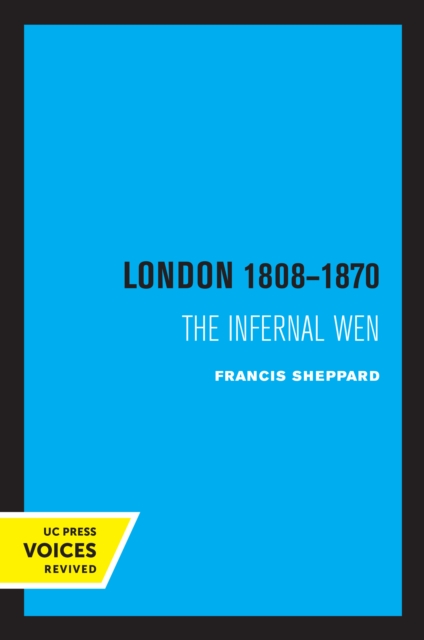
London 1808-1870
This title is part of UC Press's Voices Revived program, which commemorates University of California Press's mission to seek out and cultivate the brightest minds and give them voice, reach, and impact. Drawing on a backlist dating to 1893, Voices Revived makes high-quality, peer-reviewed scholarship accessible once again using print-on-demand technology. This title was originally published in 1971.
eBook