
Catalogue Search | MBRL


Are you sure you want to remove the book from the shelf?

{{itemTitle}}
18,061
result(s) for
"HISTORY / Modern / 20th Century."
Sort by:

The role of terrorism in twenty-first-century warfare
A critical reflection on the role of terrorism in major armed conflicts occurring during the 1990s and the first decade of the twenty first century. Case studies include Bosnia, Kosovo, Chechnya, Iraq, Afghanistan, and Syria.
eBook

Electronic literature : new horizons for the literary
A visible presence for some two decades, electronic literature has already produced many works that deserve the rigorous scrutiny critics have long practiced with print literature. Only now, however, with Electronic Literature by N. Katherine Hayles, do we have the first systematic survey of the field and an analysis of its importance, breadth, and wide-ranging implications for literary study. Hayles’s book is designed to help electronic literature move into the classroom. Her systematic survey of the field addresses its major genres, the challenges it poses to traditional literary theory, and the complex and compelling issues at stake. She develops a theoretical framework for understanding how electronic literature both draws on the print tradition and requires new reading and interpretive strategies. Grounding her approach in the evolutionary dynamic between humans and technology, Hayles argues that neither the body nor the machine should be given absolute theoretical priority. Rather, she focuses on the interconnections between embodied writers and users and the intelligent machines that perform electronic texts. Through close readings of important works, Hayles demonstrates that a new mode of narration is emerging that differs significantly from previous models. Key to her argument is the observation that almost all contemporary literature has its genesis as electronic files, so that print becomes a specific mode for electronic text rather than an entirely different medium. Hayles illustrates the implications of this condition with three contemporary novels that bear the mark of the digital.
eBook

Trauma Culture
It may be said that every trauma is two traumas or ten thousand-depending on the number of people involved. How one experiences and reacts to an event is unique and depends largely on one's direct or indirect positioning, personal psychic history, and individual memories. But equally important to the experience of trauma are the broader political and cultural contexts within which a catastrophe takes place and how it is \"managed\" by institutional forces, including the media.In Trauma Culture, E. Ann Kaplan explores the relationship between the impact of trauma on individuals and on entire cultures and nations. Arguing that humans possess a compelling need to draw meaning from personal experience and to communicate what happens to others, she examines the artistic, literary, and cinematic forms that are often used to bridge the individual and collective experience. A number of case studies, including Sigmund Freud's Moses and Monotheism, Marguerite Duras' La Douleur, Sarah Kofman's Rue Ordener, Rue Labat, Alfred Hitchcock's Spellbound, and Tracey Moffatt's Night Cries, reveal how empathy can be fostered without the sensationalistic element that typifies the media.From World War II to 9/11, this passionate study eloquently navigates the contentious debates surrounding trauma theory and persuasively advocates the responsible sharing and translating of catastrophe.
eBook

Transnational Palestine : migration and the right of return before 1948
Tens of thousands of Palestinians migrated to the Americas in the final decades of the nineteenth century and early decades of the twentieth. By 1936, an estimated 40,000 Palestinians lived outside geographic Palestine. Transnational Palestine is the first book to explore the history of Palestinian immigration to Latin America, the struggles Palestinian migrants faced to secure Palestinian citizenship in the interwar period, and the ways in which these challenges contributed to the formation of a Palestinian diaspora and to the emergence of Palestinian national consciousness. Nadim Bawalsa considers the migrants' strategies for economic success in the diaspora, for preserving their heritage, and for resisting British mandate legislation, including citizenship rejections meted out to thousands of Palestinian migrants. They did this in newspapers, social and cultural clubs and associations, political organizations and committees, and in hundreds of petitions and pleas delivered to local and international governing bodies demanding justice for Palestinian migrants barred from Palestinian citizenship. As this book shows, Palestinian political consciousness developed as a thoroughly transnational process in the first half of the twentieth century—and the first articulation of a Palestinian right of return emerged well before 1948.
eBook

Fictions of Dignity
Over the past fifty years, debates about human rights have assumed an increasingly prominent place in postcolonial literature and theory. Writers from Salman Rushdie to Nawal El Saadawi have used the novel to explore both the possibilities and challenges of enacting and protecting human rights, particularly in the Global South. InFictions of Dignity, Elizabeth S. Anker shows how the dual enabling fictions of human dignity and bodily integrity contribute to an anxiety about the body that helps to explain many of the contemporary and historical failures of human rights, revealing why and how lives are excluded from human rights protections along the lines of race, gender, class, disability, and species membership. In the process, Anker examines the vital work performed by a particular kind of narrative imagination in fostering respect for human rights. Drawing on phenomenology, Anker suggests how an embodied politics of reading might restore a vital fleshiness to the overly abstract, decorporealized subject of liberal rights.
Each of the novels Anker examines approaches human rights in terms of limits and paradoxes. Rushdie'sMidnight's Childrenaddresses the obstacles to incorporating rights into a formerly colonized nation's legal culture. El Saadawi'sWoman at Point Zerotakes up controversies over women's freedoms in Islamic society. InDisgrace, J. M. Coetzee considers the disappointments of post-apartheid reconciliation in South Africa. And inThe God of Small Things, Arundhati Roy confronts an array of human rights abuses widespread in contemporary India. Each of these literary case studies further demonstrates the relevance of embodiment to both comprehending and redressing the failures of human rights, even while those narratives refuse simplistic ideals or solutions.
eBook

Why they die
Why do civilians suffer most during times of violent conflict? Why are civilian fatalities as much as eight times higher, calculated globally for current conflicts, than military fatalities? In Why They Die, Daniel Rothbart and Karina V. Korostelina address these questions through a systematic study of civilian devastation in violent conflicts. Pushing aside the simplistic definition of war as a guns-and-blood battle between two militant groups, the authors investigate the identity politics underlying conflicts of many types. During a conflict, all those on the opposite side are perceived as the enemy, with little distinction between soldiers and civilians. As a result, random atrocities and systematic violence against civilian populations become acceptable.
Rothbart and Korostelina devote the first half of the book to case studies: deportation of the Crimean Tatars from the Ukraine, genocide in Rwanda, the Lebanon War, and the war in Iraq. With the second half, they present new methodological tools for understanding different types of violent conflict and discuss the implications of these tools for conflict resolution.
eBook

The International Jewish Labor Bund after 1945
The Jewish Labor Bund was one of the major political forces in early twentieth-century Eastern Europe. But the decades after the Second World War were years of enormous difficulty for Bundists. Like millions of other European Jews, they faced the challenge of resurrecting their lives, so gravely disrupted by the Holocaust. Not only had the organization lost many members, but its adherents were also scattered across many continents. In this book, David Slucki charts the efforts of the surviving remnants of the movement to salvage something from the wreckage.Covering both the Bundists who remained in communist Eastern Europe and those who emigrated to the United States, France, Australia, and Israel, the book explores the common challenges they faced-building transnational networks of friends, family, and fellow Holocaust survivors, while rebuilding a once-local movement under a global umbrella. This is a story of resilience and passion-passion for an idea that only barely survived Auschwitz.
eBook

Race, ethnicity and the women's movement in England, 1968-1993
This book is the first archive-based account of the charged debates around race in the women's movement in England during the 'second wave' period.Examining both the white and the Black women's movement through a source base that includes original oral histories and extensive research using feminist periodicals, this book seeks to unpack.
eBook

Space as Storyteller
Walter Benjamin's Arcades Projectsuggests that space can become a storyteller: if so, plenty of fleeting stories can be read in the space of modernity, where repetition and the unexpected cross-pollinate. In Space as Storyteller, Laura Chiesa explores several stories across a wide range of time that narrate spatial jumps, from Benjamin's tangential take on the cityscape, the experimentalism of Futurist theatricality, the multiple and potential atlases narrated by Italo Calvino and Georges Perec, and the posturban thought and practice of Bernard Tschumi and Rem Koolhaas/OMA.Space as Storytellerdiverts attention from isolated disciplines and historical or geographical contexts toward transdisciplinary encounters that mobilize the potential to invent new spaces of comparison, a potential the author describes as \"architecturability.\"
eBook
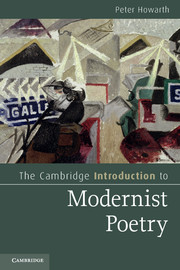
The Cambridge Introduction to Modernist Poetry
Modernist poems are some of the twentieth-century's major cultural achievements, but they are also hard work to read. This wide-ranging introduction takes readers through modernism's most famous poems and some of its forgotten highlights to show why modernists thought difficulty and disorientation essential for poetry in the modern world. In-depth chapters on Pound, Eliot, Yeats and the American modernists outline how formal experiments take on the new world of mass media, democracies, total war and changing religious belief. Chapters on the avant-gardes and later modernism examine how their styles shift as they try to re-make the community of readers. Howarth explains in a clear and enjoyable way how to approach the forms, politics and cultural strategies of modernist poetry in English.
eBook