
Catalogue Search | MBRL


Are you sure you want to remove the book from the shelf?

{{itemTitle}}
18
result(s) for
"HISTORY / Native American bisacsh"
Sort by:
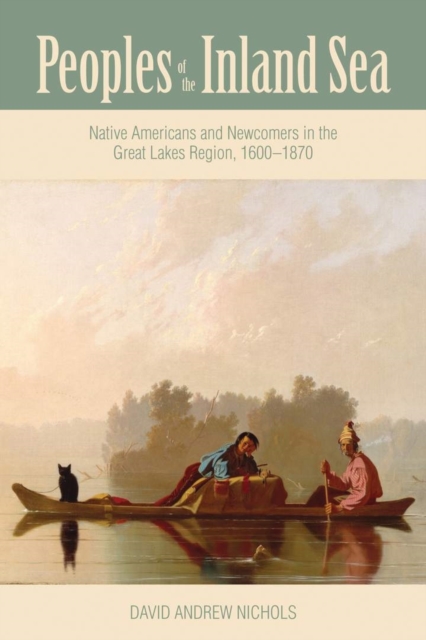
Peoples of the Inland Sea
Diverse in their languages and customs, the Native American
peoples of the Great Lakes region-the Miamis, Ho-Chunks,
Potawatomis, Ojibwas, and many others-shared a tumultuous history.
In the colonial era their rich homeland became a target of imperial
ambition and an invasion zone for European diseases, technologies,
beliefs, and colonists. Yet in the face of these challenges, their
nations' strong bonds of trade, intermarriage, and association grew
and extended throughout their watery domain, and strategic
relationships and choices allowed them to survive in an era of war,
epidemic, and invasion.
In Peoples of the Inland Sea, David Andrew Nichols
offers a fresh and boundary-crossing history of the Lakes peoples
over nearly three centuries of rapid change, from pre-Columbian
times through the era of Andrew Jackson's Removal program. As the
people themselves persisted, so did their customs, religions, and
control over their destinies, even in the Removal era. In Nichols's
hands, Native, French, American, and English sources combine to
tell this important story in a way as imaginative as it is bold.
Accessible and creative, Peoples of the Inland Sea is
destined to become a classroom staple and a classic in Native
American history.
eBook

In the Smaller Scope of Conscience
In 1989, The National Museum of the American Indian Act (NMAIA) was successfully passed after a long and intense struggle. One year later, the Native American Graves Protection and Repatriation Act (NAGPRA) followed. These federal repatriation statutes-arguably some of the most important laws in the history of anthropology, museology, and American Indian rights-enabled Native Americans to reclaim human remains, funerary objects, sacred objects, and objects of cultural patrimony.Twenty years later, the controversy instigated by the creation of NMAIA and NAGPRA continues to simmer.In the Smaller Scope of Conscienceis a thoughtful and detailed study of the ins and outs of the four-year process behind these laws. It is a singular contribution to the history of these issues, with the potential to help mediate the ongoing debate by encouraging all sides to retrace the steps of the legislators responsible for the acts.Few works are as detailed as McKeown's account, which looks into bills that came prior to NMAIA and NAGPRA and combs the legislative history for relevant reports and correspondence. Testimonies, documents, and interviews from the primary players of this legislative process are cited to offer insights into the drafting and political processes that shaped NMAIA and NAGPRA.Above all else, this landmark work distinguishes itself from earlier legislative histories with the quality of its analysis. Invested and yet evenhanded in his narrative, McKeown ensures that this journey through history-through the strategies and struggles of different actors to effect change through federal legislation-is not only accurate but eminently intriguing.
eBook

An ethic of mutual respect : the Covenant Chain and aboriginal-crown relations
This book holds up the Covenant Chain, the historical treaty relationship between the British Crown and indigenous people in North America, as a model for building an ethic of mutual respect to guide modern treaty disputes and land claims.
eBook

Blood Will Tell
Blood Will Tellreveals the underlying centrality of \"blood\" that shaped official ideas about who was eligible to be defined as Indian by the General Allotment Act in the United States. Katherine Ellinghaus traces the idea of blood quantum and how the concept came to dominate Native identity and national status between 1887 and 1934 and how related exclusionary policies functioned to dispossess Native people of their land. The U.S. government's unspoken assumption at the time was that Natives of mixed descent were undeserving of tribal status and benefits, notwithstanding that Native Americans of mixed descent played crucial roles in the national implementation of allotment policy.Ellinghaus explores on-the-ground case studies of Anishinaabeg, Arapahos, Cherokees, Eastern Cherokees, Cheyennes, Chickasaws, Choctaws, Creeks, Lakotas, Lumbees, Ojibwes, Seminoles, and Virginia tribes. Documented in these cases, the history of blood quantum as a policy reveals assimilation's implications and legacy. The role of blood quantum is integral to understanding how Native Americans came to be one of the most disadvantaged groups in the United States, and it remains a significant part of present-day debates about Indian identity and tribal membership.Blood Will Tellis an important and timely contribution to current political and scholarly debates.
eBook

Settler Common Sense
InSettler Common Sense, Mark Rifkin explores how canonical American writers take part in the legacy of displacing Native Americans. Although the books he focuses on are not about Indians, they serve as examples of what Rifkin calls \"settler common sense,\" taking for granted the legal and political structure through which Native peoples continue to be dispossessed.
In analyzing Nathaniel Hawthorne'sHouse of the Seven Gables, Rifkin shows how the novel draws on Lockean theory in support of small-scale landholding and alternative practices of homemaking. The book invokes white settlers in southern Maine as the basis for its ethics of improvement, eliding the persistent presence of Wabanaki peoples in their homeland. Rifkin suggests that Henry David Thoreau'sWaldencritiques property ownership as a form of perpetual debt. Thoreau's vision of autoerotic withdrawal into the wilderness, though, depends on recasting spaces from which Native peoples have been dispossessed as places of non-Native regeneration. As against the turn to \"nature,\" Herman Melville'sPierrepresents the city as a perversely pleasurable place to escape from inequities of land ownership in the country. Rifkin demonstrates how this account of urban possibility overlooks the fact that the explosive growth of Manhattan in the nineteenth century was possible only because of the extensive and progressive displacement of Iroquois peoples upstate.
Rifkin reveals how these texts' queer imaginings rely on treating settler notions of place and personhood as self-evident, erasing the advancing expropriation and occupation of Native lands. Further, he investigates the ways that contemporary queer ethics and politics take such ongoing colonial dynamics as an unexamined framework in developing ideas of freedom and justice.
eBook

Indigenous Landscapes and Spanish Missions
Spanish missions in North America were once viewed as confining and stagnant communities, with native peoples on the margins of the colonial enterprise. Recent archaeological and ethnohistorical research challenges that notion. Indigenous Landscapes and Spanish Missionsconsiders how native peoples actively incorporated the mission system into their own dynamic existence. The book, written by diverse scholars and edited by Lee M. Panich and Tsim D. Schneider, covers missions in the Spanish borderlands from California to Texas to Georgia.Offering thoughtful arguments and innovative perspectives, the editors organized the book around three interrelated themes. The first section explores power, politics, and belief, recognizing that Spanish missions were established within indigenous landscapes with preexisting tensions, alliances, and belief systems. The second part, addressing missions from the perspective of indigenous inhabitants, focuses on their social, economic, and historical connections to the surrounding landscapes. The final section considers the varied connections between mission communities and the world beyond the mission walls, including examinations of how mission neophytes, missionaries, and colonial elites vied for land and natural resources.Indigenous Landscapes and Spanish Missionsoffers a holistic view on the consequences of missionization and the active negotiation of missions by indigenous peoples, revealing cross-cutting perspectives into the complex and contested histories of the Spanish borderlands. This volume challenges readers to examine deeply the ways in which native peoples negotiated colonialism not just inside the missions themselves but also within broader indigenous landscapes. This book will be of interest to archaeologists, historians, tribal scholars, and anyone interested in indigenous encounters with colonial institutions.
eBook

Indian Play
When Indian University-now Bacone College-opened its doors in Indian Territory (now Oklahoma) in 1880, it was a small Baptist institution designed to train young Native Americans to be teachers and Christian missionaries among their own people and to act as agents of cultural assimilation. From 1927 to 1957, however, Bacone College changed course and pursued a new strategy of emphasizing the Indian identities of its students and projecting often-romanticized images of Indianness to the non-Indian public in its fund-raising campaigns. Money was funneled back into the school as administrators hired Native American faculty who in turn created innovative curricular programs in music and the arts that encouraged their students to explore and develop their Native identities. Through their frequent use of humor and inventive wordplay to reference Indianness-\"Indian play\"-students articulated the (often contradictory) implications of being educated Indians in mid-twentieth-century America. In this supportive and creative culture, Bacone became an \"Indian school,\" rather than just another \"school for Indians.\"
In examining how and why this transformation occurred, Lisa K. Neuman situates the students' Indian play within larger theoretical frameworks of cultural creativity, ideologies of authenticity, and counterhegemonic practices that are central to the fields of Native American and indigenous studies today.
eBook

Unconquerable
Unconquerable is John Milton Oskison's biography of John
Ross, written in the 1930s but unpublished until now. John Ross was
principal chief of the Cherokees from 1828 to his death in 1866.
Through the story of John Ross, Oskison also tells the story of the
Cherokee Nation through some of its most dramatic events in the
nineteenth century: the nation's difficult struggle against
Georgia, its forced removal on the Trail of Tears, its internal
factionalism, the Civil War, and the reconstruction of the nation
in Indian Territory west of the Mississippi. Ross remains one of
the most celebrated Cherokee heroes: his story is an integral part
not only of Cherokee history but also of the history of Indian
Territory and of the United States. With a critical introduction by
noted Oskison scholar Lionel Larré, Unconquerable sheds
light on the critical work of an author who deserves more attention
from both the public and scholars of Native American studies.
eBook

Upper Perené Arawak Narratives of History, Landscape, and Ritual
Published through the Recovering Languages and Literacies of the Americas initiative, supported by the Andrew W. Mellon Foundation.
The rich storytelling traditions of the Alto Perené Arawaks of eastern Peru are showcased in this bilingual collection of traditional narratives, ethnographic accounts, women's autobiographical stories, songs, chants, and ritual speeches. The Alto Perené speakers are located in the colonization frontier at the foot of the eastern Andes and the western fringe of the Amazonian jungle. Unfortunately, their language has a slim chance of surviving because only about three hundred fluent speakers remain. This volume collects and preserves the power and vitality of Alto Perené oral and linguistic traditions, as told by thirty members of the Native community.Upper Perené Arawak Narratives of History, Landscape, and Ritualcovers a range of themes in the Alto Perené oral tradition, through genres such as myths, folk tales, autobiographical accounts, and ethnographic texts about customs and rituals, as well as songs, chants, and oratory. Transcribed and translated by Elena Mihas, a specialist in Northern Kampa language varieties, and grounded in the actual performances of Alto Perené speakers, this collection makes these stories available in English for the first time. Each original text in Alto Perené is accompanied by an English translation, and each theme is introduced with an essay providing biographical, cultural, and linguistic information. This collection of oral literature is masterful and authoritative as well as entertaining and provocative, testifying to the power of Alto Perené storytelling.
eBook

Seeing Red
Against long odds, the Anishinaabeg resisted removal, retaining
thousands of acres of their homeland in what is now Michigan,
Wisconsin, and Minnesota. Their success rested partly on their
roles as sellers of natural resources and buyers of trade goods,
which made them key players in the political economy of plunder
that drove white settlement and U.S. development in the Old
Northwest. But, as Michael Witgen demonstrates, the credit for
Native persistence rested with the Anishinaabeg themselves.
Outnumbering white settlers well into the nineteenth century, they
leveraged their political savvy to advance a dual citizenship that
enabled mixed-race tribal members to lay claim to a place in U.S.
civil society. Telling the stories of mixed-race traders and
missionaries, tribal leaders and territorial governors, Witgen
challenges our assumptions about the inevitability of U.S.
expansion. Deeply researched and passionately written, Seeing
Red will command attention from readers who are invested in
the enduring issues of equality, equity, and national belonging at
its core.
eBook