
Catalogue Search | MBRL


Are you sure you want to remove the book from the shelf?

{{itemTitle}}
186,804
result(s) for
"HISTORY General."
Sort by:

Modern South Africa in world history : beyond imperialism
\" This book assesses South African history within imperial and global networks of power, trade and communication. South African modernity is understood in terms of the interplay between internal and external forces. Key historical themes, including the emergence of an industrialised economy, the development of systematic racial discrimination and popular resistance against racial power, and the influence of national and ethnic identities on political and social organisation, are set out in relation to imperial and global influences. Accompanied by additional online material such as photographs, maps and graphs, this book is central to our understanding of South Africa in the context of world history. \"-- Provided by publisher.
Book

Mobilizing Labour for the Global Coffee Market
Coffee has been grown on Java for the commercial market since the early eighteenth century, when the Dutch East India Company began buying from peasant producers in the Priangan highlands. What began as a commercial transaction, however, soon became a system of compulsory production. This book shows how the Dutch East India Company mobilized land and labor, why they turned to force cultivation, and what effects the brutal system they installed had on the economy and society.
eBook

Understanding architecture : its elements, history, and meaning
\"This bestselling, illustrated survey of Western architecture is now fully revised throughout, explaining the structure, function, history, and meaning of architecture in a way that is both accessible and engaging. The long-awaited third edition includes increased global coverage with new mini chapters on Africa, Japan, China, India, and Islamic Architecture; a new chapter covering the future of architecture in the twenty-first century; updated coverage of sustainability and green architecture and its impact on design; an update to the historical survey; and over fifty images in full color. Understanding Architecture continues to be the only text in the field to examine architecture as a cultural phenomenon as well as an artistic and technological achievement with its straightforward, two-part structure: (1) The Elements of Architecture and (2) The History and Meaning of Architecture. Comprehensive and clearly written, Understanding Architecture is a classic survey of Western architecture. \"-- Provided by publisher.
Book

Responsible History
“I can warmly recommend Responsible History to any concerned historian in need of a reliable compass for responsible conduct. I endorse Voltaire’s words quoted in this book: ‘Those who can make you believe absurdities, can make you commit atrocities.’ Responsible conduct is necessary because irresponsible conduct is dangerous.” [From the Foreword.] The abuse of history is common and quite possibly once more on the rise. Although this is well documented, there is no general theory that enables historians to identify, prove, explain, and evaluate the many types of abuse of history. In this book, the author, founder of the Network of Concerned Historians, presents such a theory. Reflecting on the responsible use of history, the author identifies the duties that the living has toward the dead and analyzes the rights to memory and history necessary to fulfill these duties. He concludes his powerful argument by proposing a code of ethics as a guide for responsible historians. This work is vital for any historian who wants to oppose and prevent the abuse of history.
eBook

History
Without denying the importance of the postmodernist approach to the narrative form and rhetorical strategies of historiography, the author, one of Germany's most prominent cultural historians, argues here in favor of reason and methodical rationality in history. He presents a broad variety of aspects, factors and developments of historical thinking from the 18th century to the present, thus continuing, in exemplary fashion, the tradition of critical self-reflection in the humanities and looking at historical studies as an important factor of cultural orientation in practical life.
eBook

The rise of the Ottoman Empire : studies in the history of Turkey, 13th-15th centuries
\"Paul Wittek's The Rise of the Ottoman Empire was first published by the Royal Asiatic Society in 1938 and has been out of print for more than a quarter of a century. The present reissue of the text also brings together translations of his other studies on Ottoman history; five closely interconnected writings from the founding of the state to the Fall of Constantinople. All but one of these pieces reproduces the texts of lectures or conference papers delivered by Wittek between 1936 and 1938 when he was teaching at Universitأ© Librأ© in Brussels, Belgium. The journals in which they were originally published are for the most part inaccessible except in specialist libraries, in a period when Wittek's activities as an Ottoman historian are coming under increasing study within the Anglo-Saxon world of scholarship. An introduction by Colin Heywood sets Wittek's work in its historical and historiographical context for the benefit of those students not privileged to experience it firsthand. This book is an interesting contribution to studies on Asian and Middle East history\"-- Provided by publisher.
Book

Mutinous memories
This book explores the eight-month wave of mutinies that struck the French infantry and navy in 1919. Based on official records and the testimony of dozens of participants, it is the first study to try to understand the world of the mutineers. Examining their words for the traces of sensory perceptions, emotions and thought processes, it reveals that the conventional understanding of the mutinies as the result of simple war-weariness and low morale is inadequate. In fact, an emotional gulf separated officers and the ranks, who simply did not speak the same language. The revolt entailed emotional sequences ending in a deep ambivalence and sense of despair or regret. Taking this into account, the book considers how mutineer memories persisted after the events in the face of official censorship, repression and the French Communist Party’s co-option of the mutiny.
eBook

The lost history of liberalism : from ancient Rome to the twenty-first century
\"The Lost History of Liberalism challenges our most basic assumptions about a political creed that has become a rallying cry - and a term of derision - in today's increasingly divided public square. Taking readers from ancient Rome to today, Helena Rosenblatt traces the evolution of the words \"liberal\" and \"liberalism,\" revealing the heated debates that have taken place over their meaning. In this timely and provocative book, Rosenblatt debunks the popular myth of liberalism as a uniquely Anglo-American tradition centered on individual rights. It was only during the Cold War and America's growing world hegemony that liberalism was refashioned into an American ideology focused so strongly on individual freedoms.\"-- Book jacket.
Book
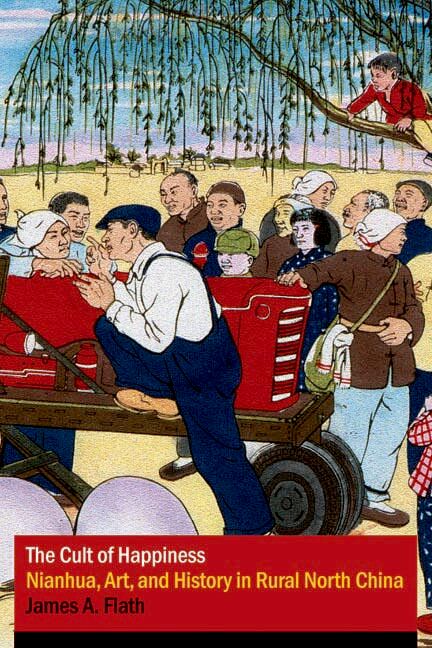
The Cult of Happiness
History and art come together in this definitive discussion of the Chinese woodblock print form of nianhua, literally “New Year pictures.” By analyzing the role of nianhua first in the home and later in commercial and political theatres, James Flath relates these artworks to the social, cultural, and political milieu of North China as it was between the late Qing dynasty and the early 1950s. Among the first studies in any field to treat folk art and folk print as historical text, The Cult of Happiness offers original insight into popular conceptions of domesticity, morality, gender, society, modernity, and the transformation of the genre as a propaganda tool under communism. An extraordinary account of the cultural life of rural North China over the period.
eBook