
Catalogue Search | MBRL


Are you sure you want to remove the book from the shelf?

{{itemTitle}}
241,844
result(s) for
"Habitat"
Sort by:

Nest, nook & cranny : poems
From tongue-in-cheek sonnets to lyrical free verse, Susan Blackaby's poems explore the many kinds of homes animals make for themselves.
Book


What do I see?
This question and answer book invites readers to explore the world around them. Repetitive text patterns and rhyme engage readers as they build fundamental literacy skills.
Book

The negative effects of habitat fragmentation operate at the scale of dispersal
Habitat loss is often considered the greatest near-term threat to biodiversity. Yet the impact of habitat fragmentation, or the change in habitat configuration for a given amount of habitat loss, has been intensely debated. We isolated effects of habitat loss from fragmentation on the demography, movement, and abundance of wild populations of a specialist herbivore, Chelinidea vittiger, by removing 2,088 patches across 15 landscapes. We compared fragmentation resulting from random loss, which is often considered in theory, to aggregated loss, which is often observed in the real world. When quantifying fragmentation caused by random vs. aggregated loss, aggregated loss led to less fragmented landscapes than random loss based on patch isolation, but more fragmented landscapes when based on isolation at a larger mesoscale scale defined by dispersal distances of C. vittiger. Overall, habitat loss decreased population size and demographic parameters, with thresholds occurring at approximately 70–80% patch loss. Synergistic effects also occurred, where an aggregated pattern of loss had negative effects at low, but not high, amounts of habitat loss. Effects on population size of C. vittiger were driven by reductions in movement and subsequent reproduction. The direction of habitat fragmentation effects from random and aggregated loss treatments, for a given habitat amount, was conflictingly positive or negative depending on the scale at which fragmentation was quantified. Fragmentation quantified at the scale of dispersal for this species best explained population size and highlighted that fragmentation had negative effects at a mesoscale. Our results emphasize the importance of quantifying habitat fragmentation at biologically appropriate scales.
Journal Article


Habitat quality, not habitat amount, drives mammalian habitat use in the Brazilian Pantanal
ContextAn understanding of species-habitat relationships is required to assess the impacts of habitat fragmentation and degradation. To date, habitat modeling in fragmented landscapes has relied on landscape composition and configuration metrics and the importance of habitat quality in determining species distributions has not been sufficiently explored.ObjectivesWe evaluated how habitat use by herbivores and frugivorous mammals is shaped by a potential interaction of habitat amount and quality in the Brazilian Pantanal wetland. We also assessed if the contribution of habitat quality to species´ habitat use varies according to the species sensitivity to habitat loss.MethodsWe combined mammal detection data obtained from camera traps with thematic maps to estimate the amount of habitat and measured habitat quality using local environment variables and distance to waterbodies. Specifically, we used a single-season occupancy approach to evaluate the relative support of univariate, additive, and interactive relationships between species-specific habitat use and measures of habitat quality and quantity.ResultsHabitat quality was more important than habitat amount in determining species habitat use (occupancy) in a naturally fragmented landscape. Habitat quality alone was the best predictor of habitat use for two of the six species (white lipped peccary and collared peccary), but no species’ habitat use was explained solely by habitat amount. Habitat amount was influential only when considered in conjunction with habitat quality covariates and only for two sensitive species to habitat loss (agouti and red brocket deer). Habitat quality alone was the best predictor of habitat use for two of the less sensitive species (white lipped peccary and collared peccary). Habitat use for two species was not explained by any covariate (tapir and gray brocket deer).ConclusionsConservation programs should incorporate both habitat quality and amount when dealing with sensitive species and prioritize habitat quality management when focusing in less sensitive species.
Journal Article

Why do spiders live in webs? : all about animal habitats
Describes the homes of favorite animals, from forest-dwelling bears to burrowing rabbits and presents the inspiring zoologists who study them.
Book
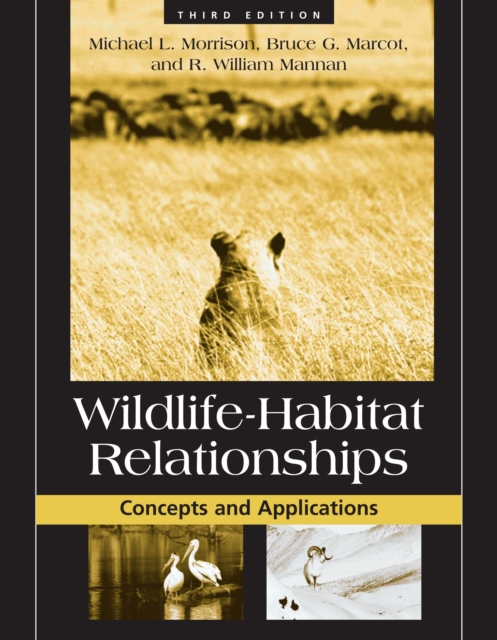
Wildlife-habitat relationships : concepts and applications
Wildlife-Habitat Relationships goes beyond introductory wildlife biology texts to provide wildlife professionals and students with an understanding of the importance of habitat relationships in studying and managing wildlife. The book offers a unique synthesis and critical evaluation of data, methods, and studies, along with specific guidance on how to conduct rigorous studies. Now in its third edition, Wildlife-Habitat Relationships combines basic field zoology and natural history, evolutionary biology, ecological theory, and quantitative tools in explaining ecological processes and their influence on wildlife and habitats. Also included is a glossary of terms that every wildlife professional should know.
eBook

Landscape experiments unlock relationships among habitat loss, fragmentation, and patch-size effects
Habitat loss is often considered the greatest near-term threat to biodiversity, while the impact of habitat fragmentation remains intensely debated. A key issue of this debate centers on the problem of scale–landscape or patch–at which to assess the consequences of fragmentation. Yet patterns are often confounded across scales, and experimental designs that could solve this scaling problem remain scarce. We conducted two field experiments in 30 experimental landscapes in which we manipulated habitat loss, fragmentation, and patch size for a community of four insect herbivores that specialize on the cactus Opuntia. In the first experiment, we destroyed 2088 Opuntia patches in either aggregated or random patterns and compared the relative effects of landscape-scale loss and fragmentation to those of local patch size on species occurrence. This experiment focused on manipulating the relative separation of remaining patches, where we hypothesized that aggregated loss would disrupt dispersal more than random loss, leading to lower occurrence. In the second experiment, we destroyed 759 Opuntia patches to generate landscapes that varied in patch number and size for a given amount of habitat loss and assessed species occurrence. This experiment focused on manipulating the subdivision of remaining habitat, where we hypothesized that an increase in the number of patches for a given amount of loss would lead to negative effects on occurrence. For both, we expected that occurrence would increase with patch size. We find strong evidence for landscape-scale effects of habitat fragmentation, with aggregated loss and a larger number of patches for a given amount of habitat loss leading to a lower frequency of patches occupied in landscapes. In both experiments, occurrence increased with patch size, yet interactions of patch size and landscape-scale loss and fragmentation drove species occurrence in patches. Importantly, the direction of effects were consistent across scales and effects of patch size were sufficient to predict the effects of habitat loss and fragmentation across entire landscapes. Our experimental results suggest that changes at both the patch and landscape scales can impact populations, but that a long-standing pattern—the patch-size effect—captures much of the key variation shaping patterns of species occurrence.
Journal Article