
Catalogue Search | MBRL


Are you sure you want to remove the book from the shelf?

{{itemTitle}}
27
result(s) for
"Haiti Colonization."
Sort by:

Three ancient colonies : Caribbean themes and variations
Mintz seeks to conjoin his knowledge of the history of Jamaica, Haiti, and Puerto Rico. 50 years later, the eminent scholar of the Caribbean returns to those experiences to meditate on the societies and on the island people who befriended him.
Book

Racial Equality and Anticolonial Solidarity: Anténor Firmin’s Global Haitian Liberalism
This article recovers Anténor Firmin’s contribution to anticolonial political thought by excavating his liberal worldmaking project of global racial equality and anticolonial solidarity. I assess Firmin’s contrast between “true” and “false” liberalism in Haiti, reconstructing his understanding of true Haitian liberalism as committed to the core ideas of historical progress, national regeneration, and rehabilitation of the Black race globally. I contextualize his Equality of the Human Races in metropolitan Paris during his first exile, arguing that his critique of anthropological racism should be seen as integral to his commitment to Haitian liberalism. I then situate his discussion of what he called “European Solidarity” in wider legitimating languages of French colonialism. This recovers Firmin’s neglected critique of colonialism as a reciprocal system of economic exploitation and discursive domination, and his attempt to rescue the universal ideal of solidarity from its truncated expression in languages of racial inequality and practices of colonization.
Journal Article

The Haitians
In this sweeping history, leading Haitian intellectual Jean Casimir
argues that the story of Haiti should not begin with the usual
image of Saint-Domingue as the richest colony of the eighteenth
century. Rather, it begins with a reconstruction of how individuals
from Africa, in the midst of the golden age of imperialism, created
a sovereign society based on political imagination and a radical
rejection of the colonial order, persisting even through the U.S.
occupation in 1915. The Haitians also critically
retheorizes the very nature of slavery, colonialism, and
sovereignty. Here, Casimir centers the perspectives of Haiti's
moun andeyo -the largely African-descended rural peasantry.
Asking how these systematically marginalized and silenced people
survived in the face of almost complete political
disenfranchisement, Casimir identifies what he calls a
counter-plantation system. Derived from Caribbean political and
cultural practices, the counter-plantation encompassed consistent
reliance on small-scale landholding. Casimir shows how
lakou , small plots of land often inhabited by generations
of the same family, were and continue to be sites of resistance
even in the face of structural disadvantages originating in
colonial times, some of which continue to be maintained by the
Haitian government with support from outside powers.
eBook

Haitian Reserve Army of Labor
Haiti has endured both natural and man-made violence since colonization, shaping its population into a global reserve army of labor for the world-system. This paper examines how historical and structural factors, including colonialism, political instability, and economic exploitation, have contributed to the creation of a vulnerable population appropriable as a cheap labor force. It explores how these factors, compounded by phenomenological violence—the internalization of oppression and fear—have led to widespread migration, positioning Haitians as a global reserve army of labor, particularly in industries like sugarcane production in the Dominican Republic. Through this lens, the paper highlights how migration, fueled by both environmental and systemic violence, has entrenched Haitians in labor markets worldwide.
Journal Article

Postcolonial disorders
The essays in this volume reflect on the nature of subjectivity in the diverse places where anthropologists work at the beginning of the twenty-first century. Contributors explore everyday modes of social and psychological experience, the constitution of the subject, and forms of subjection that shape the lives of Basque youth, Indonesian artists, members of nongovernmental HIV/AIDS programs in China and the Republic of Congo, psychiatrists and the mentally ill in Morocco and Ireland, and persons who have suffered trauma or been displaced by violence in the Middle East and in South and Southeast Asia.
eBook

From Spaniard to Creole : the archaeology of cultural formation at Puerto Real, Haiti
While most studies of intercultural contact focus on the impact of the intrusive power on the native culture, this book examines the effects of the colonization process on the Spaniards in the New World during the 16th century. The site of Puerto Real on the north coast of Haiti serves as a case study. Based on the results of excavations at both Puerto Real and St. Augustine, Florida, this study suggests that the introduction of New World and African cultural elements into Spanish colonial culture began almost at contact. The model of acculturative processes, developed in St. Augustine and tested at Puerto Real, can serve to guide future Spanish colonial research. It can also be applied to non-Hispanic colonial sites in the New World. Did the French and British adapt to their new environments in a manner similar to the Spanish? Work done at Puerto Real demonstrates the utility of archaeology in the study of the effects of culture contact.
eBook
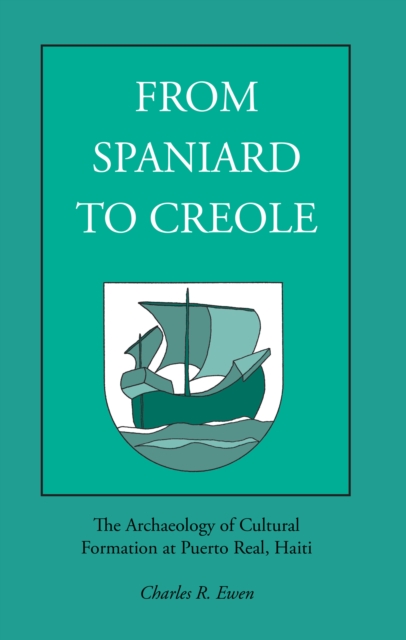
From Spaniard to Creole
While most studies of intercultural contact focus on the
impact of the intrusive power on the native culture, this book
examines the effects of the colonization process on the
Spaniards in the New World during the 16th century. The site of
Puerto Real on the north coast of Haiti serves as a case study.
Based on the results of excavations at both Puerto Real and St.
Augustine, Florida, this study suggests that the introduction
of New World and African cultural elements into Spanish
colonial culture began almost at contact. The model of
acculturative processes, developed in St. Augustine and tested
at Puerto Real, can serve to guide future Spanish colonial
research. It can also be applied to non-Hispanic colonial sites
in the New World. Did the French and British adapt to their new
environments in a manner similar to the Spanish? Work done at
Puerto Real demonstrates the utility of archaeology in the
study of the effects of culture contact.
eBook

“Go to our brethren, the Haytians”: Haiti as the African Americans’ Promised Land in the Antebellum Era
In the antebellum era, although some prominent African American leaders were firmly opposed to emigration and vocally denounced the American Colonization Society and its African project, others did advocate relocation to different and closer places. This article examines the genesis and the rise of the “Haitian propaganda” that climaxed in the 1850s, and ultimately culminated in the actual emigration of several thousand African Americans to Haiti between 1859 and 1862. Dans la première moitié du xixe siècle, alors que la plupart des Africains-Américains dénonçaient haut et fort les projets de colonisation de l’Afrique portés par l’American Colonization Society, un certain nombre de voix osèrent s’élever en faveur d’une émigration choisie vers des territoires géographiquement plus proches. Cet article examine la genèse et l’évolution de la « propagande haïtienne » portée par certains de ces émigrationnistes, qui culmina dans les années 1850 et aboutit à l’émigration concrète de plusieurs milliers de Noirs libres et émancipés en Haïti entre 1859 et 1862.
Journal Article

Citizenship and colonialism
This article interrogates some of the faultlines in liberal thinking on citizenship, unpicking the historical traces that remain embedded in dominant assumptions. Citizenship has been used in the past, and still is today, as a tool of colonisation, and this has implications for the
way we understand citizenship and statelessness. The argument is explored through a number of examples, including the treatment of the Haudenosaunee, or Iroquois, lacrosse team in 2010, when some of the world's greatest lacrosse players forfeited their place in the world championship because
they rejected a colonial citizenship; the position of aboriginal people in Australia; the ideas of John Locke and their continuing influence within liberalism; and the relationship between the French revolution and Saint Domingue (now Haiti). Many assumptions from the period when ideas of
citizenship were developing remain in play today, particularly the notion of birthright - citizenship as a right limited to those who have inherited it at birth. Today the possession of a functioning citizenship is crucial for access to the internal institutions of a state, or to the
system of states, as is evident in the plight of those who lack any functioning citizenship - those who are called 'stateless'. Ensuring that every person has access to a citizenship that is appropriate to them must therefore be part of our joint global response to the reality of statelessness.
But it is also crucial to examine why citizenship holds the power that it does, and to critique the need for a recognised citizenship in order for persons to find access to rights.
Journal Article

A Vain Fascination: Writing from and about Haiti after the Earthquake
In the wake of the huge earthquake that struck Haiti on 12 January 2010, Haiti instantly became the focus of media attention across the world. At that moment, the tropes that had imprisoned Haiti for two centuries (barbarism, savagery, vodou, the land-that-God-forgot, etc.) began to resurface. Some Haitian intellectuals sought to combat those images, but in so doing they inadvertently revealed their complicity not only in the negative discursive construction of their country, but also in the economic and military re-colonisation of Haiti over the last decade. Adept in the fabrication of replicas of 'post-political' discourse, These Haitian intellectuals are in reality a subset of that country's morally bankrupt political class.
Journal Article