
Catalogue Search | MBRL


Are you sure you want to remove the book from the shelf?

{{itemTitle}}
142
result(s) for
"Halifax, Earl"
Sort by:


Conservative Politics in National and Imperial Crisis
Whilst serving in the prestigious post of Viceroy of India between 1926 and 1931, Lord Irwin (later the Earl of Halifax) was kept informed about political events in Britain by frequent and lengthy letters from Cabinet Ministers, senior Conservative MPs and other prominent figures, such as the editor of The Times. Covering events from the General Strike of May 1926 to Irwin's negotiation of a pact with Gandhi in March 1931, these private and previously unpublished letters mix analysis and gossip. They offer a frank account from within the highest political circles of the Baldwin government of 1924-29 and the serious crisis in the Conservative Party which followed in 1929-31. There is also much commentary on major figures such as Stanley Baldwin, Neville Chamberlain, Winston Churchill and Ramsay MacDonald. Of great depth and richness, and emanating from experienced and shrewd political insiders, this collection is an essential historical source for British history between the two world wars.
eBook

John Mitchell's Map of North America (1755): A Study of the Use and Publication of Official Maps in Eighteenth-Century Britain
John Mitchell's famous map of North America stands as an archetype of the official publication of maps in eighteenth-century Britain. It was, however, the product of a special effort by the Earl of Halifax, president of the Board of Trade, who sought to advance his own aggressive agenda with respect to the British empire in North America in the run-up to the Seven Years' War (1756-1763, known in North America as the French and Indian War, 1755-1760), to persuade his ministerial colleagues both directly through negotiation and indirectly by manipulating public opinion. This re-evaluation of Mitchell's work concludes that its archetypal status is unwarranted. The practices that were developed by administrators in London and the colonies for commissioning, using and circulating regional maps are examined. A distinction is made between the use by officials of printed maps as sources for general geographical knowledge and of manuscript maps for knowledge specific to certain administrative issues. Then the origins of Mitchell's map are re-examined. The conclusion reached is that the map is truly innovative: it was the result of a uniquely successful solicitation of information from the colonies and its publication broke with the established patterns of map circulation and consumption.
Journal Article
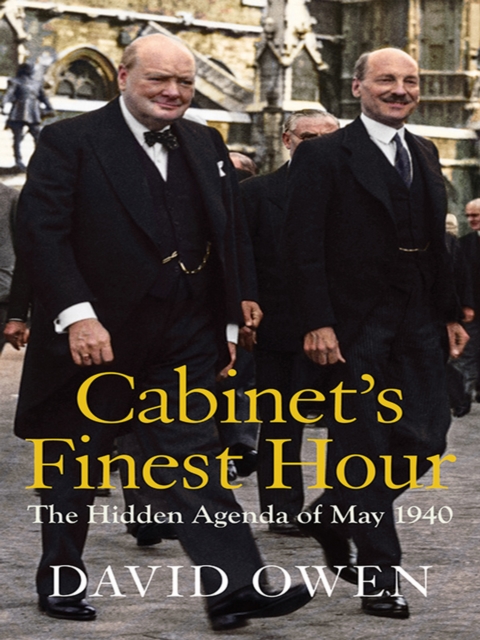
Cabinet's Finest Hour
In May 1940, the British War Cabinet debated over the course of nine meetings a simple question: Should Britain fight on in the face of overwhelming odds, sacrificing hundreds of thousands of lives, or seek a negotiated peace? Using Cabinet papers from the United Kingdom's National Archives, David Owen illuminates in fascinating detail this little-known, yet pivotal, chapter in the history of World War II.
Eight months into the war, defeat seemed to many a certainty. With the United States still a year and half away from entering, Britain found itself in a perilous position, and foreign secretary Lord Halifax pushed prime minister Winston Churchill to explore the possibility of a negotiated peace with Hitler, using Mussolini as a conduit. Speaking for England is the story of Churchill's triumph in the face of this pressure, but it is also about how collective debate and discussion won the day—had Churchill been alone, Owen argues, he would almost certainly have lost to Halifax, changing the course of history. Instead, the Cabinet system, all too often disparaged as messy and cumbersome, worked in Britain's interests and ensured that a democracy on the brink of defeat had the courage to fight on.
eBook
Mr. Bevin to Mr. Balfour (Washington)
Instructs him to discuss Soviet-Danubian trade agreements with State Dept. Note 1: Also sent to Paris
Government Document
British Missions (Washington) to Cabinet Offices (Received 5 December, 6.5 a.m.)
Lord Halifax to Mr. Attlee and Mr. Bevin: although concessions were not secured, considers rupture of negotiations would be damaging
Government Document
The Earl of Halifax (Washington) to Mr. Bevin (Received 1 March, 4.15 a.m.) No. 1301 Telegraphic AN 3932/101/45
Talks in Washington on Pacific bases agreed by Mr. Byrnes who also sought bases in India. Calendars: i-ii
Government Document
Mr. Bevin to the Earl of Halifax (Washington) No. 1187 Telegraphic W 1354/2/802
Instructions to inform State Dept. that Air Transport Agreement is largely acceptable but difficulties arise on Leased Bases. Calendars: i-iii
Government Document