
Catalogue Search | MBRL


Are you sure you want to remove the book from the shelf?

{{itemTitle}}
9
result(s) for
"Hamilton, Alexander, 1757-1804 Political and social views."
Sort by:

The essential Hamilton : letters & other writings : America's most controversial founder--in his own words
\"A brash immigrant who rose to become George Washington's right-hand man. A fierce partisan whose nationalist vision made him Thomas Jefferson's bitter rival. An unfaithful husband whose commitment to personal honor brought his life to a tragic early end. The amazing success of Lin-Manuel Miranda's musical Hamilton has stoked an extraordinary resurgence of interest in Alexander Hamilton, the brilliant and divisive founder who profoundly shaped the American republic. Now, Library of America presents an unrivaled portrait of Hamilton in his own words, charting his meteoric rise, his controversial tenure as treasury secretary, and his scandalous final years, culminating in his infamous duel with Aaron Burr. Selected and introduced by acclaimed historian Joanne B. Freeman, here is a reader's edition of Hamilton's essential public writings and private letters, plus the correspondence between Burr and Hamilton that led to their duel and two conflicting eyewitness accounts of their fatal encounter.\"--Back cover.
BOOK


Publius and political imagination
Jason Frank’s Publius and Political Imagination is the first volume of the Modernity and Political Thought series to take as its focus not a single author, but collaboration between political thinkers, in this very special case the collective known by the pseudonym: Publius. Frank's revisionist reading of The Federalist Papers—perhaps the most canonical text in American political thought—counters familiar realist and deliberativist interpretations and demonstrates the neglected importance of political imagination to both Publius's arguments and to the republic he was invented to found.
eBook

Alexander Hamilton's public administration
\"Hamilton's Public Administration deals with Hamilton as both a founder of the American republic, steeped in the currents of political philosophy and science of his day, and as its chief administrative theorist and craftsman, deeply involved in establishing the early institutions and policies that would bring his interpretation of the written Constitution to life. Accordingly, this book addresses (1) the complex mix of classical and modern ideas which informed his vision of a modern commercial and administrative republic, (2) the administrative ideas, institutions and practices which flowed from that vision, and (3) the substantive policies he deemed essential to its realization. The analysis flows from immersion in his extant papers (reports, letters, pamphlets, and essays running to thirty-one volumes in total) and many thematic and biographical works on his life. It aims to provide a comprehensive explanation of his theoretical contributions, and a richly detailed account of his ideas and practices in historical context\"-- Provided by publisher.
BOOK
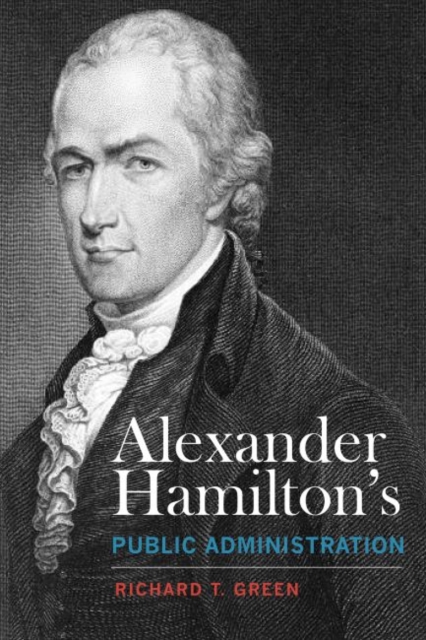
Alexander Hamilton's Public Administration
Examines how Hamilton’s thoughts and experiences
about public administration theory and practice have shaped the
nation American public administration inherited from
Alexander Hamilton a distinct republican framework through which
we derive many of our modern governing standards and practices.
His administrative theory flowed from his republican vision,
prescribing not only the how of administration but also what
should be done and why. Administration and policy merged
seamlessly in his mind, each conditioning the other. His
Anti-Federalist detractors clearly saw this and fought his vision
tooth and nail. That conflict endures to this day because
Americans still have not settled on just one vision of the
American republic. That is why, Richard Green argues, Hamilton is
a pivotal figure in our current reckoning. If we want to more
fully understand ourselves and our ways of governing today, we
must start by understanding Hamilton, and we cannot do that
without exploring his administrative theory and practice in depth
.
Alexander Hamilton’s Public Administration
considers Hamilton both as a founder of the American republic,
steeped in the currents of political philosophy and science of
his day, and as its chief administrative theorist and craftsman,
deeply involved in establishing the early institutions and
policies that would bring his interpretation of the written
Constitution to life. Accordingly, this book addresses the
complex mix of classical and modern ideas that informed his
vision of a modern commercial and administrative republic; the
administrative ideas, institutions, and practices that flowed
from that vision; and the substantive policies he deemed
essential to its realization. Green’s analysis grows out of
an immersion in Hamilton’s extant papers, including
reports, letters, pamphlets, and essays. Readers will find a
comprehensive explanation of his theoretical contributions and a
richly detailed account of his ideas and practices in historical
context.
eBook


Power versus Liberty
Does every increase in the power of government entail a loss of liberty for the people? James H. Read examines how four key Founders--James Madison, Alexander Hamilton, James Wilson, and Thomas Jefferson--wrestled with this question during the first two decades of the American Republic.
Power versus Liberty reconstructs a four-way conversation--sometimes respectful, sometimes shrill--that touched on the most important issues facing the new nation: the Constitution, the Bill of Rights, federal authority versus states' rights, freedom of the press, the controversial Bank of the United States, the relation between nationalism and democracy, and the elusive meaning of \"the consent of the governed.\"
Each of the men whose thought Read considers differed on these key questions. Jefferson believed that every increase in the power of government came at the expense of liberty: energetic governments, he insisted, are always oppressive. Madison believed that this view was too simple, that liberty can be threatened either by too much or too little governmental power. Hamilton and Wilson likewise rejected the Jeffersonian view of power and liberty but disagreed with Madison and with each other.
The question of how to reconcile energetic government with the liberty of citizens is as timely today as it was in the first decades of the Republic. It pervades our political discourse and colors our readings of events from the confrontation at Waco to the Oklahoma City bombing to Congressional debate over how to spend the government surplus. While the rhetoric of both major political parties seems to posit a direct relationship between the size of our government and the scope of our political freedoms, the debates of Madison, Hamilton, Wilson, and Jefferson confound such simple dichotomies. As Read concludes, the relation between power and liberty is inherently complex.
eBook
