
Catalogue Search | MBRL


Are you sure you want to remove the book from the shelf?

{{itemTitle}}
672
result(s) for
"Han dynasty"
Sort by:


Savage Exchange
Savage Exchange explores the politics of representation during the Han dynasty (206 BCE-220 CE) at a pivotal moment when China was asserting imperialist power on the Eurasian continent and expanding its local and long-distance (\"Silk Road\") markets. Tamara T. Chin explains why rival political groups introduced new literary forms with which to represent these expanded markets. To promote a radically quantitative approach to the market, some thinkers developed innovative forms of fiction and genre. In opposition, traditionalists reasserted the authority of classical texts and advocated a return to the historical, ethics-centered, marriage-based, agricultural economy that these texts described. The discussion of frontiers and markets thus became part of a larger debate over the relationship between the world and the written word. These Han debates helped to shape the ways in which we now define and appreciate early Chinese literature and produced the foundational texts of Chinese economic thought. Each chapter in the book examines a key genre or symbolic practice (philosophy, fu-rhapsody, historiography, money, kinship) through which different groups sought to reshape the political economy. By juxtaposing well-known texts with recently excavated literary and visual materials, Chin elaborates a new literary and cultural approach to Chinese economic thought. Co-Winner, 2016 Harry Levin Prize, American Comparative Literature Association; Honorable Mention, 2016 Joseph Levenson Book Prize, Pre-1900 Category, China and Inner Asia Council of the Association for Asian Studies.
eBook

The culture of the Qin and Han dynasties of China
\"The dynasties of ancient China ruled the country for centuries. The contributions of the leaders and people of this time have a legacy that can still be seen in Chinese culture today. This title begins with background information on China before the Qin conquest and ends with the end of the Han Dynasty in AD 220. Readers learn about life in Chinese cities and the countryside, as well as important social studies topics such as religion, class structure, education, family life, food, and clothing. By the end of this title, readers will understand how cultural life in Han China set a pattern that is still seen today.\"-- Provided by publisher.
Book

“Sirens” in the East: Human-Headed Birds on Han Pictorial Stones and Their Transregional Connections
Human-headed birds, a recurrent yet understudied motif on Han dynasty pictorial stones, are examined in this study with a focus on their mythical representations. Placed within visualisation of the world of the Queen Mother of the West, a belief popular in the Han Dynasty, these figures are argued to depict the Blue Birds (Qingniao) of Han mythology. Moreover, a distinct variation in the Shandong region shows a human-headed bird offering Jiahe, an auspicious plant, symbolising immortality and well-being in tomb art. Through a chaîne opératoire analysis, the paper traces their creation as a composite form, integrating familiar Han bird imagery—particularly owls—with Greco-Roman Siren elements transmitted along the Silk Road. The regional clustering of such depictions in zones of early cross-cultural contact underscores the role of external influences in shaping Han visual traditions. This study highlights how mythological beings were adapted amid shifting religious ideas and transregional interactions in early imperial China.
Journal Article


The earliest evidence of pattern looms: Han Dynasty tomb models from Chengdu, China
Excavation of the Han Dynasty chambered tomb at Laoguanshan in Chengdu, south-west China, has provided the earliest known evidence of pattern loom technology. Four model looms, along with accompanying artefacts and figurines relating to the weaving process, give insight into the technique of jin silk production. The discovery is hugely significant as it provides the first direct evidence of pattern-weave textile production in ancient China. Jin silk, made using this method, was both valuable and widely distributed, and the design of the machine influenced the invention of later looms and the spread of technology throughout Eurasia and Europe, representing great technological accomplishment for the second century BC.
Journal Article

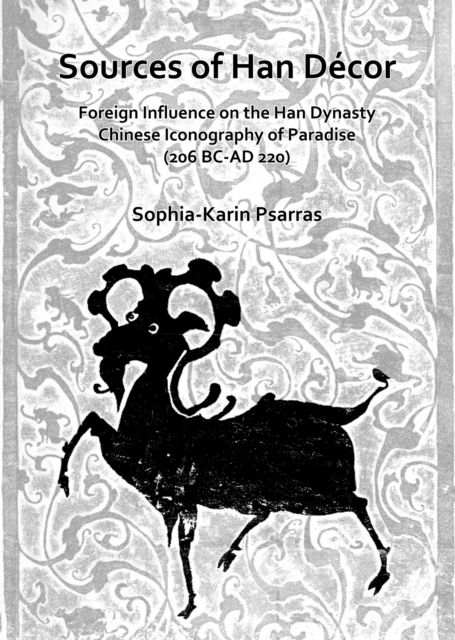
Sources of Han Décor
Using archaeological data to examine the development of Han dynasty Chinese art (206 BC-AD 220), Sources of Han Décor focusses on three major iconographies (the animal master, the tree of life, and animal predation), together with a series of minor motifs (particularly the griffin and a number of vegetal forms). All of these are combined in what may be considered the most important iconographic creation of the Han: images of paradise. While influence from the Chinese Bronze Age (especially, c. the 14th-3rd centuries BC) on Han art is expected, a surprisingly profound debt to Greece, the Near East, and the steppe is evident not only in the art of the Han era, but in that of the preceding Eastern Zhou (c. 771-221 BC). Initial Eastern Zhou incorporation of this largely-Western influence appears concentrated in chronological parallel to the Orientalization of Greek art (c. the 7th century BC) and the eastern spread of Hellenism (c. the 4th century BC), followed by repeated introduction of foreign motifs during the Han, when these influences were fully integrated into Chinese art.
eBook


These Bones Shall Rise Again
These Bones Shall Rise Again, brings together in one
volume many of David N. Keightley's seminal essays on the origins
of early Chinese civilization. Written over a period of three
decades and accessible to the non-specialist, these essays provide
a wealth of information and insights on the Shang dynasty,
traditionally dated 1766-1122 or 1056 BCE. Of all the eras of
Chinese history, the Shang has been a particularly elusive one,
long considered more myth than reality. A historian with a keen
appreciation for anthropology and archaeology, Keightley has given
us many descriptions of Shang life. Best known for his analysis of
oracle bones, he has looked beyond the bones themselves and
expanded his historical vision to ponder the lives of those who
used them. What did the Shang diviner think he was doing? The
temerity to ask such questions and the insights they have provided
have been provocative and, at times, controversial. Equally
intriguing have been Keightley's assertions that many of the
distinctive features of Chinese civilization were already in
evidence during the Shang, 3000 years ago. In this collection,
readers will find not only an essential reference but also the best
kind of thought-provoking scholarship.
eBook