
Catalogue Search | MBRL


Are you sure you want to remove the book from the shelf?

{{itemTitle}}
36
result(s) for
"Han dynasty, 202 B.C.-220 A.D"
Sort by:


Problems of Han Administration
China's early emperors must pay their respects to their predecessors in the correct form; the conduct of government and commercial practice depended on a generally accepted system of weights and measures; critics needed a secure means of expressing their views.
eBook

The culture of the Qin and Han dynasties of China
\"The dynasties of ancient China ruled the country for centuries. The contributions of the leaders and people of this time have a legacy that can still be seen in Chinese culture today. This title begins with background information on China before the Qin conquest and ends with the end of the Han Dynasty in AD 220. Readers learn about life in Chinese cities and the countryside, as well as important social studies topics such as religion, class structure, education, family life, food, and clothing. By the end of this title, readers will understand how cultural life in Han China set a pattern that is still seen today.\"-- Provided by publisher.
Book
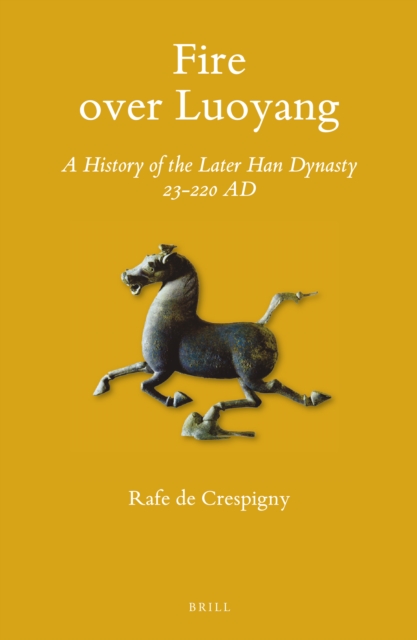
Fire over Luoyang
Rafe de Crespigny provides the first account in a Western language of one of the great dynasties of China, which dominated east Asia but collapsed in dramatic fashion at the end of the second century AD.
eBook


Savage Exchange
Savage Exchange explores the politics of representation during the Han dynasty (206 BCE-220 CE) at a pivotal moment when China was asserting imperialist power on the Eurasian continent and expanding its local and long-distance (\"Silk Road\") markets. Tamara T. Chin explains why rival political groups introduced new literary forms with which to represent these expanded markets. To promote a radically quantitative approach to the market, some thinkers developed innovative forms of fiction and genre. In opposition, traditionalists reasserted the authority of classical texts and advocated a return to the historical, ethics-centered, marriage-based, agricultural economy that these texts described. The discussion of frontiers and markets thus became part of a larger debate over the relationship between the world and the written word. These Han debates helped to shape the ways in which we now define and appreciate early Chinese literature and produced the foundational texts of Chinese economic thought. Each chapter in the book examines a key genre or symbolic practice (philosophy, fu-rhapsody, historiography, money, kinship) through which different groups sought to reshape the political economy. By juxtaposing well-known texts with recently excavated literary and visual materials, Chin elaborates a new literary and cultural approach to Chinese economic thought. Co-Winner, 2016 Harry Levin Prize, American Comparative Literature Association; Honorable Mention, 2016 Joseph Levenson Book Prize, Pre-1900 Category, China and Inner Asia Council of the Association for Asian Studies.
eBook

Facing the monarch : modes of advice in the early Chinese court
\"Focused on the era between the Spring and Autumn period and the latter Han dynasty, this volume investigates the dynamics between early Chinese ministers and monarchs at a time when ministers employed manifold innovative rhetorical tactics by analyzing discrete excerpts from classical Chinese works\"--Provided by publisher.
Book

Public Memory in Early China
In early imperial China, the dead were remembered by stereotyping them, by relating them to the existing public memory and not by vaunting what made each person individually distinct and extraordinary in his or her lifetime. Their posthumous names were chosen from a limited predetermined pool; their descriptors were derived from set phrases in the classical tradition; and their identities were explicitly categorized as being like this cultural hero or that sage official in antiquity. In other words, postmortem remembrance was a process of pouring new ancestors into prefabricated molds or stamping them with rigid cookie cutters. Public Memory in Early China is an examination of this pouring and stamping process. After surveying ways in which learning in the early imperial period relied upon memorization and recitation, K. E. Brashier treats three definitive parameters of identity—name, age, and kinship—as ways of negotiating a person’s relative position within the collective consciousness. He then examines both the tangible and intangible media responsible for keeping that defined identity welded into the infrastructure of Han public memory.
eBook

Day of the Dragon King
The magic treehouse takes Jack and Annie back two thousand years to ancient China where they must find the original copy of an old legend before the Imperial Library is burned down by the evil Dragon King.
Book

Rewriting Early Chinese Texts
Rewriting Early Chinese Texts examines the problems of reconstituting and editing ancient manuscripts that will revise—indeed \"rewrite\"—Chinese history. It is now generally recognized that the extensive archaeological discoveries made in China over the last three decades necessitate such a rewriting and will keep an army of scholars busy for years to come. However, this is by no means the first time China's historical record has needed rewriting. In this book, author Edward L. Shaughnessy explores the issues involved in editing manuscripts, rewriting them, both today and in the past.
The book begins with a discussion of the difficulties encountered by modern archaeologists and paleographers working with manuscripts discovered in ancient tombs. The challenges are considerable: these texts are usually written in archaic script on bamboo strips and are typically fragmentary and in disarray. It is not surprising that their new editions often meet with criticism from other scholars. Shaughnessy then moves back in time to consider efforts to reconstitute similar bamboo-strip manuscripts found in the late third century in a tomb in Jixian, Henan. He shows that editors at the time encountered many of the same difficulties faced by modern archaeologists and paleographers, and that the first editions produced by a court-appointed team of editors quickly prompted criticism from other scholars of the time. Shaughnessy concludes with a detailed study of the editing of one of these texts, the Bamboo Annals (Zhushu jinian), arguably the most important manuscript ever discovered in China. Showing how at least two different, competing editions of this text were produced by different editors, and how the differences between them led later scholars to regard the original edition—the only one still extant—as a forgery, Shaughnessy argues for this text's place in the rewriting of early Chinese history.
eBook