
Catalogue Search | MBRL


Are you sure you want to remove the book from the shelf?

{{itemTitle}}
20
result(s) for
"Hannibal, 247 B.C.-182 B.C."
Sort by:

Hannibal : a Hellenistic life
\"Hannibal lived a life of incredible feats of daring and survival, massive military engagements, and ultimate defeat. A citizen of Carthage and military commander in Punic Spain, he famously marched his war elephants and huge army over the Alps into Rome's own heartland to fight the Second Punic War. Yet the Romans were the ultimate victors. They eventually captured and destroyed Carthage, and thus it was they who wrote the legend of Hannibal: a brilliant and worthy enemy whose defeat represented military glory for Rome. In this groundbreaking biography Eve MacDonald expands the memory of Hannibal beyond his military feats and tactics. She considers him in the wider context of the society and vibrant culture of Carthage which shaped him and his family, employing archaeological findings and documentary sources not only from Rome but also the wider Mediterranean world of the third century B.C. MacDonald also analyzes Hannibal's legend over the millennia, exploring how statuary, Jacobean tragedy, opera, nineteenth-century fiction, and other depictions illuminate the character of one of the most fascinating military personalities in all of history\"-- Provided by publisher.
Book

Valorizing the Barbarians : enemy speeches in Roman historiography
Comparing and contrasting speeches attributed to barbarian leaders by ancient Roman historians, this book offers a systematic examination of the ways in which those historians valorized foreigners and presented criticisms of their own society.
eBook


Hannibal's Odyssey
Hannibal's invasion of Italia in 218 BC is depicted from the standpoint of environmental evidence elicited from ancient texts, and analyzed against present-day Earth Science databases. The conclusion is that the Punic Army followed the southern route over the Alps; a proposal first made by Sir Gavin de Beer in the 1960's.
eBook
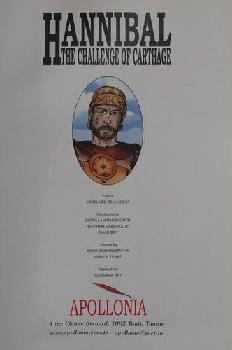
Hannibal : the challenge of Carthage
A history of the campaigns of the military genius who vowed to conquer the Romans and who entered Italy by crossing the Alps on elephants.

Hannibal's Dynasty
Accessible and enlightening, Hannibal's Dynasty provides the full story of Carthage's achievement, going beyond the usual focus on Hannibal and military matters alone to look at a wide range of political and diplomatic issues too.
Dexter Hoyos shows how the aristocratic Barcid family won dominance in the free republic of Carthage, and how they exploited family connections to lead Carthage to greatness at home and abroad.
For students of Hannibal, his dynasty and his legacy - this is the book to read.
eBook


War with Hannibal
This edition of Book III of Eutropiuss Breviarium ab urbe condita is designed to be a students first encounter with authentic, unabridged Latin prose. Written in a simple and direct style, the Breviarium covers the period of Roman history that students find the most interestingthe Second Punic War fought against Carthageand the original Latin text is supplemented with considerable learning support. Full annotations on every page, detailed commentary on grammar and syntax, and a glossary designed specifically for the text allow students to build both their confidence and their reading skills.The commentary in the back of the book is cross-referenced to the following commonly used textbooks:Wheelocks Latin, 6th EditionLatin: An Intensive Course by Moreland and FleischerEcce Romani II, 3rd EditionLatin for Americans, Level 2Jenneys Second Year LatinAllen and Greenoughs New Latin GrammarMacrons have been added to the entire text in accordance with the vowel quantities used in the Oxford Latin Dictionary. Additional resources include an unannotated version of the text for classroom use, supplementary passages in English from other ancient authors, and appendixes with a timeline of events and maps and battle plans.The text may be used in secondary schools and colleges as early as the first year of study. The copious translation help, notes, and cross-references also make it ideal for independent learners.
eBook