
Catalogue Search | MBRL


Are you sure you want to remove the book from the shelf?

{{itemTitle}}
8,664
result(s) for
"Happiness Research."
Sort by:


The Politics of Happiness
During the past forty years, thousands of studies have been carried out on the subject of happiness. Some have explored the levels of happiness or dissatisfaction associated with typical daily activities, such as working, seeing friends, or doing household chores. Others have tried to determine the extent to which income, family, religion, and other factors are associated with the satisfaction people feel about their lives. The Gallup organization has begun conducting global surveys of happiness, and several countries are considering publishing periodic reports on the growth or decline of happiness among their people. One nation, tiny Bhutan, has actually made \"Gross National Happiness\" the central aim of its domestic policy. How might happiness research affect government policy in the United States--and beyond? In The Politics of Happiness, former Harvard president Derek Bok examines how governments could use the rapidly growing research data on what makes people happy--in a variety of policy areas to increase well-being and improve the quality of life for all their citizens.
eBook


Independent by necessity? The life satisfaction of necessity and opportunity entrepreneurs in 70 countries
The relationship between self-employment and subjective well-being (SWB) is contingent on the heterogeneity observed among entrepreneurs. We argue that independence and job control, two commonly suggested sources of entrepreneurs’ higher SWB, are likely to disproportionately benefit opportunity entrepreneurs who were pulled into their occupation choice. A review of the psychological literature on the determinants of well-being further supports the view that more dynamic and impactful entrepreneurship should lead to higher SWB. Analysis of Global Entrepreneurship Monitor data from 70 countries (N = 111,589) confirm this proposition. We show that entrepreneurs, all else equal, rate their life satisfaction substantially higher than employees and, further, that this effect is entirely driven by opportunity entrepreneurs.
Journal Article


Analysis of Factors Influencing Happiness Level Using the MLP Neural Network Analysis Method: The Case of Korea
The aim of this study is to analyse the factors affecting the overall happiness level of Korean residents using neural network analysis, and to identify the resultant theoretical and policy implications. The analysis data for this study consist of survey data collected in 2020 by the Community Well-Being Research Center at Seoul National University Graduate School of Public Administration in Korea; the number of respondents was 16,555. The study employed the Multi-Layer Perceptron (MLP) method, one of the neural network analysis methods. It was found that the most important factor affecting the happiness of Korean residents was their own level of awareness of their social status. The next important was satisfaction with the level of infrastructure relating to their local living environment, the third most important being their level of awareness of their own income level. The study strongly suggests that awareness of the social status of local residents should be reflected in future happiness research and the establishment of happiness-related policies. It also suggests the need to apply new research methods, including neural network analysis, given that big data analysis has proven insufficient in happiness research. In the future, thanks to the development of artificial intelligence, the use of big data analysis methods will become more desirable in providing programmes for improving happiness levels tailored to individual situations.
Journal Article

The good life : lessons from the world's longest scientific study of happiness
What makes a life fulfilling and meaningful? The simple but surprising answer is: relationships. The stronger our relationships, the more likely we are to live happy, satisfying, and overall healthier lives. In fact, the Harvard Study of Adult Development reveals that the strength of our connections with others can predict the health of both our bodies and our brains as we go through life. The invaluable insights in this book emerge from the revealing personal stories of hundreds of participants in the Harvard Study as they were followed year after year for their entire adult lives, and this wisdom is bolstered by research findings from this and many other studies. Relationships in all their forms--friendships, romantic partnerships, families, coworkers, tennis partners, book club members, Bible study groups--all contribute to a happier, healthier life. And as The Good Life shows us, it's never too late to strengthen the relationships you have, and never too late to build new ones. Dr. Waldinger's TED Talk about the Harvard Study, \"What Makes a Good Life,\" has been viewed more than 42 million times and is one of the ten most-watched TED talks ever. The Good Life has been praised by bestselling authors Jay Shetty (\"Robert Waldinger and Marc Schulz lead us on an empowering quest towards our greatest need: meaningful human connection\"), Angela Duckworth (\"In a crowded field of life advice and even life advice based on scientific research, Schulz and Waldinger stand apart\"), and happiness expert Laurie Santos (\"Waldinger and Schulz are world experts on the counterintuitive things that make life meaningful\"). With warmth, wisdom, and compelling life stories, The Good Life shows us how we can make our lives happier and more meaningful through our connections to others.
Book
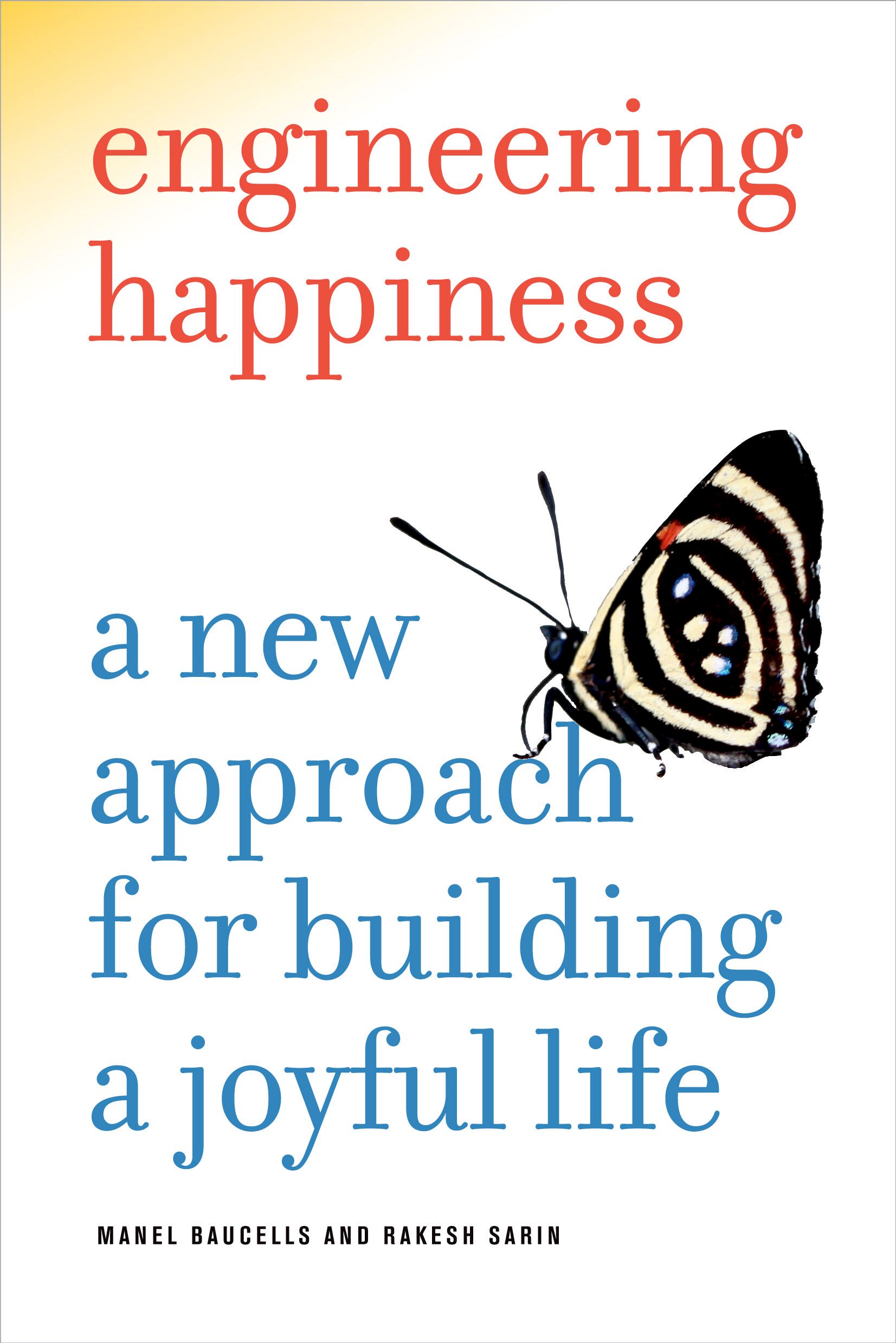
Engineering Happiness
Manel Baucells and Rakesh Sarin have been conducting ground-breaking research on happiness for more than a decade, and in this book they distill their provocative findings into a lively, accessible guide for a wide audience of readers. Integrating their own research with the latest thinking in the behavioral and social sciences—including management science, psychology, and economics—they offer a new approach to the puzzle of happiness. Woven throughout with wisdom from the world’s religions and literatures, Engineering Happiness has something to offer everyone—regardless of background, profession, or aspiration—who wants to better understand, control, and attain a more joyful life.• Shows how a few major principles can explain how happiness works and why it is so elusive• Demonstrates how the essence of attaining happiness is choice• Explores how to avoid happiness traps• Tells how to recognize happiness triggers in everyday life
eBook

Happiness Research: State and Prospects
This paper intends to provide an evaluation of where the economic research on happiness stands and in which interesting directions it might develop. First, the current state of the research on happiness in economics is briefly discussed. We emphasize the potential of happiness research in testing competing theories of individual behavior. Second, the crucial issue of causality is taken up illustrating it for a particular case, namely whether marriage makes people happy or whether happy people get married. Third, happiness research is taken up as a new approach to measuring utility in the context of cost-benefit analysis.
Journal Article

Societal QOL is More than the Sum of QOL of Individuals: The Whole is Greater than the Sum of the Parts
I submit that we are too focused on individual-level happiness research at the expense of societal level QOL research. That is, societal QOL cannot be simply treated as the sum of the happiness of individual citizens. In making this assertion I review and discuss Abott Ferris’ latest book:
Approaches to Improving the Quality of Life
(published by Springer, 2010).
Journal Article