
Catalogue Search | MBRL


Are you sure you want to remove the book from the shelf?

{{itemTitle}}
2,262
result(s) for
"Harbors History."
Sort by:

China’s Foreign Places
During the nineteenth and early twentieth centuries, the imperial powers—principally Britain, the United States, Russia, France, Germany and Japan—signed treaties with China to secure trading, residence and other rights in cities on the coast, along important rivers, and in remote places further inland. The largest of them—the great treaty ports of Shanghai and Tientsin—became modern cities of international importance, centres of cultural exchange and safe havens for Chinese who sought to subvert the Qing government. They are also lasting symbols of the uninvited and often violent incursions by foreign powers during China’s century of weakness. The extraterritorial privileges that underpinned the treaty ports were abolished in 1943—a time when much of the treaty port world was under Japanese occupation. China’s Foreign Places provides a historical account of the hundred or more major foreign settlements that appeared in China during the period 1840 to 1943. Most of the entries are about treaty ports, large and small, but the book also includes colonies, leased territories, resorts and illicit centres of trade. Information has been drawn from a wide range of sources and entries are arranged alphabetically with extensive illustrations and maps. China’s Foreign Places is both a unique work of reference, essential for scholars of this period and travellers to modern China. It is also a fascinating account of the people, institutions and businesses that inhabited China’s treaty port world.
eBook

From Hispalis to Ishbiliyya : the ancient port of Seville, from the Roman empire to the end of the Islamic period (45 BC-AD 1248)
From Hispalis to Ishbiliyya: The ancient port of Seville, from the Roman Empire to the end of the Islamic period (45 BC - AD 1248)' focuses on the history and development of the ancient port of Seville, which is located in the lower Guadalquivir River Basin, Spain. This unique study is important because, despite its commercial importance, little has been known about the port, and so the purpose was to examine the topography, layout, and facilities of the ancient port of Seville, their history and development from approximately the 1st c. BC to about the 13th c. AD. This longue duree study was conducted adopting a holistic and interdisciplinary approach by examining a diverse range of information (historical, archaeological and scientific), a maritime archaeological perspective as well as a diachronic study of three different historical periods (Roman, Late Antique, Islamic). As a result, it has been possible to offer a description of the construction, development, and demise of the port. The study was one of the first comprehensive studies of an ancient port in Spain and one of the first to be conducted in a combined holistic and diachronic manner in Europe. This methodology has produced significant results not obtained with other simpler approaches, thus serving as a model for studies of other archaeological sites, especially those in relation with maritime or riverine culture.
Book
Famagusta maritima : mariners, merchants, pilgrims and mercenaries
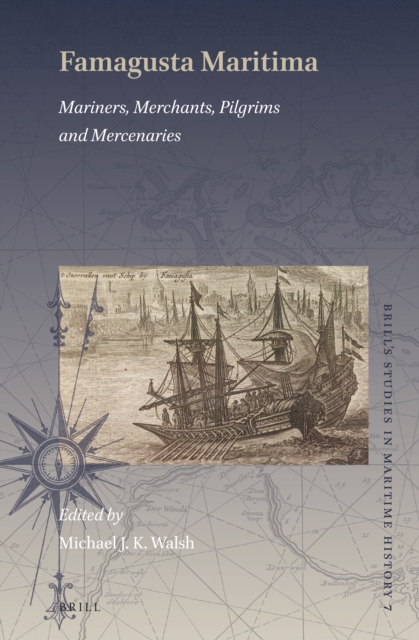
Introduction: \"Old ships [sail] like swans asleep ... for Famagusta and the hidden sun\" -- A holy site for sailors: Our Lady of the Cave in Famagusta / Michele Bacci -- Placed in the midst of enemies?: material evidence for the existence of maritime cultural networks connecting fourteenth-century Famagusta with overseas regions in Europe, Africa and Asia / Tomasz Borowski -- Between the Papal court and the Islamic world: Famagusta and Cypriot merchants in the fourteenth century / Mike Carr -- The role of Famagusta in Genoese maritime routes between the fourteenth and fifteenth centuries / Antonio Musarra -- Starting point of the Genoese thalassocracy in Cyprus: an unpublished roll of knights and squires imprisoned in Famagusta in 1374 / Pierre-Vincent Claverie -- The export of soap and olive oil from the port of Famagusta in the fourteenth and fifteenth centuries / Nicholas Coureas -- Maritime slave trading in fourteenth-century Famagusta / Ahmet Usta -- Sea defenses in the Renaissance: Famagusta in comparative Venetian perspective / Dragos Cosmescu -- Power, peril and maritime-trade wish fulfillment in Thomas Dekker's The pleasant comedy of old fortunatus / William Spates -- The harbor of Famagusta during the Ottoman period in travelogues and French consular archives / Lucie Bonato -- The development of Famagusta harbor during the British Colonial period (1878-1960) / Asu Tozan -- Famagusta on Cyprus and the sea: hotel architecture, urban development and tourism during the British Colonial and early postcolonial period / Marko Kiessel
eBook



Ottoman Izmir : the rise of a cosmopolitan port, 1840-1880
Between 1840 and 1880, the Eastern Mediterranean port of Izmir (Smyrna) underwent unprecedented change. A modern harbor that welcomed international steamships and new railway lines that transported a cornucopia of products transformed the physical city. Migrants, seasonal workers, and transient sailors thronged into an already diverse metropolis, helping to double the population to 200,000. Simultaneously, Ottoman officials and enterprising citizens vied to control and reform the citys administrative and legal institutions. Ottoman Izmir examines how urban space, institutional structures, and everyday practices shaped one another in the thriving seaport of Izmir during a volatile period of growth. Sibel Zandi-Sayek investigates a variety of urban actorsMuslims and non-Muslims, Ottomans and Europeans, newcomers and native residents, merchants, investors, civil servants, and press reporterswho were actively engaged in restructuring the city. Concentrating on the workings of urban committees and on laws and policies that were written, rewritten, but never fully implemented, Zandi-Sayek exposes how modern interventions sought to impose clear-cut concepts of public and private, safety and danger, and hygiene on a city that previously had a wide range of customary regulations. Ottoman Izmir shows how Izmirs various stakeholders contested its built environment. In so doing, it offers a new view of the dynamics of urban modernization.
eBook

Qalhat, a medieval port city of Oman : from a field of ruins to UNESCO
Although it is one of the main archaeological sites in Oman, the medieval port of Qalhat, near Sur in Ash-Sharqiyah Governorate, has long remained poorly documented. The extensive research initiated in 2008 by the Ministry of Heritage and Tourism shed striking light on the history of this famous harbour city.
BOOK

Ostia in Late Antiquity
Ostia Antica was Rome's ancient harbor. Its houses and apartments, taverns and baths, warehouses, shops and temples have long contributed to a picture of daily life in ancient Rome. Recent investigations have revealed, however, that life in Ostia did not end with a bang but with a whimper. Only on the cusp of the Middle Ages did the town's residents entrench themselves in a smaller settlement outside the walls. What can this new evidence tell us about life in the later Roman Empire, as society navigated an increasingly Christian world? Ostia in Late Antiquity, the first academic study on Ostia to appear in English in almost 20 years and the first to treat the Late Antique period, tackles the dynamics of this transformative time. Drawing on new archaeological research, including the author's own, and incorporating both material and textual sources, it presents a social history of the town from the third through the ninth century.
eBook