
Catalogue Search | MBRL


Are you sure you want to remove the book from the shelf?

{{itemTitle}}
134
result(s) for
"Have Pity Man"
Sort by:
Keep on Keepin’ On
Kay Swift remained active throughout the 1970s in her work and in her social life. For a septuagenarian, she was remarkably productive. Even though she may not have been working at her former pace, she continued to compose and pursue her musical activities. As in the 1960s, she wrote fewer popular songs and compositions and tended to write more pieces, both secular and sacred, that were classical in style. She also added to her cycle of children’s songs, with “Shoana,” a tribute to April’s granddaughter, who was born in 1970.
Swift returned in these years to her early practice of
Book Chapter

CASUAL HOOKUPS TO FORMAL DATES: Refining the Boundaries of the Sexual Double Standard
\"Hooking up,\" a popular type of sexual behavior among college students, has become a pathway to dating relationships. Based on open-ended narratives written by 273 undergraduates, we analyze how students interpreted a vignette describing a heterosexual hookup followed by a sexless first date. In contrast to the sexual script which holds that women want relationships more than sex and men care about sex more than relationships, students generally accorded women sexual agency and desire in the hookup and validated men's post-hookup relationship interest. However, in explaining the sexless date, students typically reasoned the woman was being chaste and withholding sex to redeem her reputation whereas they often characterized the man's abstinence in terms of a pity date. The findings underscore the tenacity of gendered sexual scripts around heterosexual dates and hookups but also reveal fissures and contradictions that suggest some changes to the sexual double standard.
Journal Article
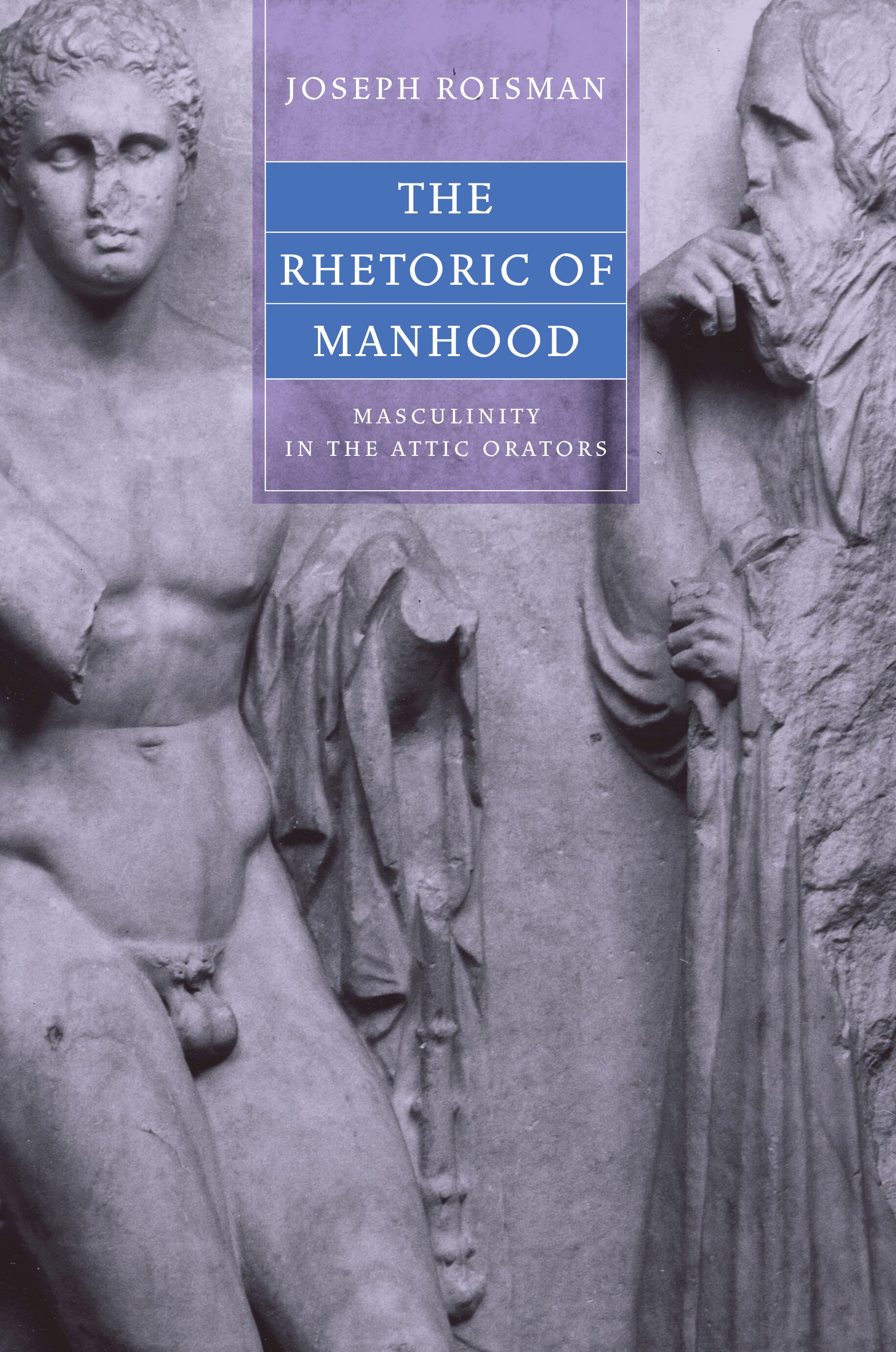
The Rhetoric of Manhood
The concept of manhood was immensely important in ancient Athens, shaping its political, social, legal, and ethical systems. This book, a groundbreaking study of manhood in fourth-century Athens, is the first to provide a comprehensive examination of notions about masculinity found in the Attic orators, who represent one of the most important sources for understanding the social history of this period. While previous studies have assumed a uniform ideology about manhood, Joseph Roisman finds that Athenians had quite varied opinions about what constituted manly values and conduct. He situates the evidence for ideas about manhood found in the Attic orators in its historical, ideological, and theoretical contexts to explore various manifestations of Athenian masculinity as well as the rhetoric that both articulated and questioned it. Roisman focuses on topics such as the nexus between manhood and age; on Athenian men in their roles as family members, friends, and lovers; on the concept of masculine shame; on relations between social and economic status and manhood; on manhood in the military and politics; on the manly virtue of self-control; and on what men feared.
eBook

Antifandom and the Moral Text
Opposed and yet in some ways similar to the fan is the antifan: he or she who actively and vocally hates or dislikes a given text, personality, or genre. By studying antifan discussion and postings at the Web site Television Without Pity, this article examines antifan interaction with the television text. Focusing on the ensuing splintering of this text into aesthetic, moral, and rational-realistic dimensions, it is argued that antifan engagement with television forces a reevaluation of existing assumptions of textual ontology and of audience behavior and consumption.
Journal Article

Aristotle's Ethics
Aristotle's moral philosophy is a pillar of Western ethical thought. It bequeathed to the world an emphasis on virtues and vices, happiness as well-being or a life well lived, and rationally motivated action as a mean between extremes. Its influence was felt well beyond antiquity into the Middle Ages, particularly through the writings of St. Thomas Aquinas. In the past century, with the rise of virtue theory in moral philosophy, Aristotle's ethics has been revived as a source of insight and interest. While most attention has traditionally focused on Aristotle's famous Nicomachean Ethics, there are several other works written by or attributed to Aristotle that illuminate his ethics: the Eudemian Ethics, the Magna Moralia, and Virtues and Vices.
This book brings together all four of these important texts, in thoroughly revised versions of the translations found in the authoritative complete works universally recognized as the standard English edition. Edited and introduced by two of the world's leading scholars of ancient philosophy, this is an essential volume for anyone interested in the ethical thought of one of the most important philosophers in the Western tradition.
eBook

Essays on Shakespeare
Robert Heilman gives an appreciation of Shakespeare as a whole man. Northrop Frye writes on balance and symbolism. Harry Levin shows how Shakespeare used names to indicate and enhance character. J.V. Cunningham looks at Shakespeare in his workshop; Gunnar Bokland, and Maynard Mack also contribute brilliant studies.
Originally published in 1965.
The Princeton Legacy Library uses the latest print-on-demand technology to again make available previously out-of-print books from the distinguished backlist of Princeton University Press. These editions preserve the original texts of these important books while presenting them in durable paperback and hardcover editions. The goal of the Princeton Legacy Library is to vastly increase access to the rich scholarly heritage found in the thousands of books published by Princeton University Press since its founding in 1905.
eBook

Ioláni; or, Tahíti as it was
Written 150 years ago, never published, and presumed lost for nearly a century, Wilkie Collins's earliest novel now appears in print for the first time. Ioláni is a sensational romance--a tale of terror and suspense, bravery and betrayal, set against the lush backdrop of Tahiti. The book's complicated history is worthy of a writer famous for intricate plots hinging on long-kept secrets. Collins wrote the book as a young man in the early 1840s, twenty years beforeThe MoonstoneandThe Woman in Whitemade his name among Victorian novelists. He failed to find a publisher for the work, shelved the manuscript for years, and eventually gave it to an acquaintance. It disappeared into the hands of private collectors and remained there--acquiring mythical status as a lost novel--from the turn of the century until its sudden appearance on the rare book market in New York in 1991. This first edition appears with the permission of the new owners, who keep the mystery alive by remaining anonymous.
The novel is set in Tahiti prior to European contact. It tells the story of the diabolical high priest, Ioláni , and the heroic young woman, Idüa, who bears his child. Determined to defy the Tahitian custom of killing firstborn children, Idüa and her friend Aimáta flee with the baby and take refuge among Ioláni's enemies. The vengeful priest pursues them, setting into motion a plot that features civil war, sorcery, sacrificial rites, wild madmen, treachery, and love. Collins explores themes that he would return to again and again in his career: oppression by sinister, patriarchal figures; the bravery of forceful, unorthodox women; the psychology of the criminal mind; the hypocrisy of moralists; and Victorian ideas of the exotic. As Ira Nadel shows in his introduction, the novel casts new light on Collins's development as a writer and on the creation of his later masterpieces. A sample page from the manuscript appears as the frontispiece to this edition. The publication of Ioláni is a major literary event: a century and half late, Wilkie Collins makes his literary debut.
Originally published in 1999.
ThePrinceton Legacy Libraryuses the latest print-on-demand technology to again make available previously out-of-print books from the distinguished backlist of Princeton University Press. These paperback editions preserve the original texts of these important books while presenting them in durable paperback editions. The goal of the Princeton Legacy Library is to vastly increase access to the rich scholarly heritage found in the thousands of books published by Princeton University Press since its founding in 1905.
eBook

Reinterpreting the Homeric Simile of \Iliad\ 16.7-11: The Girl and Her Mother in Ancient Greek Warfare
Though long regarded as a scene of mother-daughter domesticity during peacetime, \"Iliad\" 16.7—11 reveals the destruction of normal life for a daughter and her mother on the verge of being captured by ancient Greek warriors. As such it provides exemplary insight into this fundamental aspect of ancient warfare. Further, as reinterpreted here, the simile gains great dramatic and emotive power, strengthens the Homeric characterization of Achilles as a forthright speaker given to poetic realism, and heightens the tragedy of Patroclus by revealing how Achilles by his own admission fails to fulfill his protective role as Patroclus' warrior mother.
Journal Article

Sexing Death: Giuseppe Patroni Griffi's \'Tis Pity She's a Whore\
John Ford's 'Tis Pity She's a Whore (1633), which narrates the tragedy of Annabella and Giovanni, the siblings whose sexual relationship cannot be sustained within the confines of Parma's religious and patriarchal social structures, is a play that drives relentlessly toward death. This article explores the implications of this drive for spectatorship via a consideration of Giuseppe Patroni Griffi's feature film 'Tis Pity She's a Whore (1973) (released in Italian as Addio, Fratello Crudele (1971)). Through an examination of the death of Annabella and Patroni Griffi's directorial intervention into Ford's text in the final moments of the film-the massacre of the extended family and the display and beheading of Giovanni's naked body-I argue that the film's representation of death works to deprioritize the deaths of Annabella and her extended family, excising them from a community of mourners, in favor of reifying (in quasi-spiritual and erotic terms) Giovanni's death. In Patroni Griffi's film, death is not only made sexy in the deaths of Annabella and Giovanni but also \"sexed\" such that men are afforded more space for mourning-and being mourned-than women. By reading the representations of death in dialogue with one another and, on occasion, by considering differences between the VHS version and the cuts made to the DVD version, I draw attention to this differential. In so doing the article considers how spectators are enjoined to look upon violence and the possibilities that the film offers for thinking about the gender politics of death and mourning.
Journal Article

Historicizing the Gaze
Mowry discusses Jean I. Marsden's Fatal Desire: Women, Sexuality, and the English Stage, 1660-1720 which seems like a breath of fresh air to scholars working on intersection of gender and eighteenth-cenurty culture. Marsden construct a shrewd, nuanced, and much-needed history of the \"gaze\"--long a stable of feminist, theatrical, and cinematic theory. Fatal Desire \"explores the impact of the theatrical spectacle of female sexuality on the world of Restoration and eighteenth-century theater\" and \"focuses on the impact of women on the stage and in the theater, examining the ways in which their material presence altered the representation of women in drama and even reshaped dramatic form at a time when theater was the most public and most debated literary venue.\"
Journal Article