
Catalogue Search | MBRL


Are you sure you want to remove the book from the shelf?

{{itemTitle}}
323
result(s) for
"Hawaii -- In motion pictures"
Sort by:

Calvin Coconut : extra famous
Calvin and his friends have the opportunity to earn some money by appearing as extras in a zombie movie being filmed on a nearby beach.
Book

Hollywood's Hawaii
Whether presented as exotic fantasy, a strategic location during World War II, or a site combining postwar leisure with military culture, Hawaii and the South Pacific figure prominently in the U.S. national imagination.Hollywood's Hawaiiis the first full-length study of the film industry's intense engagement with the Pacific region from 1898 to the present.Delia Malia Caparoso Konzett highlights films that mirror the cultural and political climate of the country over more than a century-from the era of U.S. imperialism on through Jim Crow racial segregation, the attack on Pearl Harbor and WWII, the civil rights movement, the contemporary articulation of consumer and leisure culture, as well as the buildup of the modern military industrial complex. Focusing on important cultural questions pertaining to race, nationhood, and war, Konzett offers a unique view of Hollywood film history produced about the national periphery for mainland U.S. audiences.Hollywood's Hawaiipresents a history of cinema that examines Hawaii and the Pacific and its representations in film in the context of colonialism, war, Orientalism, occupation, military buildup, and entertainment.
eBook

The US military in Hawai'i : colonialism, memory, and resistance
An examination of how the US military in Hawaii is depicted by museum curators, memorial builders, film makers, and newspaper reporters. These mediums convey information, and engage their audiences, in ways that, together, form a powerful advocacy for the benefits of militarism in the islands.
eBook
American Film History
This authoritative collection of introductory and specialized readings explores the rich and innovative history of this period in American cinema. Spanning an essential range of subjects from the early 1900s Nickelodeon to the decline of the studio system in the 1960s, it combines a broad historical context with careful readings of individual films. * Charts the rise of film in early twentieth-century America from its origins to 1960, exploring mainstream trends and developments, along with topics often relegated to the margins of standard film histories * Covers diverse issues ranging from silent film and its iconic figures such as Charlie Chaplin, to the coming of sound and the rise of film genres, studio moguls, and, later, the Production Code and Cold War Blacklist * Designed with both students and scholars in mind: each section opens with an historical overview and includes chapters that provide close, careful readings of individual films clustered around specific topics * Accessibly structured by historical period, offering valuable cultural, social, and political contexts * Contains careful, close analysis of key filmmakers and films from the era including D.W. Griffith, Charles Chaplin, Buster Keaton, Erich von Stroheim, Cecil B. DeMille, Don Juan, The Jazz Singer, I Am a Fugitive from a Chain Gang, Scarface, Red Dust, Glorifying the American Girl, Meet Me in St. Louis, Citizen Kane, Bambi, Frank Capra's Why We Fightseries, The Strange Love of Martha Ivers, Rebel Without a Cause, Force of Evil, and selected American avant-garde and underground films, among many others. * Additional online resources such as sample syllabi, which include suggested readings and filmographies for both general specialized courses, will be available online. * May be used alongside American Film History: Selected Readings, 1960 to the Present, to provide an authoritative study of American cinema through the new millennium
eBook

American Film History
From the American underground film to the blockbuster superhero, this authoritative collection of introductory and specialized readings explores the core issues and developments in American cinematic history during the second half of the twentieth-century through the present day. Considers essential subjects that have shaped the American film industry-from the impact of television and CGI to the rise of independent and underground film; from the impact of the civil rights, feminist and LGBT movements to that of 9/11. Features a student-friendly structure dividing coverage into the periods 1960-1975, 1976-1990, and 1991 to the present day, each of which opens with an historical overview Brings together a rich and varied selection of contributions by established film scholars, combining broad historical, social, and political contexts with detailed analysis of individual films, including Midnight Cowboy, Nashville, Cat Ballou, Chicago, Back to the Future, Killer of Sheep, Daughters of the Dust, Nothing But a Man, Ali, Easy Rider, The Conversation, The Texas Chain Saw Massacre, Longtime Companion, The Matrix, The War Tapes, the Batman films, and selected avant-garde and documentary films, among many others. Additional online resources, such as sample syllabi, which include suggested readings and filmographies, for both general and specialized courses, will be available online. May be used alongside American Film History: Selected Readings, Origins to 1960 to provide an authoritative study of American cinema from its earliest days through the new millennium.
eBook

Hollywood's America
Fully revised, updated, and extended, the fifth edition of Hollywood's America provides an important compilation of interpretive essays and primary documents that allows students to read films as cultural artifacts within the contexts of actual past events. * A new edition of this classic textbook, which ties movies into the broader narrative of US and film history * This fifth edition contains nine new chapters, with a greater overall emphasis on recent film history, and new primary source documents which are unavailable online * Entries range from the first experiments with motion pictures all the way to the present day * Well-organized within a chronological framework with thematic treatments to provide a valuable resource for students of the history of American film
eBook
1941
The December 7th attack on Pearl Harbor motivated painter-filmmaker Francis Lee to produce these abstract images evocative of the horrors of war. Splattered wet paint and broken light bulbs allude to the senseless destruction. The potent visuals are reinforced by the driving rhythms of Stravinsky's aggressive atonal music. 16mm 1.37:1 color sound; music by Igor Stravinsky.
Streaming Video

The Army Learns to Luau: Imperial Hospitality and Military Photography in Hawai'i
Circulating in the contemporary global cultural marketplace, the tourist luau is an iconic form of commodified hospitality and leisure, readily available in embodied and mediated forms. This article traces the emergence of the luau as a material practice and discursive formation during the \"mili-touristic\" economy of World War II Hawai'i in films shot by US military units. US combat photography units staged ethnographic performances of hula and luaus, transforming the luau from a privileged experience for a select few to a mass mediated event. These filmic performances produced scripts of imperial hospitality: imagined and enacted scripts in which Islanders and soldiers play roles as host and guest, respectively. Military luaus rendered uneven colonial relationships as mutual and consensual encounters between white soldiers and Native women. Through the exercise of biopower, military cameras did not merely discipline Hawaiian populations, but also integrated colonial subjects and regulated Hawaiian sexuality. These gendered scripts continue to secure Hawai'i as a rest and relaxation capital for US military personnel.
Journal Article
\Our Ancestors that We Carry on Our Backs\: Restaging Hawai'i's History in the Plays of Victoria Nalani Kneubuhl
During the past twenty years, Hawaiian dramatist and museum educator Victoria Nalani Kneubuhl has become established as one of the foremost playwrights working in the contemporary Pacific. Since the mid-1980s, a dominant strand of Kneubuhl's oeuvre has involved a critical examination of Hawai'i's colonial history, using various forms of theatrical performance to interrogate historical injustices and characterizations of Hawaiian culture that erase or overwrite indigenous epistemologies, offering restorative models and, in some instances, stimulating efforts that bring about material social change. This paper surveys six of Kneubuhl's historiographic works produced during the 1980s and 1990s, highlighting varied dramaturgical strategies employed to engage the cultural past in order to address contemporary concerns. The discussion distinguishes two broad theatrical genres arising from Kneubuhl's training and work experience: historical \"plays for the theatre,\" which incorporate fictional or fantastic elements and are designed for repeated performance within the aesthetic and commercial frame of amateur or professional theatre production; and her \"living history programs,\" site- and occasion-specific performances based more directly on documentary sources and developed in consultation with historians, with a stricter pedagogical purview and a tendency toward a more realist style of presentation. This overview of Kneubuhl's plays and programs foregrounds the important cultural interventions effected by her work during the last two decades, and contributes to an investigation of the various uses of performance in helping to construct indigenous histories in Oceania, while engaging in a broader dialogue about the ways in which theatre functions actively within the postcolonial Pacific.
Journal Article
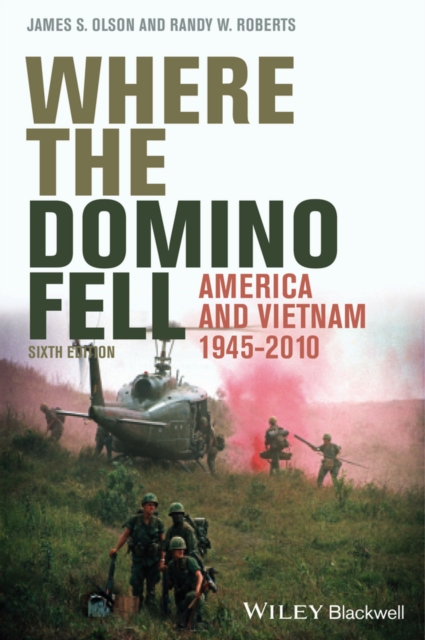
Where the domino fell
This updated, expanded edition of Where the Domino Fell recounts the history of American involvement in Vietnam from the end of World War II, clarifying the political aims, military strategy, and social and economic factors that contributed to the participants' actions. Revised and updated to include an examination of Vietnam through the point of view of the soldiers themselves, and brings the story up to the present day through a look at how the war has been memorialized A final chapter examines Vietnam through the lens of Oliver Stone's films and opens up a discussion of the War in popular culture Written with brevity and clarity, this concise narrative history of the Vietnam conflict is an ideal student text A chronology, glossary, and a bibliography all serve as helpful reference points for students An important contribution not only to the study of the Vietnam War but to an understanding of the larger workings of American foreign policy.
eBook