
Catalogue Search | MBRL


Are you sure you want to remove the book from the shelf?

{{itemTitle}}
21,742
result(s) for
"Hawking, Stephen"
Sort by:

On the origin of time : Stephen Hawking's final theory
\"Stephen Hawking's closest collaborator offers the intellectual superstar's final thoughts on the cosmos-a dramatic revision of the theory that made him the heir to Einstein's legacy. Perhaps the biggest question Stephen Hawking tried to answer in his extraordinary life was how the universe could have created conditions so perfectly hospitable to life. Pondering this mystery led Hawking to study the big bang origin of the universe, but his early work ran into a crisis when the math predicted many big bangs producing a multiverse-countless different universes, most far too bizarre to harbor life. Holed up in the theoretical physics department at Cambridge, Stephen Hawking and his friend and collaborator Thomas Hertog worked shoulder to shoulder for twenty years on a new quantum theory of the cosmos. As their journey took them deeper into the big bang, they were startled to find a deeper level of evolution in which the physical laws themselves transform and simplify until particles, forces, and even time itself fades away. Once upon a time, perhaps, there was no time. This led them to a revolutionary idea: the laws of physics are not set in stone but are born and co-evolve as the universe they govern takes shape. On the Origin of Time takes the reader on a quest to understand questions bigger than our universe, peering into the extreme quantum physics of black holes and the big bang and drawing on the latest developments in string theory. As Hawking's final days drew near, the two collaborators developed a final theory proposing their radical new Darwinian perspective on the origins of our universe. Hertog offers a striking new vision that ties together more deeply than ever the nature of the universe's birth with our existence. This new theory profoundly transforms the way we think about our place in the order of the cosmos and may ultimately prove Hawking's biggest legacy\"-- Provided by publisher.
Book

Artificial Intelligence on Food Vulnerability: Future Implications within a Framework of Opportunities and Challenges
This study explores the field of artificial intelligence (AI) through the lens of Stephen Hawking, who warned of its potential dangers. It aims to provide a comprehensive understanding of AI and its implications for food security using a qualitative approach and offering a contemporary perspective on the topic. The study explores the challenges and opportunities presented by AI in various fields with an emphasis on the global food reality. It also highlights the critical importance of striking a harmonious balance between technological progress and the preservation of local wisdom, cultural diversity, and environmental sustainability. In conclusion, the analysis argues that AI is a transformative force with the potential to address global food shortages and facilitate sustainable food production. However, it is not without significant risks that require rigorous scrutiny and ethical oversight.
Journal Article

A Bonaventurian rousing of the metaphysics of primary causality to counter New Materialism
Bonaventure discerned the continuous presence of the problem of primary causality in contingent beings. From his perspective, full knowledge of the problem of primary causality emerges only when human reason is reduced to the first cause. In contrast, materialists do not consider primary causality because its empirically scientific epistemological method marginalises the idea of first cause (i.e., God). The zeitgeist of materialism and its entrenched reductionist ontology remains the core of physical and natural science in considering that all that has been is matter and holding that empiricist methods are the most reliable tools through which being can be investigated. These foundational premises are now reembraced in an in vogue ontology in the human and social sciences, New Materialism. In theology and religion, this paradigm has been applied too, despite the obvious perpendicularity in content and method of materialism when compared to metaphysical theorisations held as articles of Christian faith. Given that the human and social sciences are the natural home for expanding the conceptualisation of science, which might include faith, a case is developed that reductionist New Materialism influences against faith. Consequently, a twofold responsive model to New Materialism is made through Bonaventurianism: (1) by critiquing the absoluteness of materialist empiricism and (2) by arguing that reductionist epistemology is unreflective of multimodal being.Contribution: A contribution is made to Franciscan and Bonaventurian scholarship by the reintroduction of Bonaventure’s thought in the ambit of science and religion, focussing especially on ontological and epistemic questions.
Journal Article

رحلة إلى اللانهاية : حياتي مع ستيفن
هذا الكتاب هو عبارة عن مذكرات مؤلمة كتبتها جين وايلد الزوجة الأولى لستيفن هوكينج فتحكي قصة بعين الرائي لزواج غير عادي فمنذ ارتفعت شهرة ستيفن الأكاديمية بدأ جسده بالانهيار أمام المرض، حاولت جين بدورها رعايته على مدار 24 ساعة إلى جانب احتياجات الأسرة المتزايدة لتكشف عن قوتها الداخلية في سبيل إعادة التوازن لحياة زوج عبقري وفي الوقت الذي صارحت فيه جين نفسها بذكاء زوجها وإنجازاته لم تكن أقل صدقا عندما قصت كيف انتهى زواجهما بشكل راق لتتزوج بعدها من صديق قديم للعائلة.
BOOK

The Agencies of God’s Word and Spirit: Modern Science as a “Sacred Reminder”
In this essay, I argue that modern science can function as a source of “sacred reminders” for aspects of Christian theology, like the doctrine of the Trinity, that are not normally engaged with in the empirical world. This approach is an alternative to the usual ways of relating scientific and theological endeavors in terms of conflict, separation, or consonance. I demonstrate this by beginning with the thoughts of two representative physicists (John Archibald Wheeler and Steven Hawking), particularly focusing on a fundamental distinction they make about the underlying ideal of the physical sciences. Noting a striking similarity of this distinction with some of the biblical imagery of God’s Word and Spirit, I review biblical texts along these lines to show partial continuity with the groundbreaking ideas of our physicists, and to show how they can be generalized to include (a) levels of organization beyond those of physics; (b) intensive, localized agencies of Word and Spirit as well as the more extensive agencies suggested their ideas; and (c) the commissioning agency of God the Father. A review of the theology of Irenaeus shows that these distinctions in biblical imagery were developed in the early Church and played an important role in early Trinitarian theology.
Journal Article

Stephen Hawking
Stephen Hawking was one of the world's most famous scientists. His ground-breaking research into black holes and the Big Bang has helped to explain the beginnings of our universe and his book A Brief History of Time has sold over 10 million copies. Diagnosed with a form of motor neuron disease when he was a young man, Stephen was inspired to achieve his goals as fast as possible. Through incredible determination and skill, he became a legendary scientist, a best-selling author, and the man that changed the way we think about the universe.
BOOK
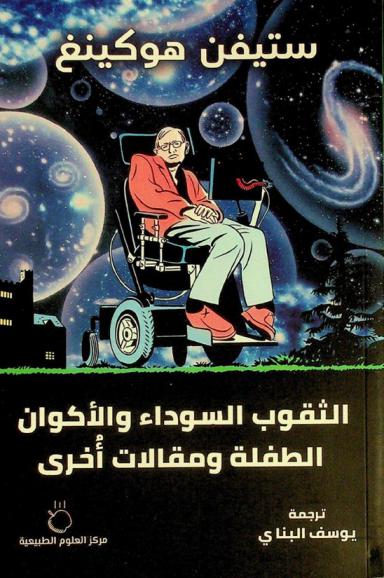
الثقوب السوداء والأكوان الطفلة ومقالات أخرى
كتاب \"الثقوب السوداء والأكوان الطفلة ومقالات أخرى\" للمؤلف ستيفن هوكينغ، وترجمة يوسف البناي، هو مجموعة من المقالات التي كتبها العالم الفيزيائي الشهير ستيفن هوكينغ. يتناول الكتاب مجموعة متنوعة من الموضوعات العلمية المعقدة ويقدمها بلغة بسيطة ومفهومة للقارئ العادي، يناقش هوكينغ في عدة مقالات فكرة الثقوب السوداء، وهي مناطق في الفضاء تتميز بجاذبية قوية جدا لدرجة أن لا شيء، ولا حتى الضوء، يمكنه الهروب منها. يتناول الكتاب نظريات هوكينغ حول الإشعاع المنبعث من الثقوب السوداء، المعروف ب \"إشعاع هوكينغ\"، والذي كان اكتشافا ثوريا في مجال الفيزياء، حيث يتناول هوكينغ فكرة الأكوان المتعددة أو الأكوان الطفلة، وهي نظريات تشير إلى وجود أكوان موازية لكوننا، تختلف في خصائصها وقوانينها الفيزيائية. يناقش كيف يمكن أن تكون هذه الأكوان الطفلة قد نشأت وكيف تؤثر على فهمنا للكون.
Book

The Bit Player: Stephen Hawking and the Object Voice
This essay argues that the mechanical voice of Stephen Hawking requires theorizing the public as a voice object. I contend that Hawking's mechanical voice threatened his audience with what Jacques Lacan called the object voice, a voice in excess of bodies and languages that functions as an elusive object-cause of desire. Upon showing how the psychoanalytic account of voice and rhetorical scholarship on publics may mutually inform one another, I argue that, due to the role of publics as an objet petit a, the strange qualities of Hawking's synthesizer were rhetorically surmounted. In sum, this essay considers whether Hawking's mechanical voice was really all that different from our own.
Journal Article