
Catalogue Search | MBRL


Are you sure you want to remove the book from the shelf?

{{itemTitle}}
54,617
result(s) for
"Health Policy - trends"
Sort by:

The new public health
The book provides a unified approach to public health appropriate for all masters' level students and practitioners-specifically for courses in MPH programs, community health and preventive medicine programs, community health education programs, community health nursing programs.
Book

Governing Health in Contemporary China
The lack of significant improvement in people's health status and other mounting health challenges in China raise a puzzling question about the country's internal transition: why did the reform-induced dynamics produce an economic miracle, but fail to reproduce the success Mao had achieved in the health sector? This book examines the political and policy dynamics of health governance in post-Mao China. It explores the political-institutional roots of the public health and health care challenges and the evolution of the leaders' policy response in contemporary China. It argues that reform-induced institutional dynamics, when interacting with Maoist health policy structure in an authoritarian setting, have not only contributed to the rising health challenges in contemporary China, but also shaped the patterns and outcomes of China's health system transition. The study of China's health governance will further our understanding of the evolving political system in China and the complexities of China's rise. As the world economy and international security are increasingly vulnerable to major disease outbreaks in China, it also sheds critical light on China's role in global health governance.
eBook

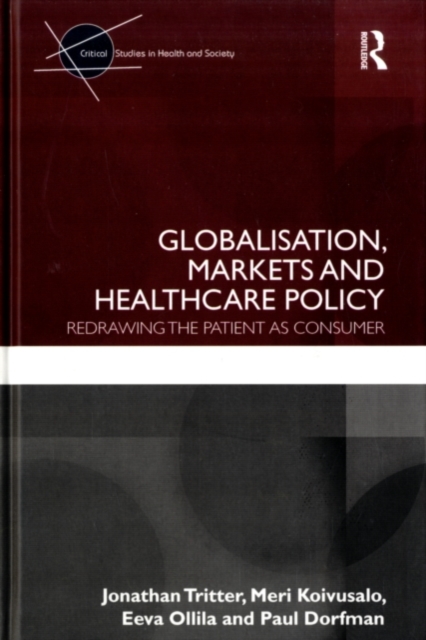
Globalisation, Markets and Healthcare Policy
Although the last two decades have seen the healthcare systems of most developed countries face pressure for major reform, the impact of this reform on the relationship between empowerment, consumerism and citizen’s rights has received limited research attention. Globalisation, Markets and Healthcare Policy sets out to redress this imbalance.
This book explores the extent to which globalisation and commercialisation relate to current and emerging health policies. It also looks at the implications for citizens, patients and social rights, as well as how policy making interacts with the interests of global and European trade and economic policies. Topics discussed include:
How the impact of globalisation on health systems is apparent in the influence of international actors and European policies.
How the impact of globalisation is mediated by national priorities and policies and is therefore reflected in diverse influences.
How commercialisation of health is presented as benefiting citizens and patients but has the potential to undermine the aims and values inherent in health systems.
How the role of citizens' interests, social rights, patient’s rights and priorities of patient and public involvement need to be separated from commercialisation, choice and consumerism in health care.
Essential reading for policy makers and students of public policy, politics, law and health services, Globalisation, Markets and Healthcare Policy will also appeal to those interested in patient involvement international healthcare, international relations, trans-national organisations and the EU.
Introduction 1. Analysing Patient and Public Involvement and Health Policy 2. National Health Systems: From Public Provision to Market Competition 3. From Patients to Consumers 4. Globalisation and Global Policy Influences: Mapping the Big Picture 5. The European Union: Trading in Healthcare or Building a Healthier Europe? 6. England: From NHS to PLC 7. Sweden: A Market Orientation to the Welfare State 8. Finland: Privatisation in the Context of Decentralised Service Provision 9. Comparison between Countries - Is There a Common Concern? 10. Current Trends in Commercialisation and Consumerism in Health 11. Challenges for the Future - People and Public Finances 12. Citizens, Patients and Consumers: Critical Reflections on Globalisation, Markets and Healthcare Policy
Jonathan Tritter is Research Professor in Patient and Public Involvement, Special Advisor in the NHS Centre for Involvement at the University of Warwick and Professorial Fellow in the Governance and Public Management Group in Warwick Business School.
Meri Koivusalo is Senior Researcher in the National Institute for Health and Welfare (THL), Finland.
Eeva Ollila is Senior Researcher in the National Institute for Health and Welfare (THL), Finland and Adjunct Professor of Health Policy at the University of Tampere, Finland.
Paul Dorfman is Senior Research Fellow at the NHS Centre for Involvement at the University of Warwick.
'[This book] systematically reveals the shadowy global and European economic forces impelling national governments towards growing commercialisation of public health care under the banner of \"consumer choice\". The authors show this is neither what most people want from health care, nor the best way to deal with current policy pressures. They highlight the threats that current developments pose, and convincingly show there is a better road to patient and user empowerment' - Mick Carpenter, University of Warwick, UK
eBook

Better but not well : mental health policy in the United States since 1950
The past half-century has been marked by major changes in the treatment of mental illness: important advances in understanding mental illnesses, increases in spending on mental health care and support of people with mental illnesses, and the availability of new medications that are easier for the patient to tolerate. Although these changes have made things better for those who have mental illness, they are not quite enough. In Better But Not Well, Richard G. Frank and Sherry A. Glied examine the well-being of people with mental illness in the United States over the past fifty years, addressing issues such as economics, treatment, standards of living, rights, and stigma. Marshaling a range of new empirical evidence, they first argue that people with mental illness—severe and persistent disorders as well as less serious mental health conditions—are faring better today than in the past. Improvements have come about for unheralded and unexpected reasons. Rather than being a result of more effective mental health treatments, progress has come from the growth of private health insurance and of mainstream social programs—such as Medicaid, Supplemental Security Income, housing vouchers, and food stamps—and the development of new treatments that are easier for patients to tolerate and for physicians to manage. The authors remind us that, despite the progress that has been made, this disadvantaged group remains worse off than most others in society. The \"mainstreaming\" of persons with mental illness has left a policy void, where governmental institutions responsible for meeting the needs of mental health patients lack resources and programmatic authority. To fill this void, Frank and Glied suggest that institutional resources be applied systematically and routinely to examine and address how federal and state programs affect the well-being of people with mental illness.
eBook

The burden of headache disorders in Ethiopia: national estimates from a population-based door-to-door survey
Background
Headache disorders are the third-highest cause of disability worldwide, with migraine and medication-overuse headache (MOH) the major contributors. In Ethiopia we have shown these disorders to be highly prevalent: migraine 17.7%, TTH 20.6%, probable MOH (pMOH) 0.7%, any headache yesterday (HY) 6.4%. To inform local health policy, we now estimate disability and other burdens attributable to headache in this country.
Methods
In a cross-sectional survey using cluster-randomized sampling, we visited households unannounced in four diverse regions (urban and rural) of Ethiopia. We interviewed one member (18–65 years old) of each household using the HARDSHIP structured questionnaire. Screening and diagnostic questions based on ICHD-II were followed by burden enquiry in multiple domains. We estimated disability using disability weights (DWs) from the Global Burden of Disease 2013 study.
Results
We interviewed 2385 participants (1064 [44.7%] male, 596 [25.0%] urban; participating proportion 99.8%). Reported mean intensity of migraine was 2.6 (scale 1–3). People with migraine spent 11.7% of their time in the ictal state (DW: 0.441); they were therefore 5.2% disabled overall. Pain and disability from TTH were much lower. Mean intensity of pMOH was 2.95. People with pMOH spent 60.2% of time with headache (DW: 0.223), and were 13.4% disabled. Average proportions of per-person lost productive time were, for migraine, 4.5% from paid work, 5.3% from household work; for pMOH they were 29.2% and 16.0%. There were highly-disabled minorities, and large gender differences, males losing more paid workdays, females more household workdays. All headache types were associated with impairments in quality of life. Across the population aged 18–65 years (effectively the working population), disability from headache was 1.4%, with 1.6% of workdays lost (half from migraine). Estimates from HY, eliminating recall error, were highly compatible.
Conclusions
Ethiopia is a low-income country, and cannot afford these losses – including, perhaps, 1.6% of GDP. Political action is necessary, aimed at mitigating both the economic burden and the associated ill health. WHO has recommended structured headache services with their basis in primary care as the most efficient, effective, affordable and equitable solution, potentially cost-saving. We believe they can be implemented within Ethiopia’s existing health-care infrastructure.
Journal Article

Impact of Policy Interventions on Postoperative Opioid Prescribing
Abstract
Objective
To assess postoperative opioid prescribing in response to state and organizational policy changes.
Methods
We used an observational study design at an academic medical center in the Northeast United States over a time during which there were two important influences: 1) implementation of state rules regarding opioid prescribing and 2) changes in organization policies reflecting evolving standards of care. Results were summarized at the surgical specialty and procedure level and compared between baseline (July–December 2016) and postrule (July–December 2017) periods.
Results
We analyzed data from 17,937 procedures from July 2016 to December 2017, two-thirds of which were outpatient. Schedule II opioids were prescribed in 61% of cases and no opioids at all in 28%. The median morphine milligram equivalent (MME) prescribed at discharge decreased 40%, from 113 MME in the baseline period to 68 MME in the postrule period. Decreases were seen across all the surgical specialties.
Conclusions
Postoperative opioid prescribing at the time of hospital discharge decreased between 2016 and 2017 in the setting of targeted and replicable state and health care organizational policies.
Policy Implications
Policies governing the use of opioids are an effective and adoptable approach to reducing opioid prescribing following surgery.
Journal Article
Critical reflections on health services development in india
The book undertakes a critical examination of health service development in India and provides an explanation of its underdevelopment.It analyzes the trajectory of health services development in India and dissects the roles of various actors which shape that process viz.the State, civil society, and the people.
eBook


Health Care Market Concentration Trends In The United States: Evidence And Policy Responses
Policy makers and analysts have been voicing concerns about the increasing concentration of health care providers and health insurers in markets nationwide, including the potential adverse effect on the cost and quality of health care. The Council of Economic Advisers recently expressed its concern about the lack of estimates of market concentration in many sectors of the US economy. To address this gap in health care, this study analyzed market concentration trends in the United States from 2010 to 2016 for hospitals, physician organizations, and health insurers. Hospital and physician organization markets became increasingly concentrated over this time period. Concentration among primary care physicians increased the most, partially because hospitals and health care systems acquired primary care physician organizations. In 2016, 90 percent of Metropolitan Statistical Areas (MSAs) were highly concentrated for hospitals, 65 percent for specialist physicians, 39 percent for primary care physicians, and 57 percent for insurers. Ninety-one percent of the 346 MSAs analyzed may have warranted concern and scrutiny because of their concentration levels in 2016 and changes in their concentrations since 2010. Public policies that enhance competition are needed, such as stricter enforcement of antitrust laws, reducing barriers to entry, and restricting anticompetitive behaviors.
Journal Article