
Catalogue Search | MBRL


Are you sure you want to remove the book from the shelf?

{{itemTitle}}
4,273
result(s) for
"Hebrew Literature"
Sort by:


Jewish Culture and Creativity
Jewish Culture and Creativity honors the wide-ranging scholarship of Prof. Michael Fishbane with contributions of his students on subjects that cover the gamut of Jewish studies, from biblical and rabbinic literature to medieval and modern Jewish culture, and concluding with case studies of the creative application of Prof. Fishbane’s thought and theology in contemporary Jewish life. The innovative scholarship represented in this volume offers critical new perspectives from antiquity to contemporary Judaism and will serve as a stimulus for new directions in and beyond the field of Jewish studies.
eBook


Modern Jewish Literatures
Is there such a thing as a distinctive Jewish literature? While definitions have been offered, none has been universally accepted. Modern Jewish literature lacks the basic markers of national literatures: it has neither a common geography nor a shared language-though works in Hebrew or Yiddish are almost certainly included-and the field is so diverse that it cannot be contained within the bounds of one literary category. Each of the fifteen essays collected inModern Jewish Literaturestakes on the above question by describing a movement across boundaries-between languages, cultures, genres, or spaces. Works in Hebrew and Yiddish are amply represented, but works in English, French, German, Italian, Ladino, and Russian are also considered. Topics range from the poetry of the Israeli nationalist Natan Alterman to the Russian poet Osip Mandelstam; from turn-of-the-century Ottoman Jewish journalism to wire-recorded Holocaust testimonies; from the intellectual salons of late eighteenth-century Berlin to the shelves of a Jewish bookstore in twentieth-century Los Angeles. The literary world described inModern Jewish Literaturesis demarcated chronologically by the Enlightenment, the Haskalah, and the French Revolution, on one end, and the fiftieth anniversary of the State of Israel on the other. The particular terms of the encounter between a Jewish past and present for modern Jews has varied greatly, by continent, country, or village, by language, and by social standing, among other things. What unites the subjects of these studies is not a common ethnic, religious, or cultural history but rather a shared endeavor to use literary production and writing in general as the laboratory in which to explore and represent Jewish experience in the modern world.
eBook


The Reception of Jeremiah in Modern Hebrew Literature
Looking at some illustrative examples of the reception of Jeremiah in modern Hebrew literature, this article explores how both the prophet and the book named after him were reworked by modern Hebrew authors and poets in the body of literary works in Hebrew that emerged during the late eighteenth and early nineteenth centuries in Europe in the wake of the Enlightenment.
Journal Article

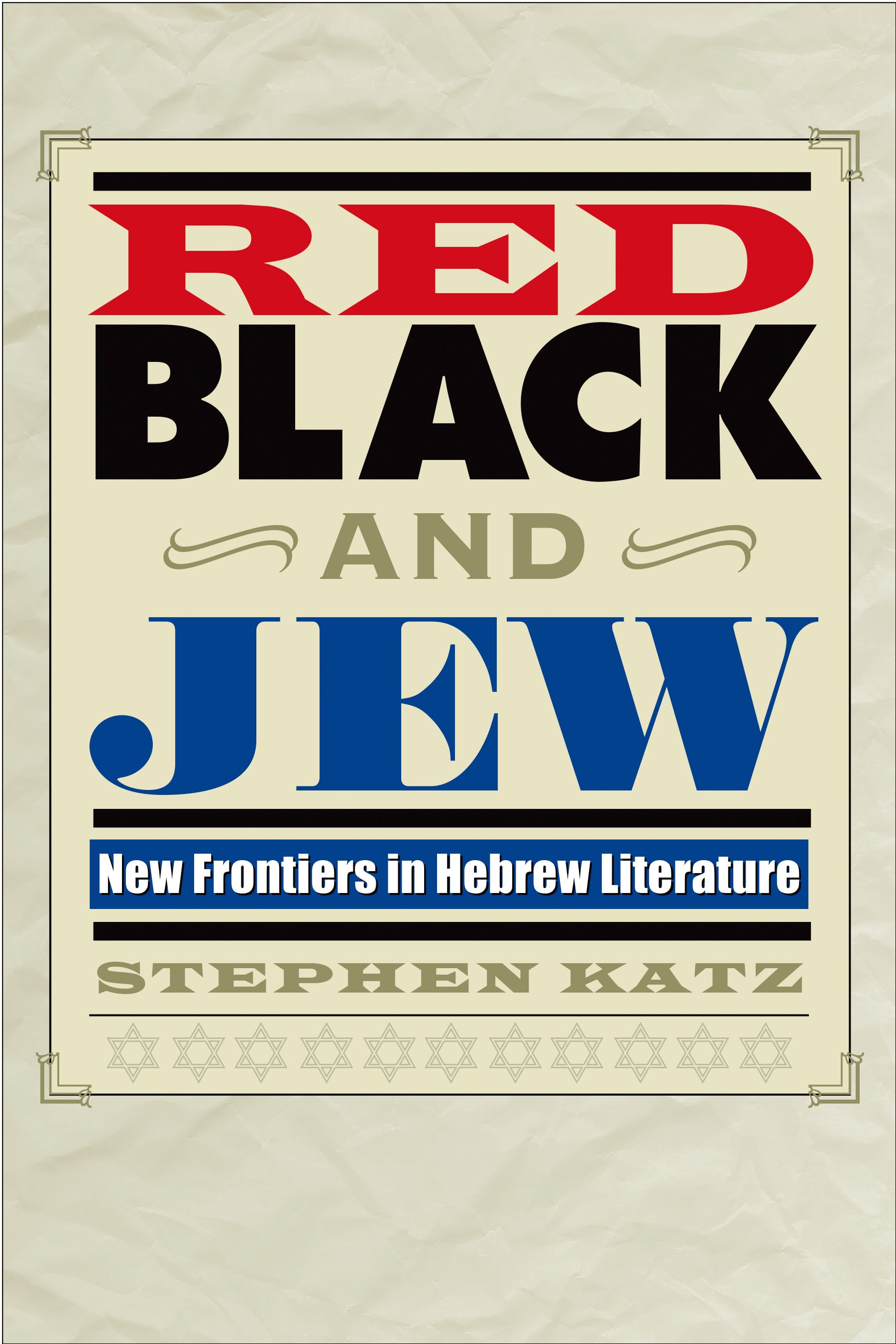
Red, Black, and Jew
Between 1890 and 1924, more than two million Jewish immigrants landed on America's shores. The story of their integration into American society, as they traversed the difficult path between assimilation and retention of a unique cultural identity, is recorded in many works by American Hebrew writers. Red, Black, and Jew illuminates a unique and often overlooked aspect of these literary achievements, charting the ways in which the Native American and African American creative cultures served as a model for works produced within the minority Jewish community. Exploring the paradox of Hebrew literature in the United States, in which separateness, and engagement and acculturation, are equally strong impulses, Stephen Katz presents voluminous examples of a process that could ultimately be considered Americanization. Key components of this process, Katz argues, were poems and works of prose fiction written in a way that evoked Native American forms or African American folk songs and hymns. Such Hebrew writings presented America as a unified society that could assimilate all foreign cultures. At no other time in the history of Jews in diaspora have Hebrew writers considered the fate of other minorities to such a degree. Katz also explores the impact of the creation of the state of Israel on this process, a transformation that led to ambivalence in American Hebrew literature as writers were given a choice between two worlds. Reexamining long-neglected writers across a wide spectrum, Red, Black, and Jew celebrates an important chapter in the history of Hebrew belles lettres.
eBook

From the Kheyder to the Ḥeder: A Transformation of the Room
In this article I argue that the transformation of the ḥeder (the traditional Jewish study room) in modern Hebrew literature from the late-nineteenth to the late-twentieth century reflects a profound shift in Jewish identity, encapsulating the tensions between tradition and modernity. I explore how the ḥeder , once a site of rigorous religious education, evolves into a potent symbol of individual creativity and self-expression in the works of Micha Josef Berdyczewski, Yosef Haim Brenner, Dvora Baron, Hayim Nahman Bialik, and Shmuel Yosef Agnon. By situating this literary transformation within the broader currents of secularization and European modernism, I illuminate how these authors grapple with the dual forces of cultural continuity and change. I conclude with a discussion of Youval Shimoni’s 1999 novel Ḥeder , which suggests that while the ḥeder ’s function has changed, the room continues to serve as a space for introspection and artistic creation in a world that is increasingly uncertain.
Journal Article

Reading Bialik in Tehran
The allied occupation of Iran in 1941 ushered in a new monarch, the physical and further cultural presence of several jostling foreign powers, and the increased footprint of mainstream Zionist organizations in the country. Iranians generally underwent great upheaval then, but for Iran's Jews the period was further complicated by the multiple political and cultural spaces now demanding their attention and seeking their loyalty. As in past periods, print culture was a key means of pro cessing this flux and responding to change, with Jewish intellectuals and activists frequently attempting to digest and relay information to regular readers. As this essay will argue, the process of translation and the production of original literature were key means for preserving a sense of the community's self in the midst of so much turmoil. Iranian Jews (who numbered roughly eighty thousand to one hundred thousand in this period) were keen to take advantage of this unfolding opportunity to engage in the public sphere, seeing it as a chance to voice both their sense of domestic belonging and their connectedness to the wider Jewish world.
Journal Article