
Catalogue Search | MBRL


Are you sure you want to remove the book from the shelf?

{{itemTitle}}
6,138
result(s) for
"Hegemony History."
Sort by:


Alexander’s Veterans and the Early Wars of the Successors
From antiquity until now, most writers who have chronicled the events following the death of Alexander the Great have viewed this history through the careers, ambitions, and perspectives of Alexander's elite successors. Few historians have probed the experiences and attitudes of the ordinary soldiers who followed Alexander on his campaigns and who were divided among his successors as they fought for control of his empire after his death. Yet the veterans played an important role in helping to shape the character and contours of the Hellenistic world.
This pathfinding book offers the first in-depth investigation of the Macedonian veterans' experience during a crucial turning point in Greek history (323-316 BCE). Joseph Roisman discusses the military, social, and political circumstances that shaped the history of Alexander's veterans, giving special attention to issues such as the soldiers' conduct on and off the battlefield, the army assemblies, the volatile relationship between the troops and their generals, and other related themes, all from the perspective of the rank-and-file. Roisman also reexamines the biases of the ancient sources and how they affected ancient and modern depictions of Alexander's veterans, as well as Alexander's conflicts with his army, the veterans' motives and goals, and their political contributions to Hellenistic history. He pays special attention to the Silver Shields, a group of Macedonian veterans famous for their invincibility and martial prowess, and assesses whether or not they deserved their formidable reputation.
eBook


Alexander's heirs
Alexander’s Heirs offers a narrative account of the approximately forty years following the death of Alexander the Great, during which his generals vied for control of his vast empire, and through their conflicts and politics ultimately created the Hellenistic Age. -Offers an account of the power struggles between Alexander’s rival generals in the forty year period following his death -Discusses how Alexander’s vast empire ultimately became the Hellenistic World -Makes full use of primary and secondary sources -Accessible to a broad audience of students, university scholars, and the educated general reader -Explores important scholarly debates on the Diadochi
eBook

Embracing 'Asia' in China and Japan : Asianism discourse and the contest for hegemony, 1912-1933
This book examines how Asianism became a key concept in mainstream political discourse between China and Japan and how it was used both domestically and internationally in the contest for political hegemony. It argues that, from the early 1910s to the early 1930s, this contest changed Chinese and Japanese perceptions of?Asia?, from a concept that was foreign-referential, foreign-imposed, peripheral, and mostly negative and denied (in Japan) or largely ignored (in China) to one that was self-referential, self-defined, central, and widely affirmed and embraced. As an ism, Asianism elevated?Asia? as a geographical concept with culturalist-racialist implications to the status of a full-blown political principle and encouraged its proposal and discussion vis-à-vis other political doctrines of the time, such as nationalism, internationalism, and imperialism. By the mid-1920s, a great variety of conceptions of Asianism had emerged in the transnational discourse between Japan and China. Terminologically and conceptually, they not only paved the way for the appropriation of?Asia? discourse by Japanese imperialism from the early 1930s onwards but also facilitated the embrace of Sino-centric conceptions of Asianism by Chinese politicians and collaborators.
Book
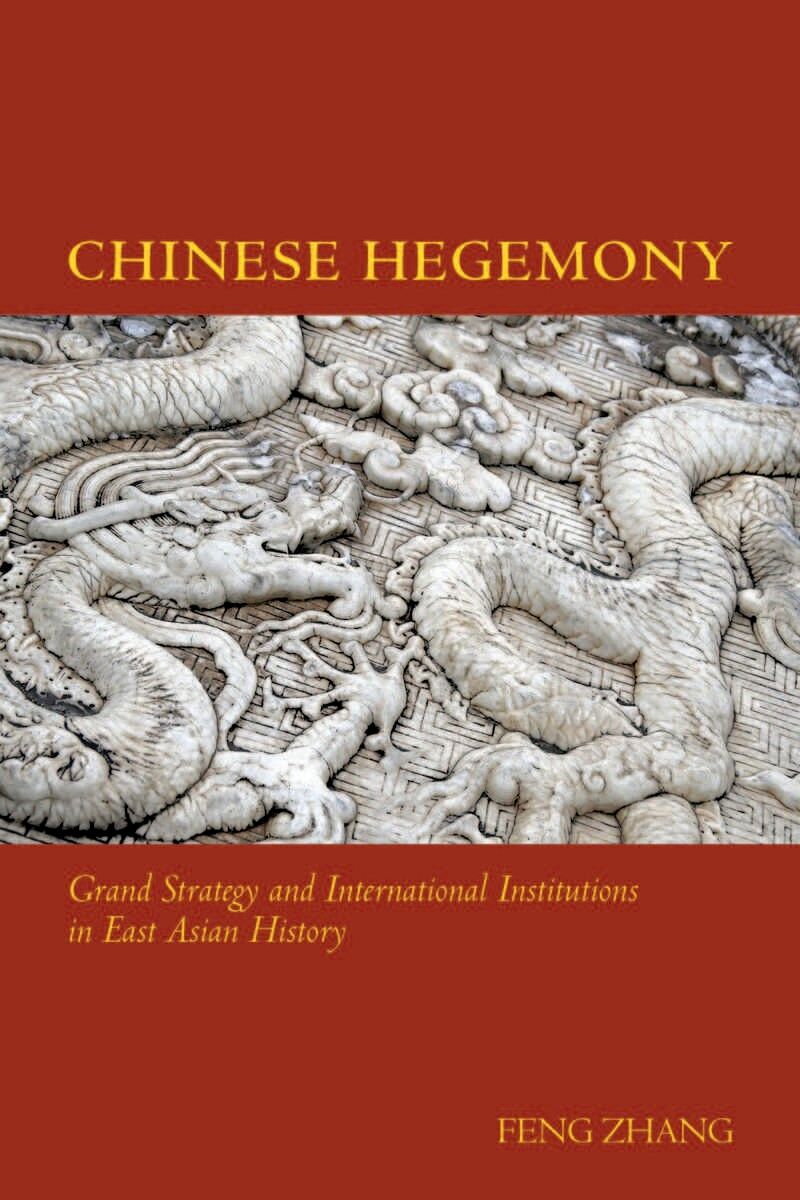
Chinese Hegemony
Chinese Hegemony: Grand Strategy and International Institutions in East Asian History joins a rapidly growing body of important literature that combines history and International Relations theory to create new perspectives on East Asian political and strategic behavior. The book explores the strategic and institutional dynamics of international relations in East Asian history when imperial China was the undisputed regional hegemon, focusing in depth on two central aspects of Chinese hegemony at the time: the grand strategies China and its neighbors adopted in their strategic interactions, and the international institutions they engaged in to maintain regional order-including but not limited to the tribute system.
Feng Zhang draws on both Chinese and Western intellectual traditions to develop a relational theory of grand strategy and fundamental institutions in regional relations. The theory is evaluated with three case studies of Sino-Korean, Sino-Japanese, and Sino-Mongol relations during China's early Ming dynasty-when a type of Confucian expressive strategy was an essential feature of regional relations. He then explores the policy implications of this relational model for understanding and analyzing contemporary China's rise and the changing East Asian order. The book suggests some historical lessons for understanding contemporary Chinese foreign policy and considers the possibility of a more relational and cooperative Chinese strategy in the future.
eBook


Culture and hegemony in the colonial Middle East
This work is a study of the nature and origin of nationality and modern social ideals in the Middle East, particularly Egypt, in the late nineteenth to mid-twentieth centuries.Bringing together writings on political and social reform with literary works, Noorani challenges dominant assumptions about the emergence of modernity.
eBook

The dimensions of hegemony : language, culture and politics in revolutionary Russia
In The Dimensions of Hegemony Craig Brandist offers a detailed analysis of debates around the cultural and linguistic aspects of proletarian leadership in revolutionary Russia. The result is a new perspective on critiques usually associated with sociolinguistic and post-colonial studies.
eBook