
Catalogue Search | MBRL


Are you sure you want to remove the book from the shelf?

{{itemTitle}}
50
result(s) for
"Henri de Man"
Sort by:

Leaving Marxism : studies in the dissolution of an ideology
This book seeks to understand the failure of Marxism by viewing it up close, in the experiences of three important Marxist intellectuals, each of whom embraced Marxism early in life and later decisively rejected it. Their experiences provide the framework for a more general account of modern ideological disenchantment.
eBook

The Wager of Lucien Goldmann
InThe Wager of Lucien Goldmann,Mitchell Cohen provides the first full-length study of this major figure of postwar French intellectual life and champion of socialist humanism. While many Parisian leftists staunchly upheld Marxism's \"scientificity\" in the 1950s and 1960s, Lucien Goldmann insisted that Marxism was by then in severe crisis and had to reinvent itself radically if it were to survive. He rejected the traditional Marxist view of the proletariat and contested the structuralist and antihumanist theorizing that infected French left-wing circles in the tumultuous 1960s.
Highly regarded by thinkers as diverse as Jean Piaget and Alasdair MacIntyre, Goldmann is shown here as a socialist who, unlike many others of his time, refused to portray his aspirations for humanity's future as an inexorable unfolding of history's laws. He saw these aspirations instead as a wager akin to Pascal's in the existence of God. \"Risk,\" Goldmann wrote in his classic study of Pascal and Racine,The Hidden God,\"possibility of failure, hope of success, and the synthesis of the three in a faith which is a wager are the essential constituent elements of the human condition.\" InThe Wager of Lucien Goldmann,Cohen retrieves Goldmann's achievement--his \"genetic structuralist\" method, his sociology of literature, his libertarian socialist politics.
eBook

Ulf Starks pojkland En litterär exkursion i Stureby
A great part of Ulf Stark’s literary œuvre takes place in Stureby, a suburb south of Stockholm, and more specifically Stureby in the 1950s, the place and era of the author’s own boyhood. Although the environment we enter via Stark’s authorship is to be regarded as his imaginary universe, an investigation such as this shows that there are several links and correspondences between the literary setting and the real suburb. In order to investigate some of these connections, this study invokes two theoretical fields. The first one is literary geography, more precisely Henri Lefebvre’s spatial triad, concerning three both different and interacting ways of understanding a room: the perceived, the conceptualized, and the social. Furthermore this survey takes into account different historical documents concerning Stureby, and also a form of literary excursion, a pondering walking tour around Stureby of today, with Stark’s narrative in mind. The second theoretical field is boyhood studies and in particular the idea of a boys’ own “nation”, a distinct cultural world with its own rituals and own symbols and values: a social space where the boys play outside the rules of the adult world. The book chosen for this investigation is Stark’s Min vän Percys magiska gymnastikskor (My Friend Percy’s Magical Gym Shoes, 1991). The study shows that specific places in Stureby, such as the suburban road, the tunnel, the kiosk, and the subway bridge are invaded and appropriated by the boys, and turned into arenas of different boy culture rituals and adventures. This, in turn, means that the geographical places described in Stark’s work influence the style of the work – for example its narrative action, its vocabulary, the narrative devices, and the compositional form.
Journal Article
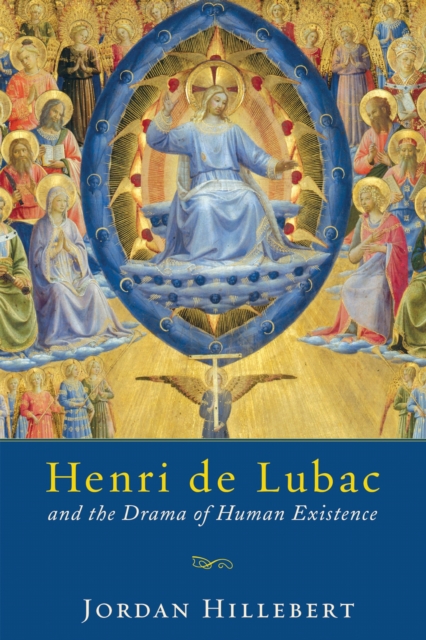
Henri de Lubac and the Drama of Human Existence
The French Jesuit Henri de Lubac (1896-1991) was one of the most
influential theologians of the twentieth century. The publication
of his Surnaturel in 1946, addressing the issue of the
interrelation of nature and the supernatural, precipitated one of
the most far-reaching theological debates of the century,
culminating in a new historical, methodological, and theological
consensus on the topic. And yet the question continues to be
debated: How should de Lubac's position be understood? Although
many have suggested that de Lubac saw human nature as
always-already graced, in Henri de Lubac and the Drama of Human
Existence , Jordan Hillebert advances a new reading of de
Lubac's theology of the supernatural that is at variance with most
prevailing interpretations. Through his analysis of how a
\"hermeneutics of human existence\" pervades de Lubac's writings,
Hillebert argues that, in de Lubac's theology, the relation between
the human being and humanity's supernatural finality is best
considered in terms of the \"supernatural insufficiency of human
nature.\" In this way, Hillebert demonstrates that de Lubac's
theology of the supernatural offers a via media between
neo-scholastic \"extrinsicism\" on the one hand and post-conciliar
\"intrinsicism\" on the other.
Although some authors have drawn attention to the theme of human
existence in de Lubac's writings, Henri de Lubac and the Drama
of Human Existence is an original study that shows
how a hermeneutics of human existence provides an interpretative
key to his writings-especially in regard to the controversial
question of the relation of nature and the supernatural. Due to the
book's broad ecumenical appeal, it will interest scholars in the
fields of modern theology and, more specifically, Roman Catholic
theology.
eBook