
Catalogue Search | MBRL


Are you sure you want to remove the book from the shelf?

{{itemTitle}}
588,077
result(s) for
"Henry"
Sort by:

Alibis of Empire
Alibis of Empire presents a novel account of the origins, substance, and afterlife of late imperial ideology. Karuna Mantena challenges the idea that Victorian empire was primarily legitimated by liberal notions of progress and civilization. In fact, as the British Empire gained its farthest reach, its ideology was being dramatically transformed by a self-conscious rejection of the liberal model. The collapse of liberal imperialism enabled a new culturalism that stressed the dangers and difficulties of trying to \"civilize\" native peoples. And, hand in hand with this shift in thinking was a shift in practice toward models of indirect rule. As Mantena shows, the work of Victorian legal scholar Henry Maine was at the center of these momentous changes. Alibis of Empire examines how Maine's sociotheoretic model of \"traditional\" society laid the groundwork for the culturalist logic of late empire. In charting the movement from liberal idealism, through culturalist explanation, to retroactive alibi within nineteenth-century British imperial ideology, Alibis of Empire unearths a striking and pervasive dynamic of modern empire.
eBook
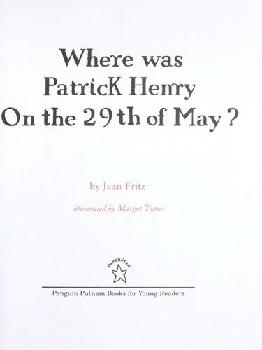
Where was Patrick Henry on the 29th of May?
A brief biography of Patrick Henry tracing his progress from planter to statesman.
Book

Performing the Everyday in Henry James's Late Novels
Focusing on James's last three completed novels - The Ambassadors, The Wings of the Dove, and The Golden Bowl - Maya Higashi Wakana shows how a microsociological approach to James's novels radically revises the widespread tradition of putting James's characters into historical and cultural contexts. Wakana begins with the premise that day-to-day living is inherently theatrical and thus duplicitous, and goes on to show that James's art relies significantly on his powerful sense of the agonizing and even dangerous complications of mundane face-to-face rituals that pervade his work. Centrally informed by social thinkers such as G. H. Mead and Erving Goffman, Wakana's study discloses the richness, complexity, and singularity of the interpersonal connections depicted in James's late novels. Persuasively argued, and rich in original close readings, her book makes an important contribution to James's studies and to theories of social interaction.
eBook


Acting beautifully : Henry James and the ethical aesthetic
What is the matter with the women in Henry James? In The Portrait of a Lady, The Wings of the Dove, and his short story “The Altar of the Dead,” one woman returns to a monster of a husband, another dies rather than confront the truth of her lover’s engagement, while yet another stakes her all on having a candle lit for a dead lover, only to promptly reject it. Exploring these strange choices, Sigi Jöttkandt argues that the singularity of these acts lies in their ethical nature, and that the ethical principle involved cannot be divorced from the question of aesthetics. She combines close readings of James with suggestive tours through Kantian aesthetics and set theory to uncover the aesthetic underpinning of the Lacanian ethical act, which has been largely overlooked in the current drive to discover a Cartesian origin for the subject as the subject of science.
eBook


The Gospel According to This Moment
Henry David Thoreau is best known as a writer, naturalist, and
social critic, but he was also a schoolteacher, surveyor, and
pencil-maker. In The Gospel According to This Moment ,
Unitarian minister Barry M. Andrews reveals how an idiosyncratic
and unconventional religious faith was central to Thoreau's
many-faceted life-a dimension that has been largely unexamined.
Through close readings of his writings and a focus on his Unitarian
upbringing, Harvard education, mentoring by Ralph Waldo Emerson,
and immersion in ancient Eastern and Western philosophies, Andrews
explores the nature of Thoreau's spiritual message, what he called
the \"Gospel according to this moment,\" which enables a flourishing
and deliberate life. Today, Thoreau is widely recognized as an
advocate for simple living, environmental preservation, and civil
disobedience. As Andrews uncovers, Thoreau is also a spiritual
guide who can teach us an alternative way of being religious in the
world.
eBook