
Catalogue Search | MBRL


Are you sure you want to remove the book from the shelf?

{{itemTitle}}
17,885
result(s) for
"Herbert Hoover"
Sort by:


The Final Illness of Herbert Hoover
Herbert Hoover, the archetypal self-made man, was the 31st president of the United States. His term in office was overwhelmed by the Great Depression and he was defeated by Franklin Delano Roosevelt in the 1932 November presidential election. His post-presidential years were spent writing and serving 4 subsequent presidents. Near the end of his life, he underwent a cholecystectomy for symptomatic gallstones and a colectomy for colon cancer. His health care was complicated by the development of cirrhosis and recurrent gastrointestinal bleeding. After his 90th birthday, he died in October 1964 from massive bleeding due to a Dieulafoy lesion of the gastric cardia. This manuscript will review the details of his health and the physicians who cared for Hoover during his final years.
Journal Article

Herbert Hoover in the White House : the ordeal of the presidency /
\"Herbert Clark Hoover was the thirty-first President of the United States. He served one term, from 1929 to 1933. Often considered placid, passive, unsympathetic, and even paralyzed by national events, Hoover faced an uphill battle in the face of the Great Depression. Many historians dismiss him as merely ineffective. But in [this book], Charles Rappleye draws on rare and intimate sources--memoirs and diaries and thousands of documents kept by members of his cabinet and close advisors--to reveal a very different figure than the one often portrayed. The real Hoover, argues Rappleye, just lacked the tools of leadership\"--Amazon.com.
Book


The life of Herbert Hoover : fighting Quaker, 1928-1933
This is the first definitive study of the presidency of America's least understood, most neglected and most under-appreciated Chief Executive. Born in a Quaker hamlet in Iowa, orphaned at nine, Herbert Hoover rose to wealth and world fame as an international mining engineer, the savior of Belgium during the Great War, and Food Administrator under Woodrow Wilson. Perhaps the greatest Secretary of Commerce in American history, he helped engineer the prosperity of the 1920s and vainly warned of an economy overheated by speculation that collapsed in the Wall Street Crash of 1929. Combining government with private resources, he became the first president to pit government action against the economic cycle, setting precedents and spawning ideas employed by his successor and all future presidents. Modest, shy, humble, with a subtle sense of humor, he lacked the self-promotional style of professional politicians and eschewed political invective. His depression measures mitigated the effects of the depression yet failed to end it. In foreign policy he sponsored naval disarmament, refused to recognition territory seized by force, and made world peace his priority. Maligned as a miserly misanthrope, he was blamed for the crash and depression during the 1932 campaign, which he lost to Franklin D. Roosevelt by a slightly larger margin than he had defeated Al Smith in 1928. Jeansonne's study sweeps away the cobwebs of neglect from Hoover's presidency and his lively prose humanizes and evokes greater understanding of our thirty-first president. -- Publisher's description.
Book
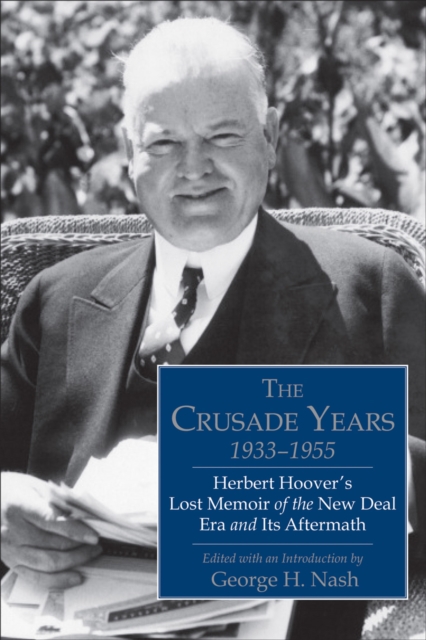
The Crusade Years, 1933–1955
Covering an eventful period in Herbert Hoover's career—and, more specifically, his life as a political pugilist from 1933 to 1955—this previously unknown memoir was composed and revised by the 31st president during the 1940s and 1950s—and then, surprisingly, set aside. This work recounts Hoover's family life after March 4, 1933, his myriad philanthropic interests, and, most of all, his unrelenting \"crusade against collectivism\" in American life. Aside from its often feisty account of Hoover's political activities during the Roosevelt and Truman eras, and its window on Hoover's private life and campaigns for good causes, The Crusade Years invites readers to reflect on the factors that made his extraordinarily fruitful postpresidential years possible. The pages of this memoir recount the story of Hoover's later life, his abiding political philosophy, and his vision of the nation that gave him the opportunity for service. This is, in short, a remarkable saga told in the former president's own words and in his own way that will appeal as much to professional historians and political scientists as it will lay readers interested in history.
eBook

Herbert Hoover : a life
\"Jeansonne delves into the life of [a] misunderstood president, offering up a surprising new portrait of Herbert Hoover--dismissing previous assumptions and [positing] a political Progressive in the mold of Theodore Roosevelt, and the most resourceful American since Benjamin Franklin\"--Dust jacket flap.
Book
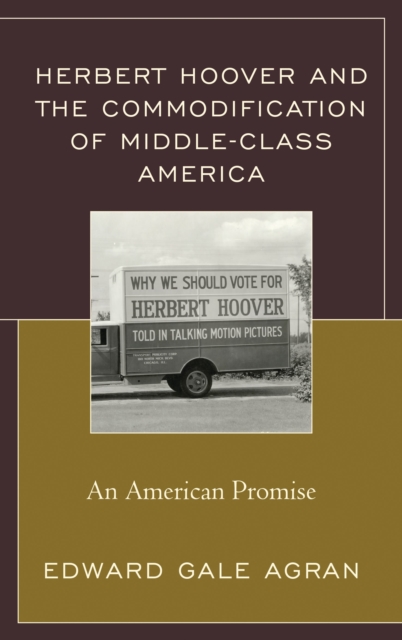
Herbert Hoover and the Commodification of Middle-Class America
Herbert Hoover rose from a rudimentary background to establish himself as a self-made millionaire and leading progressive reformer.Until the disaster that hit the nation in 1929, Hoover was known globally as the \"Great Humanitarian\" who had saved the lives of scores of millions of Europeans and Asians during and following WWI.
eBook

Herbert Hoover and world peace
Herbert Hoover and World Peace summarizes Hoover's career-long efforts to preserve peace in the world and to help America avoid unnecessary wars, from his opposition to our entry into World War I to his proposed — and rejected — Cold War strategy, which would have avoided the Vietnam War. Personal experiences in the Boxer Rebellion in China and helping to feed Belgium during World War I, coupled with his early Quaker nurture, that sensitized him to war-related tragedies. These essays illustrate the varied ways in which Hoover expressed and implemented his commitment to world peace, as humanitarian, advisor, cabinet member, president, citizen, and writer. No other president was so consistent and thoughtful on matters of world peace.
eBook