
Catalogue Search | MBRL


Are you sure you want to remove the book from the shelf?

{{itemTitle}}
7,959
result(s) for
"Heredity History."
Sort by:


Pornographic Archaeology
In Pornographic Archaeology: Medicine, Medievalism, and the Invention of the French Nation, Zrinka Stahuljak explores the connections and fissures between the history of sexuality, nineteenth-century views of the Middle Ages, and the conceptualization of modern France. This cultural history uncovers the determinant role that the sexuality of the Middle Ages played in nineteenth-century French identity.Stahuljak's provocative study of sex, blood, race, and love in nineteenth- and early twentieth-century medical and historical literature demonstrates how French medicine's obsession with the medieval past helped to define European sexuality, race, public health policy, marriage, family, and the conceptualization of the Middle Ages. Stahuljak reveals the connections between the medieval military order of the Templars and the 1830 colonization of Algeria, between a fifteenth-century French marshal and the development of Richard von Krafft-Ebing's theory of sadism, between courtly love and the 1884 law on divorce. Although the developing discipline of medieval studies eventually rejected the influence of these medical philologists, the convergence of medievalism and medicine shaped modern capitalist French society and established a vision of the Middle Ages that survives today.
eBook

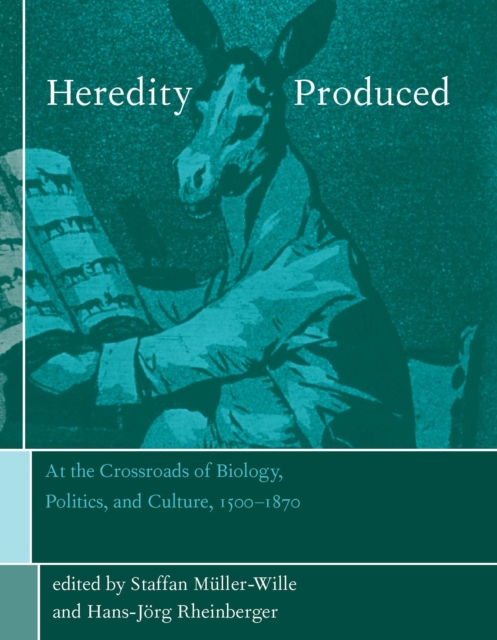
Heredity produced : at the crossroads of biology, politics, and culture, 1500-1870
The cultural history of heredity: scholars from a range of disciplines discuss the evolution of the concept of heredity, from the Early Modern understanding of the act of \"generation\" to its later nineteenth-century definition as the transmission of characteristics across generations.
eBook


How Political Repression Stifled the Nascent Foundations of Heredity Research before Mendel in Central European Sheep Breeding Societies
The nineteenth century was a time of great economic, social, and political change. The population of a modernizing Europe began demanding more freedom, which in turn propelled the ongoing discussion on the philosophy of nature. This spurred on Central European sheep breeders to debate the deepest secrets of nature: the transmission of traits from one generation to another. Scholarly questions of heredity were profoundly entwined with philosophy and politics when particular awareness of “the genetic laws of nature” claimed natural equality. The realization that the same rules of inheritance may apply to all living beings frightened both the absolutist political power and the divided society of the day. Many were not prepared to separate religious questions from novel natural phenomena. Open-minded breeders put their knowledge into practice right away to create sheep with better wool traits through inbreeding and artificial selection. This was viewed, however, as the artificial modification of nature operating against the cultural and religious norms of the day. Liberal attempts caught the attention of the secret police and, consequently, the aspirations of scholars were suppressed by political will during approximately 1820–1850.
Journal Article


The Mendelian Revolution
An introduction to the history of genetics and the rethinking of evolutionism.
eBook


Science of breeding and heredity from ancient Persia to modern Iran
About 1700 years BC, the prophet Zoroaster declared equal right for
women and men to choose their \"own ways.\" There is much evidence that
ancient Persians believed in the equal contribution of women and men
toward producing a child, and all its hereditary characteristics. Even
more surprising are the phrases in Vandidad book, which were gathered
by Mobedans in the Mad dynasty about egg extraction (gametes) from
animal reproductive organs (gonads) and their storage for future
conception. Centuries later, Western philosopher beliefs in regard to
reproduction were contrary to Persian knowledge. The Greek philosophers
believed that man′s water (semen) contains all human
characteristics, and the female uterus is only responsible for
nurturing and development of fetus. After detection of the ovum (de
Graaf 2nd half 17 century) Malpigy proposed the preformation theory
(ovist) which means there is a miniature human inside ovum, that grows
after Semen has entered the uterus and grow into a well-developed
fetus. This hypothesis was later delegated to spermatozoa. These
contradictory and inappropriate beliefs were subject to discussions and
dispute, until C.E. Wolf demonstrated that the embryo is a product of
the fertilization of ovum by spermatozoa. 800 years prior this the sage
Ferdowsi \"The Great Iranian Poet\" explains nicely the equal
participation of man and woman in the production of the fetus and
transmission of characters. After the renaissance and especially in
recent years, tremendous achievements have been made in unraveling
biological secrets of reproduction. There was no work on genetics in
Iran until 1936, when a genetic course was added to the biology
curriculum in related colleges and universities; Iranian Genetics
Society was founded in 1966, initiating a steady movement in this
field. Although there was an inevitable gap during the revolution and
war in our country, now there is great effort by researchers to
eliminate the gap and bring us into the mainstream of world science,
and development in biomedical sciences in the third millennium.
Journal Article