
Catalogue Search | MBRL


Are you sure you want to remove the book from the shelf?

{{itemTitle}}
51
result(s) for
"Hersenen."
Sort by:


Divided Brains
Asymmetry of the brain and behaviour (lateralization) has traditionally been considered unique to humans. However, research has shown that this phenomenon is widespread throughout the vertebrate kingdom and found even in some invertebrate species. A similar basic plan of organisation exists across vertebrates. Summarising the evidence and highlighting research from the last twenty years, the authors discuss lateralization from four perspectives - function, evolution, development and causation - covering a wide range of animals, including humans. The evolution of lateralization is traced from our earliest ancestors, through fish and reptiles to birds and mammals. The benefits of having a divided brain are discussed, as well as the influence of experience on its development. A final chapter discusses outstanding problems and areas for further investigation. Experts in this field, the authors present the latest scientific knowledge clearly and engagingly, making this a valuable tool for anyone interested in the biology and behaviour of brain asymmetries.
eBook

Sex differences in the brain : from genes to behavior
Sex is a fundamentally important biological variable. Recent years have seen significant progress in the integration of sex in many aspects of basic and clinical research, including analyses of sex differences in brain function. Significant advances in the technology available for studying the endocrine and nervous systems are now coupled with a more sophisticated awareness of the interconnections of these two communication systems of the body. A thorough understanding of the current knowledge, conceptual approaches, methodological capabilities, and challenges is a prerequisite to continued progress in research and therapeutics in this interdisciplinary area. This book provides scientists with the basic tools for investigating sex differences in brain and behavior, and insight into areas where important progress in understanding physiologically relevant sex differences has already been made. The book is arranged in three parts. The first part of the book introduces the study of sex differences in the brain, with an overview of how the brain, stress systems, and pharmacogenetics differ in males and females and how this information is important for the study of behavior and neurobiology of both genders. The second part presents examples of sex differences in neurobiology and behavior from both basic and clinical research perspectives, covering both humans and nonhuman animals. The final part discusses sex differences in the neurobiology of disease and neurological disorders.
eBook

Human brain anatomy in computerized images
This book provides an atlas of the normal human brain based on three dimensional reconstructions of magnetic resonance scans obtained in normal living adults as well as neurological patients with focal brain lesions. It provides detailed descriptions of sulci and gyri and illustrates how they appear in different brains. The book shows how different slice orientations obtained in the same brain produce different images that can be anatomically misinterpreted, in normal brains as well as brains with lesions. The book also addresses quantitative differences between the human brain and the brains of apes; gray and white matter differences between the hemispheres; and differences related to gender, age, and congenital deafness.
eBook

The Lying Brain
\"The Lying Brainis a study to take seriously. Its argument is timely, clear, and of particular importance to the enlargement of our understanding of the relationships among science studies, literary studies, and technology studies.\"---Ronald Schleifer, University of Oklahoma
Real and imagined machines, including mental microscopes, thought translators, and polygraphs, have long promised to detect deception in human beings. Now, via fMRI and EEG, neuroscientists seem to have found what scientists, lawyers, and law enforcement officials have sought for over a century: foolproof lie detection. But are these new lie detection technologies any different from their predecessors?The Lying Brainis the first book to explore the cultural history of an array of lie detection technologies: their ideological assumptions, the scientific and fictional literatures that create and market them, and the literacies required for their interpretation.
By examining a rich archive of materials about lie detection---from science to science fiction---The Lying Braindemonstrates the interconnections of science, literature, and popular culture in the development and dissemination of deception detection in the American cultural imagination. As Melissa Littlefield demonstrates, neuroscience is not building a more accurate lie detector; it is simply recycling centuries-old ideologies about deception and its detection.
Cover art: \"Human Brain\" © Denis Barbulet, courtesy of Shutterstock.com
eBook
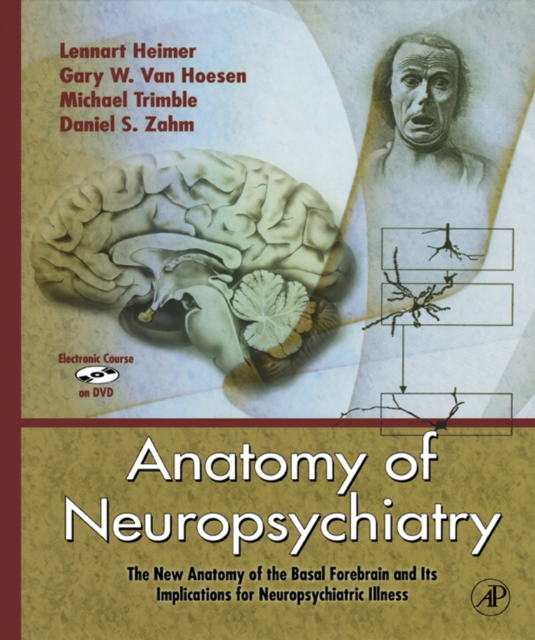
Anatomy of Neuropsychiatry
This book presents the anatomical systems that take part in the scientific and clinical study of emotional functions and neuropsychiatric disorders. It discusses the limbic system-the cortical and subcortical structures in the human brain involved in emotion, motivation, and emotional association with memory-at length and how this is no longer a useful guide to the study of psychiatric disorders. The book provides an understanding of brain anatomy, with an emphasis on the new anatomical framework which has emerged during the last quarter century. The goal is to help the reader develop an understanding of the gross anatomical organization of the human forebrain. All disc-based content for this title is now available on the Web. * A re-evaluation of brain anatomy, with an emphasis on the new anatomical framework which has emerged during the last quarter century* A compellingly expanded conceptualization of Broca's famous limbic lobe* Clinical and basic science boxes highlighting specific concepts, structures, or neuronal circuits from a clinical perspective
eBook

Consciousness and cognition : fragments of mind and brain
What were the circumstances that led to the development of our cognitive abilities from a primitive hominid to an essentially modern human? The answer to this question is of profound importance to understanding our present nature. Since the steep path of our cognitive development is the attribute that most distinguishes humans from other mammals, this is also a quest to determine human origins. This collection of outstanding scientific problems and the revelation of the many ways they can be addressed indicates the scope of the field to be explored and reveals some avenues along which research is advancing. Distinguished scientists and researchers who have advanced the discussion of the mind and brain contribute state-of-the-art presentations of their field of expertise. Chapters offer speculative and provocative views on topics such as body, culture, evolution, feelings, genetics, history, humor, knowledge, language, machines, neuroanatomy, pathology, and perception. This book will appeal to researchers and students in cognitive neuroscience, experimental psychology, cognitive science, and philosophy. * Includes a contribution by Noam Chomsky, one of the most cited authors of our time
eBook
Consciousness
This engaging and readable book provides an introduction to consciousness that does justice both to the science and to the philosophy of consciousness, that is, the mechanics of the mind and the experience of awareness. The book opens with a general discussion of the brain and of consciousness itself. Then, exploring the areas of brain science most likely to illuminate the basis of awareness, Zeman focuses on the science of sleep and waking and on the science of vision. He describes healthy states and disorders-epilepsy, narcolepsy, blindsight and hallucinations after stroke-that provide insights into the capacity for consciousness and into its contents. And he tracks the evolution of the brain, the human species, and human culture and surveys the main current scientific theories of awareness, pioneering attempts to explain how the brain gives rise to experience.Zeman concludes by examining philosophical arguments about the nature of consciousness. A practicing neurologist, he animates his text with examples from the behavioral and neurological disorders of his patients and from the expanding mental worlds of young children, including his own. His book is an accessible and enlightening explanation of why we are conscious.
eBook
Hoe mensen keuzes maken
De kennis over hoe menselijke keuzes gemaakt worden is de laatste jaren flink gegroeid. Vakgebieden als sociale psychologie en hersenwetenschap maken, zeker in Nederland, een grote bloei door. Het zeer toegankelijk geschreven boek Hoe mensen keuzen maken: de psychologie van het beslissen geeft in ruim 100 pagina’s een uniek overzicht van de nieuwste sociaal-psychologische inzichten op dit gebied.
eBook
The Behavioral Neurology of Dementia
The Behavioral Neurology of Dementia is a comprehensive textbook that offers a unique and modern approach to the diagnosis and treatment of patients with dementing conditions in the twenty-first century. The coverage is broad, ranging from common conditions such as Alzheimer's disease, Parkinsonian disorders, vascular and frontotemporal dementia, to the more obscure such as Creutzfeldt–Jakob disease. Subtypes of mild cognitive impairment are presented and the early prodromes of neurodegenerative diseases are explored. Simple approaches to bedside mental status testing, differential diagnosis and treatment, genetic testing, interpreting neuropsychological testing and neuroimaging findings, and assessing rapidly progressive dementias, paraneoplastic syndromes and disorders of white matter give guidance to both the novice and expert in dementia. The basic science of dementia is outlined in introductory chapters on animal models of dementia, dementia epidemiology and dementia neuropathology.
eBook