
Catalogue Search | MBRL


Are you sure you want to remove the book from the shelf?

{{itemTitle}}
19
result(s) for
"Hesiod Influence."
Sort by:


Ovid and Hesiod
The influence on Ovid of Hesiod, the most important archaic Greek poet after Homer, has been underestimated. Yet, as this book shows, a profound engagement with Hesiod's themes is central to Ovid's poetic world. As a poet who praised women instead of men and opted for stylistic delicacy instead of epic grandeur, Hesiod is always contrasted with Homer. Ovid revives this epic rivalry by setting the Hesiodic character of his Metamorphoses against the Homeric character of Virgil's Aeneid. Dr Ziogas explores not only Ovid's intertextual engagement with Hesiod's works but also his dialogue with the rich scholarly, philosophical and literary tradition of Hesiodic reception. An important contribution to the study of Ovid and the wider poetry of the Augustan age, the book also forms an excellent case study in how the reception of previous traditions can become the driving force of poetic creation.
eBook


Hesiod
This book offers a comprehensive account of the role of Hesiod in the ancient imagination, investigating the poet as a literary-critical concept, a moral and philosophical symbol, and generally a cultural icon endlessly employed and re-created by later Greeks.
eBook
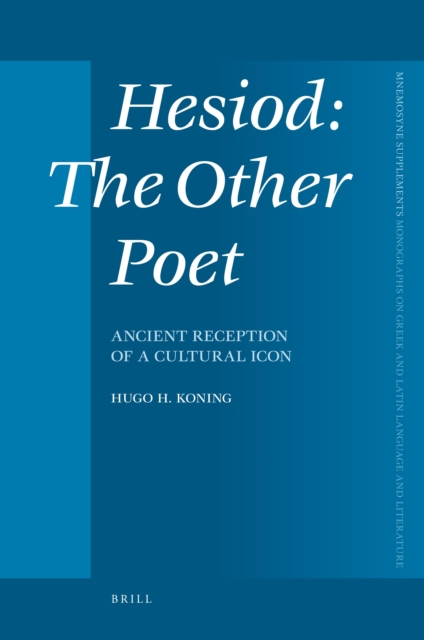
Hesiod: The Other Poet
Hesiod: The Other Poet is a study dealing with the role of Hesiod in the imagination and the collective memory of the ancient Greeks. Its main hypothesis is that Hesiod's image was to a large degree formed by the picture of Homer: Hesiod is decidedly different when presented as allied with, opposed to or simply without Homer. Following this approach, Hesiod is investigated as a moral and philosophical authority, a locus informed with values and qualities, a concept in literary-critical discourse, and more generally as a cultural and panhellenic icon constructed and reconstructed by later Greek authors who employed and so re-created him in their own texts.
eBook
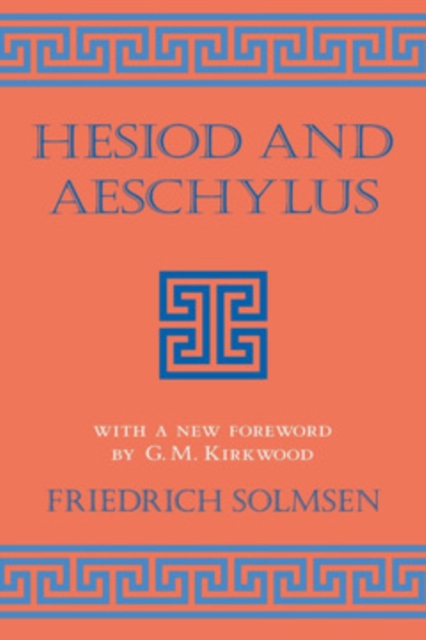
Hesiod and Aeschylus
Friedrich Solmsen provides a new approach to Hesiod's personality in this book by distinguishing Hesiod's own contributions to Greek mythology and theology from the traditional aspects of his poetry. Hesiod's vision of a better world, expressed in religious language and imagery, pictures the savagery and brutality of the earlier days of Greece giving way to an order of justice. In this new order, however, the good aspects of the past would be preserved, giving an inner continuity and strength to the changing world.
Solmsen traces the influence of Hesiod's ideas on other Athenian poets, Aeschylus in particular. From personal political experience Aeschylus could give a deeper meaning to Hesiod's dream of an organic historical evolution and of a synthesis of old and new powers. For Aeschylus, justice became the crucial problem of the political community as well as of the divine order. Through close readings of Hesiod'sTheogonyandWorks and Daysand of Aeschylus'PrometheiaandEumenides, Solmsen reinterprets the political ideas of the Greek city state and the relation between divine and human justice as seen by early Greek poets.
First published in 1949, this book has long been recognized as the standard work on Hesiod's influence. For the 1995 paperback edition, G. M. Kirkwood has written a new foreword that addresses the book's reception and discusses more recent scholarship on the works Solmsen examines, including the disputed authorship ofPrometheia.
eBook

Aesopic conversations
Examining the figure of Aesop and the traditions surrounding him, Aesopic Conversations offers a portrait of what Greek popular culture might have looked like in the ancient world. What has survived from the literary record of antiquity is almost entirely the product of an elite of birth, wealth, and education, limiting our access to a fuller range of voices from the ancient past. This book, however, explores the anonymous Life of Aesop and offers a different set of perspectives. Leslie Kurke argues that the traditions surrounding this strange text, when read with and against the works of Greek high culture, allow us to reconstruct an ongoing conversation of \"great\" and \"little\" traditions spanning centuries.
eBook

Rethinking the Other in Antiquity
Prevalent among classicists today is the notion that Greeks, Romans, and Jews enhanced their own self-perception by contrasting themselves with the so-called Other--Egyptians, Phoenicians, Ethiopians, Gauls, and other foreigners--frequently through hostile stereotypes, distortions, and caricature. In this provocative book, Erich Gruen demonstrates how the ancients found connections rather than contrasts, how they expressed admiration for the achievements and principles of other societies, and how they discerned--and even invented--kinship relations and shared roots with diverse peoples.
Gruen shows how the ancients incorporated the traditions of foreign nations, and imagined blood ties and associations with distant cultures through myth, legend, and fictive histories. He looks at a host of creative tales, including those describing the founding of Thebes by the Phoenician Cadmus, Rome's embrace of Trojan and Arcadian origins, and Abraham as ancestor to the Spartans. Gruen gives in-depth readings of major texts by Aeschylus, Herodotus, Xenophon, Plutarch, Julius Caesar, Tacitus, and others, in addition to portions of the Hebrew Bible, revealing how they offer richly nuanced portraits of the alien that go well beyond stereotypes and caricature.
Providing extraordinary insight into the ancient world, this controversial book explores how ancient attitudes toward the Other often expressed mutuality and connection, and not simply contrast and alienation.
eBook