
Catalogue Search | MBRL


Are you sure you want to remove the book from the shelf?

{{itemTitle}}
1,556
result(s) for
"Hieroglyphics"
Sort by:

Hieroglyphs
Children can create hieroglyphic messages and \"works of art\" while learning about the pictograms of Ancient Egypt.
Book

Reassessing Horapollon: A Contemporary View on Hieroglyphica
[...]I tend to believe that this results from the conjunction of different factors,4 among which are the following : a new perspective on the ancients;5 exacerbated ethnocentrism;6 and the rise of an empirical spirit that would challenge the use of images to convey philosophical or intellectual content.7 It is understandable that every cultural rupture may cause collateral effects, such as to obscure a discussion-as happened with Renaissance hieroglyphs in the eighteenth century, for example. [...]facing the notion of tj.t, it is clear that Eg yptian conception of writing was much different from ours. Because of our own cultural perspective (I would dare to say, logocentrism), we tend to determine reckless boundaries between illustration and text, between image and writing. According to some cosmogonies, everything that existed was but the result of Thoth's reading of the hieroglyphs created by Ptah in his heart.42 Needless to say, this writing had an intimate bond with native religion, a bond that would lead to its oblivion. 40 41 42 The fate of \"hieroglyphic writing\" One should not expect the hieroglyphic writing of the Greco-Roman period, exposed as it was to contemporary historical and political vicissitudes, to be the same as that used in Eg ypt during the first millennium B.C. Like any cultural entity, Eg yptian writing was still subject to the consequences of time, despite the strong convention that kept the hieroglyphic system in relative uniformity for thousands of years. According to Damascius, Horapollon's father, Asclepiades, embalmed his brother, Heraiscus: \"Asclepiades prepared to render him the honours customary to the priests and in particular to wrap his body in the garments of Osiris, mystic signs [diagramma] appeared everywhere on the sheets and around them divine visions which clearly revealed the gods with whom his soul now shared its abode\" (76E).
Journal Article

Egyptian hieroglyphs for complete beginners
Teaches how to translate Egyptian hieroglyphs into English using a step-by-step procedure that includes the use of photographs and line drawings.
Book

Descendants of Aztec Pictography
In the aftermath of the sixteenth-century Spanish conquest of
Mexico, Spanish friars and authorities partnered with indigenous
rulers and savants to gather detailed information on Aztec history,
religious beliefs, and culture. The pictorial books they created
served the Spanish as aids to evangelization and governance, but
their content came from the native intellectuals, painters, and
writers who helped to create them. Examining the nine major
surviving texts, preeminent Latin American art historian Elizabeth
Hill Boone explores how indigenous artists and writers documented
their ancestral culture.
Analyzing the texts as one distinct corpus, Boone shows how they
combined European and indigenous traditions of documentation and
considers questions of motive, authorship, and audience. For
Spanish authorities, she shows, the books revealed Aztec ideology
and practice, while for the indigenous community, they preserved
venerated ways of pictorial expression as well as rhetorical and
linguistic features of ancient discourses. The first comparative
analysis of these encyclopedias, Descendants of Aztec
Pictography analyzes how the painted compilations embraced
artistic traditions from both sides of the Atlantic.
eBook

Rocket Robinson. 1, Rocket Robinson and the pharaoh's fortune
Upon finding a note written in hieroglyphics, Rocket Robinson and his pet monkey team up with gypsy girl Nuri in 1933 Cairo to unscramble the code and locate an ancient pharaoh's fortune before thief Otto von Stürm can find it.
Book

Death and the Classic Maya Kings
Like their regal counterparts in societies around the globe, ancient Maya rulers departed this world with elaborate burial ceremonies and lavish grave goods, which often included ceramics, red pigments, earflares, stingray spines, jades, pearls, obsidian blades, and mosaics. Archaeological investigation of these burials, as well as the decipherment of inscriptions that record Maya rulers' funerary rites, have opened a fascinating window on how the ancient Maya envisaged the ruler's passage from the world of the living to the realm of the ancestors.
Focusing on the Classic Period (AD 250-900), James Fitzsimmons examines and compares textual and archaeological evidence for rites of death and burial in the Maya lowlands, from which he creates models of royal Maya funerary behavior. Exploring ancient Maya attitudes toward death expressed at well-known sites such as Tikal, Guatemala, and Copan, Honduras, as well as less-explored archaeological locations, Fitzsimmons reconstructs royal mortuary rites and expands our understanding of key Maya concepts including the afterlife and ancestor veneration.
eBook

An account of the kings of Kanu'l as recorded on the hieroglyphic stair of K'an II of Caracol
Many questions remain about the hieroglyphic stair dedicated in a.d. 642 by K'an II, the great king of Caracol. Constituent panels have been found at Caracol, Ucanal, Naranjo, and Xunantunich—archaeological sites spread between Guatemala and Belize. The most recently discovered Panels 3 and 4 at Xunantunich shed light on the tumultuous decades of the seventh century. Panel 4, which opened the hieroglyphic stair, makes a surprising statement from the outset, clarifying that Kanu'l political authority was irrevocably established at Calakmul. This bold statement serves as a synoptic précis for the entire narrative and explains why the deeds of K'an II are related, but only to the extent that these could be interwoven with the history of the Kanu'l. This makes the hieroglyphic stair such an important source, because it tracks the rulers of the Kanu'l dynasty from the vantage of a close ally. These monuments attest to the fissioning of the Kanu'l dynasty and its eventual restoration at Calakmul, from whence Classic Maya politics would be overseen for the remainder of the seventh century. In this article, we build on earlier studies and add our most recent observations and new readings based on renewed inspections of the existing panels.
Journal Article

The Humanist Interpretation of Hieroglyphs in the Allegorical Studies of the Renaissance
The Hieroglyphenkunde by Karl Giehlow published in 1915, described variously by critics as \"a masterpiece\", \"magnificent\", \"monumental\" and \"incomparable\", is here translated into English for the first time. Giehlow's work with an initial focus on the Hieroglyphica of Horapollo, the manuscript of which was discovered by Giehlow, was a pioneering attempt to introduce the thesis that Egyptian hieroglyphics had a fundamental influence on the Italian literature of allegory and symbolism and beyond that on the evolution of all Renaissance art. The present edition includes the illustrations of Albrecht Dürer from the Pirckheimer translation of the Horapollo from the early fifteenth century.
eBook

Tell Me the Story of How I Conquered You
Folio 46r from Codex Telleriano-Remensis was created in the sixteenth century under the supervision of Spanish missionaries in Central Mexico. As an artifact of seismic cultural and political shifts, the manuscript painting is a singular document of indigenous response to Spanish conquest. Examining the ways in which the folio's tlacuilo (indigenous painter/writer) creates a pictorial vocabulary, this book embraces the place \"outside\" history from rich this rich document emerged.
Applying contemporary intellectual perspectives, including aspects of gender, modernity, nation, and visual representation itself, José Rabasa reveals new perspectives on colonial order. Folio 46r becomes a metaphor for reading the totality of the codex and for reflecting on the postcolonial theoretical issues now brought to bear on the past. Ambitious and innovative (such as the invention of the concepts of elsewhere and ethnosuicide, and the emphasis on intuition), Tell Me the Story of Howl Conquered You embraces the performative force of the native scribe while acknowledging the ineffable traits of 46r-traits that remain untenably foreign to the modern excavator/scholar. Posing provocative questions about the unspoken dialogues between evangelizing friars and their spiritual conquests, this book offers a theoretic-political experiment on the possibility of learning from the tlacuilo ways of seeing the world that dislocate the predominance of the West.
eBook
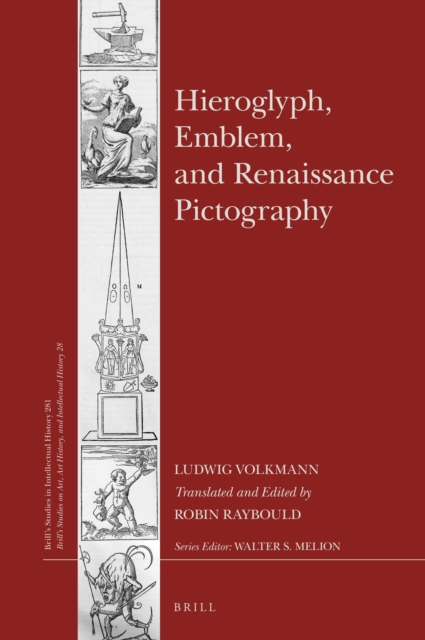
Hieroglyph, Emblem, and Renaissance Pictography
The first English translation of Volkmann's Bilderschriften der Renaissance, the pioneering review of the influence of the hieroglyph on Renaissance culture, focused on the literature of emblem and device in Germany and France.
eBook