
Catalogue Search | MBRL


Are you sure you want to remove the book from the shelf?

{{itemTitle}}
6,181
result(s) for
"High Middle Ages"
Sort by:

Emperor of the World
Emperor of the World , traces the curious history of the
story of the alliances forged by Charlemagne while visiting
Jerusalem and Constantinople, revealing how the memory of the
Frankish Emperor was manipulated to shape the institutions of
kingship and empire in the High Middle Ages.
The legend incorporates apocalyptic themes such as the
succession of world monarchies at the End of Days and the prophecy
of the Last Roman Emperor. Charlemagne's apocryphal journey to the
East increasingly resembled the eschatological final journey of the
Last Emperor, who was expected to end his reign in Jerusalem after
reuniting the Roman Empire prior to the Last Judgment. Latowsky
finds that the writers who incorporated this legend did so to
support, or in certain cases to criticize, the imperial pretentions
of the regimes under which they wrote. Latowsky removes
Charlemagne's encounters with the East from their long-presumed
Crusading context and shows how a story that began as a rhetorical
commonplace of imperial praise evolved over the centuries as an
expression of Christian Roman universalism.
eBook

Disabled Clerics in the Late Middle Ages
The petitions received and the letters sent by the Papal Chancery during the Late Middle Ages attest to the recognition of disability at the highest levels of the medieval Church. These documents acknowledge the existence of physical and/or mental impairments, with the papacy issuing dispensations allowing some supplicants to adapt their clerical missions according to their abilities. A disease, impairment, or old age could prevent both secular and regular clerics from fulfilling the duties of their divine office. Such conditions can, thus, be understood as forms of disability. In these cases, the Papal Chancery bore the responsibility for determining if disabled people were suitable to serve as clerics, with all the rights and duties of divine services. Whilst some petitioners were allowed to enter the clergy, or – in the case of currently serving churchmen – to stay more or less active in their work, others were compelled to resign their position and leave the clergy entirely. Petitions and papal letters lie at intersection of authorized, institutional policy and practical sources chronicling the lived experiences of disabled people in the Middle Ages. As such, they constitute an excellent analytical laboratory in which to study medieval disability in its relation to the papacy as an institution, alongside the impact of official ecclesiastical judgments on disabled lives.
eBook

Political Communication in Chinese and European History, 800-1600
Based on a collaboration between historians of Chinese and European politics, this volume offers a first comprehensive overview of current research on political communication in middle-period European and Chinese history. The chapters present new work on the sources and processes of political communication in European and Chinese history partly through juxtaposing and combining formerly separate historiographies and partly through direct comparison. Contrary to earlier comparative work on empires and state formation, which aimed to explain similarities and differences with encompassing models and new theories of divergence, the goal is to further conversations between historians by engaging regional historiographies from the bottom up.
eBook

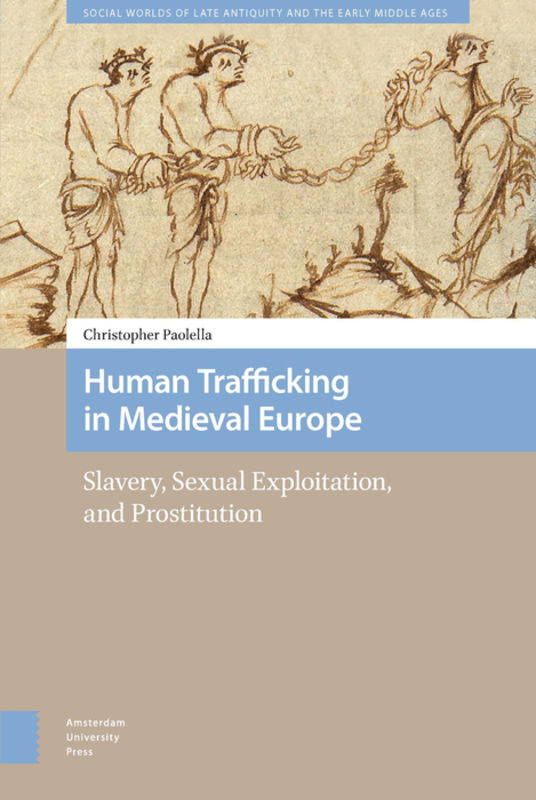
Human Trafficking in Medieval Europe
Human trafficking has become a global concern over the last twenty years, but its violence has terrorized and traumatized its victims and survivors for millennia. This study examines the deep history of human trafficking from Late Antiquity to the Early Modern Period. It traces the evolution of trafficking patterns: the growth and decline of trafficking routes, the everchanging relationships between traffickers and authorities, and it examines the underlying causes that lead to vulnerability and thus to exploitation. As the reader will discover, the conditions that lead to human trafficking in the modern world, such as poverty, attitudes of entitlement, corruption, and violence, have a long and storied past. When we understand that past, we can better anticipate human trafficking’s future, and then we are better able to fight it.
eBook

The Intellectual Dynamism of the High Middle Ages
The essays in The Intellectual Dynamism of the High Middle Ages pay tribute to the work and impact of Constant J. Mews, in spirit and in content, revealing a nuanced and integrated vision of the intellectual history of the medieval West. Mews's groundbreaking work has revealed the wide world of medieval letters: looking beyond the cathedral and the cloister for his investigations, and taking a broad view of intellectual practice in the Middle Ages, Mews has demanded that we expand our horizons as we explore the history of ideas. Alongside his cutting-edge work on Abelard, he has been a leader in the study of medieval women writers, paying heed to Hildegard and Heloise in particular. In Mews' Middle Ages, the world of ideas always belongs to a larger world: one that is cultural, gendered, and politicized.
eBook

Addressing Injustice in the Medieval Body Politic
Justice and injustice were subjects of ongoing debate in medieval Europe. Received classical and biblical models both influenced how these qualities of moral and political life were perceived, discussed and acted upon. Important among these influences was the anonymous seventh-century Irish text, On The Twelve Abuses of the Age, a biblically-inspired discussion of the moral duties particular to each sector of society. This volume probes its long influence, and its interaction with the revival of classical ideas. By bringing together scholars of political thought and practice, in lay and religious contexts spanning the seventh to fourteenth centuries, this volume crosses boundaries of periodisation, discipline and approach to reflect upon the medieval evolution of concepts of injustice and means of redress. Contributions address how ideas about justice and injustice were discussed among scholars and theologians, and how those ideas were translated into action through complaint and advice throughout the medieval period.
eBook

Interpreting Urban Spaces in Italian Cultures
Made up of both material and symbolic elements, the urban space is always dynamic and transitional; it brings together or separates the past and the present, the public and the private, the center and the periphery. The present volume focuses on the interaction between the social processes and spatial forms that shape the identity of Italian cities. Using both canonical and less well-known texts along with cultural artifacts, the essays in the volume deprovincialize the Italian city, interpreting the material and symbolic practices that have made it into a unique entity whose enduring influence extends far outside Italy.
eBook

Cardinal Adam Easton (C. 1330-1397)
The varied career of the Medideval Cardinal Adam Easton (c.1330--1397) led him from Norwich Cathedral Priory to Oxford, Avignon and Rome. This volume presents recent research on Easton's oeuvre, his diplomacy and the books that accompanied him on his travels.
eBook