
Catalogue Search | MBRL


Are you sure you want to remove the book from the shelf?

{{itemTitle}}
5,851
result(s) for
"Hijab (Custom)"
Sort by:

Correction: Responses to the Islamic headscarf in everyday interactions depend on sex and locale: A field experiment in the metros of Brussels, Paris, and Vienna on helping and involvement behaviors
[This corrects the article DOI: 10.1371/journal.pone.0254927.].
Journal Article


“Stay indoors with Purdah, men will make the money”: A qualitative study investigating women’s microfinance participation and mobility practices in Bangladesh
This study aimed to investigate the impact of Purdah, a cultural norm, on the economic independence of women who have received microfinance in Bangladesh. The study also sought to understand whether the Purdah norm has an influence on microfinance loans, such as use, control, and repayment, relevant to female borrowers' mobility practice. Perception, cultural value, and Purdah's implications for everyday life were also considered.
We selected women's groups in development programs, such as microfinance, as the case for this study. By using a snowball sampling technique, we identified 25 microfinance recipients for interview- mostly women and their spouses living in the Dumuria and Tala Upazilas in the Khulna division of Bangladesh. The research employed thematic analysis to draw conclusions and explain the findings.
The study findings show that traditional norms associated with Purdah hinder women's economic engagement and that the practice of Purdah among women is institutionalized from a very young age, primarily before marriage. The findings further explain that Purdah norms limit women's mobility, act as a cultural barrier to IGAs, create economic dependence on men, and enable men to control microfinance loans. Therefore, women are not fully in control of their microfinance loans, and microfinance participation appears to be a less satisfactory form of financial inclusion for participants.
This study suggests that viewing Purdah solely as a religious requirement limits understanding of its cultural roots. Cultural interpretation is needed to shape policies and reduce Purdah's impact on women's mobility.
Journal Article

Good Headscarf, Bad Headscarf: Drawing the (Hair)lines of Turkishness
Focusing on images disseminated by the mainstream laicist press in the 1990s, this essay examines how Turkey's headscarf bans were bolstered not just by negative images of veiling and positive images of unveiling, but also by images of women wearing what was deemed a good or acceptable type of headscarf or wearing the headscarf in contexts that were deemed appropriate. In other words, counter to prevailing opinion, Turkey's “secularist” opinion leaders did not simply ban the headscarf, but also praised and promoted it, or at least versions of it and times and places for it, in the late twentieth century. These images of the “good” headscarf worn by the “good” female citizen were intimately connected to dominant constructions of Turkishness and related to gendered ideas about the citizen's willing submission to the state. Studying the images and texts generated by mainstream laicist newspapers in support of the ban and revisiting the fractals of difference established around practices of head covering at this time helps highlight the ambiguities of Turkish laicism and the post-coup Turkish-Islamic synthesis.
Journal Article

Correction to “Diversity and Relative Abundance of Avian Species in the Wetland Area Northwest of Lake Abaya, Southern Ethiopia”
[This corrects the article DOI: 10.1155/2023/9964189.].
Journal Article

Evaluation of Scalp Hydration and pH Values in Hijab-Wearing and Non-Hijab-Wearing Women
Introduction: Indonesia is the most populous Muslim-majority country, where some women wear hijab covering their scalp and neck. Some hijab-wearing women complain of scalp problems eg, itch, dandruff, and hair loss, which might be related to severe and chronic skin barrier impairment due to occlusion. Excessive water accumulation in the occluded stratum corneum might result in increased permeability, followed by increased skin pH values. This study aimed to evaluate scalp hydration and pH values in hijab-wearing and non-hijab-wearing women. Material and Methods: This was a cross-sectional comparative analytical study using stratified random sampling methods conducted on 63 subjects, who were divided into two groups, consisting of 33 hijab-wearing and 30 non-hijab-wearing women. Both groups underwent physical examination and their medical history recorded. Scalp hydration was measured using a Corneometer (Courage + Khazaka, Koln, Germany), and scalp pH value was measured using a Skin & Scalp pH Tester (Hanna Instruments[R] HI981037, Rumania). This study was conducted at the Dermatology and Venereology Clinic of Hasan Sadikin General Hospital Bandung. Results: The mean scalp hydration and pH values were 18.34 [+ or -] 2.91 AU and 4.93 [+ or -] 0.17, respectively, in hijab-wearing women. Meanwhile, the mean scalp hydration and pH values were 17.71 [+ or -] 3.35 AU and 4.91 [+ or -] 0.16, respectively, in non-hijab-wearing women. The difference of scalp hydration and pH values between the groups was not statistically significant based on the independent t-test, with p-values of 0.430 and 0.597, respectively. Conclusion: Scalp hydration and pH values in hijab-wearing and non-hijab-wearing women did not differ significantly. Hijabwearing women should not worry about scalp barrier impairment as long as they do not have any history of underlying scalp and skin disorders, and do not wear hijab in wet condition. Keywords: hijab, hydration, pH, scalp, women
Journal Article
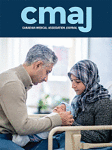
Dismantling gendered Islamophobia in medicine
The image of the oppressed, veiled Muslim woman has long been used to justify ongoing Western colonialism. In Dec 2021, the Letters pages of CMAJ gave voice to a familiar trope: that of the Muslim woman wearing a hijab, or Islamic headscarf, as an \"oppressed\" figure. Such representations align with prejudiced Orientalist discourses that classify Islam as a \"barbaric\" religious tradition in need of civilizing. This racist sentiment has been used repeatedly to justify a supposed need for Muslim women to be rescued from their cultural and religious practices by Western-European powers, with debates often centered around the hijab. Such discourses lie at the root of gendered Islamophobia, defined as \"forms of ethno-religious and racialized discrimination leveled at Muslim women that proceed from historically and textualized negative stereotypes that inform individual and systemic forms of oppression.\" Muslim women in health care professions in Canada face multiple forms of Islamophobia, including systemic barriers, overt discrimination and daily interpersonal macro- and microaggressions. Here, Khan et al discuss gendered Islamophobia in medicine and solutions to address it.
Journal Article
Diversity and Relative Abundance of Avian Species in the Wetland Area Northwest of Lake Abaya, Southern Ethiopia
Studies on the diversity and relative abundance of birds are crucial for improving wetland bird conservation in Ethiopia. The current study aimed at investigating the diversity and relative abundance of avian species in the wetland area around Lake Abaya’s northwest tip in southern Ethiopia due to the lack of previous studies that were conducted in the area. A line transect method was applied to determine the avian species in the area. A total of eight line transects were established along the banks. Using encounter rates, which provide crude ordinal scales of abundance, the relative abundance of avian species was calculated. In the intended habitat, Shannon-Wiener diversity indices (H′) were employed to analyze the diversity of avian species. During the study period, a total of 34 bird species belonging to 18 families and 12 orders were recorded. Ardeidae and Threskiornithidae were the two most dominant families. In this study, 13 bird species were frequent, four were common, four were rare, one was uncommon, and 10 had abundant records. The highest species diversity (H′ = 3.40), species evenness (0.093), and Margalef’s richness index (N = 30) were recorded during the months of June, July, and May, respectively. The lowest species diversity (H′ = 3.13), evenness (0.088), and Margalef’s richness index (N = 23) were all recorded during the month of February. The present findings will provide relevant information to the concerned bodies and policymakers to take appropriate conservation measures for wetland birds.
Journal Article