
Catalogue Search | MBRL


Are you sure you want to remove the book from the shelf?

{{itemTitle}}
3,661,851
result(s) for
"His Family"
Sort by:

House built on ashes : a memoir
\"Told through a series of vignettes, Rodrâiguez recalls his family's migration from La Sierrita, Mexico to McAllen, Texas and his search for belonging, both as a resident alien and as a young man marked by childhood trauma and poverty struggling with the societal condemnation of his burgeoning homosexuality.\"--provided by publisher.
Book

The enculturated gene
In the 1980s, a research team led by Parisian scientists identified several unique DNA sequences, or haplotypes, linked to sickle cell anemia in African populations. After casual observations of how patients managed this painful blood disorder, the researchers in question postulated that the Senegalese type was less severe. The Enculturated Gene traces how this genetic discourse has blotted from view the roles that Senegalese patients and doctors have played in making sickle cell \"mild\" in a social setting where public health priorities and economic austerity programs have forced people to improvise informal strategies of care.
eBook

Andy Warhol : prints from the collections of Jordan D. Schnitzer and his family foundation
\"I'm for mechanical art,\" said Andy Warhol (1928-87). \"When I took up silkscreening, it was to more fully exploit the preconceived image through commercial techniques of multiple reproduction.\" Printmaking was a vital artistic practice for Warhol. Prints figure prominently throughout his career from his earliest work as a commercial illustrator in the 1950s to the collaborative silkscreens made in the Factory during the 1960s and the commissioned portfolios of his final years. In their fascination with popular culture and provocative subverting of the difference between original and copy, Warhol's prints are recognized now as a prescient forerunner of today's hyper-sophisticated, hyper-saturated and hyper-accelerated visual culture.
BOOK


The New Arab Man
Middle Eastern Muslim men have been widely vilified as terrorists, religious zealots, and brutal oppressors of women.The New Arab Manchallenges these stereotypes with the stories of ordinary Middle Eastern men as they struggle to overcome infertility and childlessness through assisted reproduction.
Drawing on two decades of ethnographic research across the Middle East with hundreds of men from a variety of social and religious backgrounds, Marcia Inhorn shows how the new Arab man is self-consciously rethinking the patriarchal masculinity of his forefathers and unseating received wisdoms. This is especially true in childless Middle Eastern marriages where, contrary to popular belief, infertility is more common among men than women. Inhorn captures the marital, moral, and material commitments of couples undergoing assisted reproduction, revealing how new technologies are transforming their lives and religious sensibilities. And she looks at the changing manhood of husbands who undertake transnational \"egg quests\"--set against the backdrop of war and economic uncertainty--out of devotion to the infertile wives they love.
Trenchant and emotionally gripping,The New Arab Mantraces the emergence of new masculinities in the Middle East in the era of biotechnology.
eBook

Limiting futile therapy as part of end-of-life care in intensive care units
The debate about medical futility often involves intensive care units where life-support
procedures are routinely applied. Futile therapy is part of end-of-life therapy. In the
discussion about medical futility it is important to distinguish the effect of therapy from
the benefit for the patient. The goal of treatment is not to maintain the function of
an organ, body part or physiological activity, but to maintain health as a whole. Prolonging
ineffective treatment violates the standard of good medical practice.
In 2014, the first Polish guidelines on limiting futile therapy in patients treated in intensive
care units were published. This document presents the official position of intensive
care experts consulted by medical societies of other medical disciplines.
Limitation of futile therapy by withdrawing from already used treatments or withholding
new therapies does not mean that the role of medical personnel has ended. Intensive
care turns into palliative care.
The list of comorbidities showing a statistically significant correlation with medical
futility has been refined. These include heart failure (NYHA III/IV), neoplastic disease and
disseminated neoplastic process, and failure of two or more organs.
The published survey results are devastating; 66-89% of intensive care nurses have provided
futile treatment in their careers. Intensivists estimated that, on average, 20% of
patients in intensive care units receive futile therapy.
There is a need to disseminate standards and procedures related to end-of-life care in
Polish intensive care units.
Journal Article

Parental Incarceration and the Family
Winner of the 2014 Outstanding Book Award presented by the Academy of Criminal Justice SciencesOver 2% of U.S.children under the age of 18more than 1,700,000 childrenhave a parent in prison. These children experience very real disadvantages when compared to their peers: they tend to experience lower levels of educational success, social exclusion, and even a higher likelihood of their own future incarceration. Meanwhile, their new caregivers have to adjust to their new responsibilities as their lives change overnight, and the incarcerated parents are cut off from their childrens development.Parental Incarceration and the Familybrings a family perspective to our understanding of what it means to have so many of our nations parents in prison. Drawing from the fields most recent research and the authors own fieldwork, Joyce Ardittioffers an in-depth look at how incarceration affects entire families: offender parents, children, and care-givers. Through the use of exemplars, anecdotes, and reflections, Joyce Arditti puts a human face on the mass of humanity behind bars, as well as those family members who are affected by a parents imprisonment. In focusing on offenders as parents, a radically different social policy agenda emergesone that calls for real reform and that responds to the collective vulnerabilities of the incarcerated and their kin.
eBook

Qualitative methods for family studies & human development
Qualitative Methods for Family Studies and Human Development serves as a step-by-step, interdisciplinary, qualitative methods text for those working in the areas of family studies, human development, family therapy, and family social work. Providing a systematic outline for carrying out qualitative projects from start to finish, author Kerry J. Daly uniquely combines epistemology, theory, and methodology into a comprehensive package illustrated specifically with examples from family relations and human development research.
eBook

The Family on Trial in Revolutionary France
In a groundbreaking book that challenges many assumptions about gender and politics in the French Revolution, Suzanne Desan offers an insightful analysis of the ways the Revolution radically redefined the family and its internal dynamics. She shows how revolutionary politics and laws brought about a social revolution within households and created space for thousands of French women and men to reimagine their most intimate relationships. Families negotiated new social practices, including divorce, the reduction of paternal authority, egalitarian inheritance for sons and daughters alike, and the granting of civil rights to illegitimate children. Contrary to arguments that claim the Revolution bound women within a domestic sphere,The Family on Trialmaintains that the new civil laws and gender politics offered many women unexpected opportunities to gain power, property, or independence. The family became a political arena, a practical terrain for creating the Republic in day-to-day life. From 1789, citizens across France-sons and daughters, unhappily married spouses and illegitimate children, pamphleteers and moralists, deputies and judges-all disputed how the family should be reformed to remake the new France. They debated how revolutionary ideals and institutions should transform the emotional bonds, gender dynamics, legal customs, and economic arrangements that structured the family. They asked how to bring the principles of liberty, equality, and regeneration into the home. And as French citizens confronted each other in the home, in court, and in print, they gradually negotiated new domestic practices that balanced Old Regime customs with revolutionary innovations in law and culture. In a narrative that combines national-level analysis with a case study of family contestation in Normandy, Desan explores these struggles to bring politics into households and to envision and put into practice a new set of familial relationships.
eBook
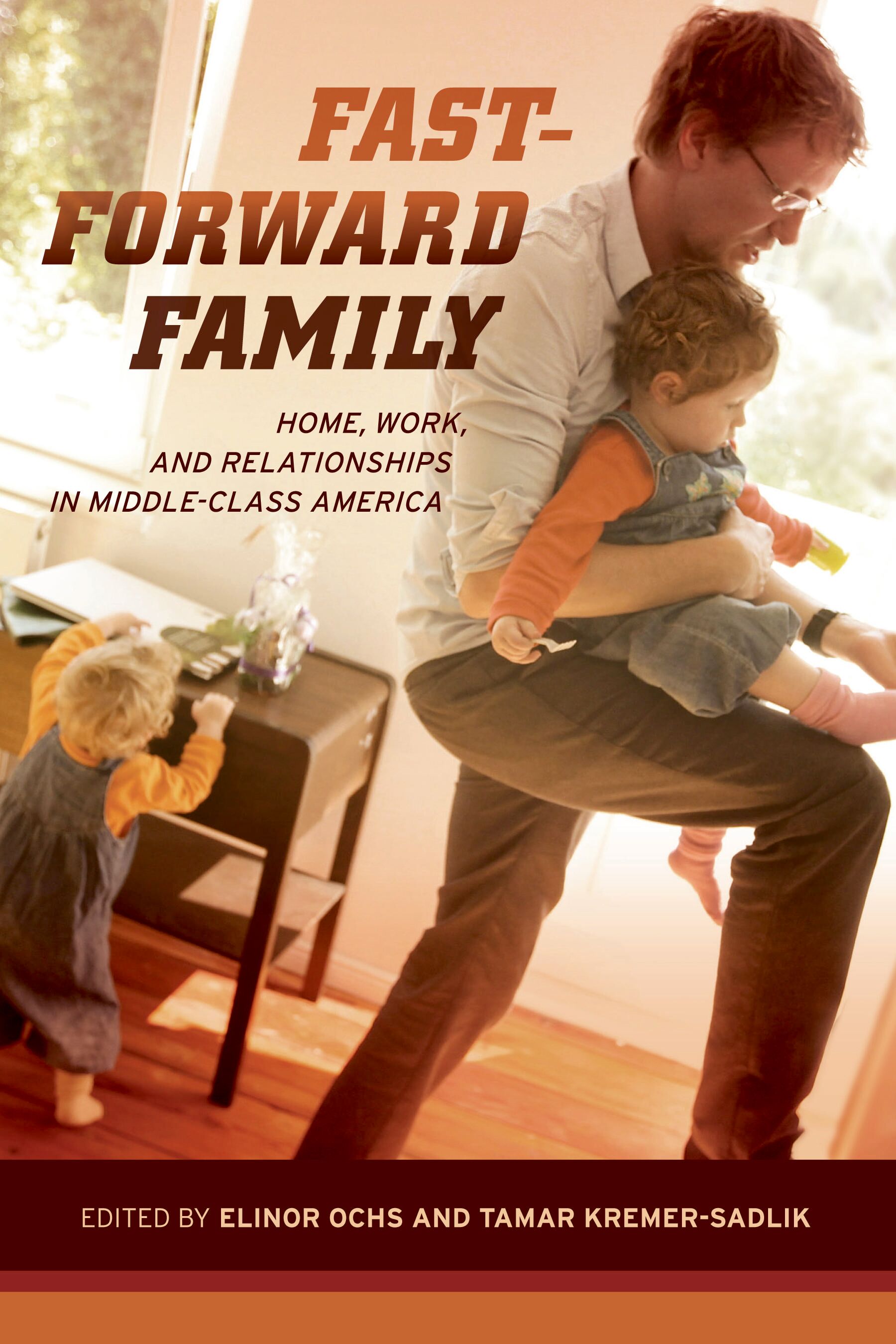
Fast-forward family
Called \"the most unusually voyeuristic anthropology study ever conducted\" by the New York Times, this groundbreaking book provides an unprecedented glimpse into modern-day American families. In a study by the UCLA Sloan Center on Everyday Lives and Families, researchers tracked the daily lives of 32 dualworker middle class Los Angeles families between 2001 and 2004. The results are startling, and enlightening. Fast-Forward Family shines light on a variety of issues that face American families: the differing stress levels among parents; the problem of excessive clutter in the American home; the importance (and decline) of the family meal; the vanishing boundaries that once separated work and home life; and the challenges for parents as they try to reconcile ideals regarding what it means to be a good parent, a good worker, and a good spouse. Though there are also moments of connection, affection, and care, it's evident that life for 21st century working parents is frenetic, with extended work hours, children's activities, chores, meals to prepare, errands to run, and bills to pay.
eBook