
Catalogue Search | MBRL


Are you sure you want to remove the book from the shelf?

{{itemTitle}}
370
result(s) for
"Hispanic American women in mass media."
Sort by:

In search of belonging : Latinas, media, and citizenship
Latina/os are the fastest and youngest growing group in the USA, and Spanish- and English-language media industries are creating content specifically to capture bilingual second and third generation Latina/o audiences. In particular, transnational media corporations are producing and marketing mainstream and niche media to women and youth, both considered lucrative segments of the audience. This project provides in-depth ethnographic analysis of how Latina/o audiences engage with both mainstream and Spanish-language media. It asks: How do Latina/o audiences, particularly women, make sense of and engage with Latina/o-oriented media? Ethnographic material provides a rare glimpse into how Latina audiences perceive mediated representations of Latinas in mainstream and Spanish-language media. At the heart of the study are a diverse group of Latinas in Chicago who vary in ethnicity, class, age, and sexual orientation. -- Provided by publisher.
Book

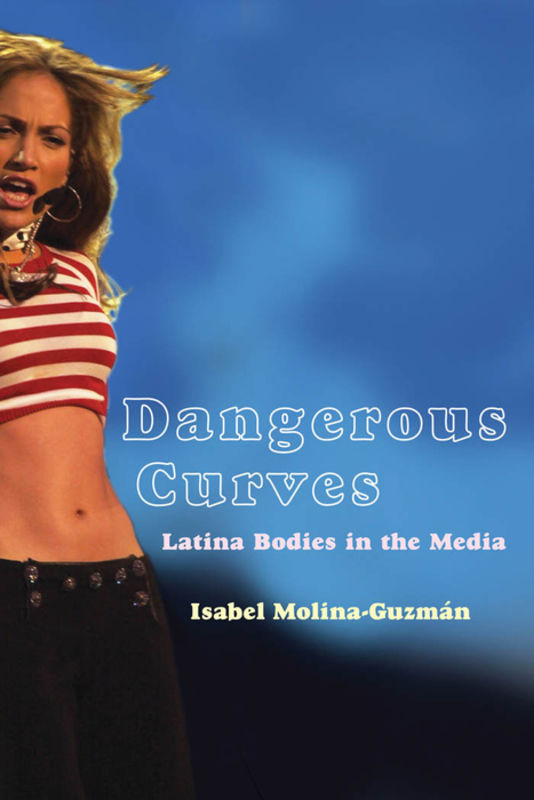
Dangerous Curves
With images of Jennifer Lopez's butt and America Ferrera's smile saturating national and global culture, Latina bodies have become an ubiquitous presence. Dangerous Curves traces the visibility of the Latina body in the media and popular culture by analyzing a broad range of popular media including news, media gossip, movies, television news, and online audience discussions.Isabel Molina-Guzman maps the ways in which the Latina body is gendered, sexualized, and racialized within the United States media using a series of fascinating case studies. The book examines tabloid headlines about Jennifer Lopez's indomitable sexuality, the contested authenticity of Salma Hayek's portrayal of Frida Kahlo in the movie Frida, and America Ferrera's universally appealing yet racially sublimated Ugly Betty character. Dangerous Curves carves out a mediated terrain where these racially ambiguous but ethnically marked feminine bodies sell everything from haute couture to tabloids.Through a careful examination of the cultural tensions embedded in the visibility of Latina bodies in United States media culture, Molina-Guzman paints a nuanced portrait of the media's role in shaping public knowledge about Latina identity and Latinidad, and the ways political and social forces shape media representations.
eBook


From bananas to buttocks : the Latina body in popular film and culture
From the exuberant excesses of Carmen Miranda in the “tutti frutti hat” to the curvaceous posterior of Jennifer Lopez, the Latina body has long been a signifier of Latina/o identity in U.S. popular culture. But how does this stereotype of the exotic, erotic Latina “bombshell” relate, if at all, to real Latina women who represent a wide spectrum of ethnicities, national origins, cultures, and physical appearances? How are ideas about “Latinidad” imagined, challenged, and inscribed on Latina bodies? What racial, class, and other markers of identity do representations of the Latina body signal or reject? In this broadly interdisciplinary book, experts from the fields of Latina/o studies, media studies, communication, comparative literature, women’s studies, and sociology come together to offer the first wide-ranging look at the construction and representation of Latina identity in U.S. popular culture. The authors consider such popular figures as actresses Lupe Vélez, Salma Hayek, and Jennifer Lopez; singers Shakira and Celia Cruz; and even the Hispanic Barbie doll in her many guises. They investigate the media discourses surrounding controversial Latinas such as Lorena Bobbitt and Marisleysis González. And they discuss Latina representations in Lupe Solano’s series of mystery books and in the popular TV shows El Show de Cristina and Laura en América. This extensive treatment of Latina representation in popular culture not only sheds new light on how meaning is produced through images of the Latina body, but also on how these representations of Latinas are received, revised, and challenged.
eBook

From Bananas to Buttocks
From the exuberant excesses of Carmen Miranda in the \"tutti frutti hat\" to the curvaceous posterior of Jennifer Lopez, the Latina body has long been a signifier of Latina/o identity in U.S. popular culture. But how does this stereotype of the exotic, erotic Latina \"bombshell\" relate, if at all, to real Latina women who represent a wide spectrum of ethnicities, national origins, cultures, and physical appearances? How are ideas about \"Latinidad\" imagined, challenged, and inscribed on Latina bodies? What racial, class, and other markers of identity do representations of the Latina body signal or reject?
In this broadly interdisciplinary book, experts from the fields of Latina/o studies, media studies, communication, comparative literature, women's studies, and sociology come together to offer the first wide-ranging look at the construction and representation of Latina identity in U.S. popular culture. The authors consider such popular figures as actresses Lupe Vélez, Salma Hayek, and Jennifer Lopez; singers Shakira and Celia Cruz; and even the Hispanic Barbie doll in her many guises. They investigate the media discourses surrounding controversial Latinas such as Lorena Bobbitt and Marisleysis González. And they discuss Latina representations in Lupe Solano's series of mystery books and in the popular TV showsEl Show de CristinaandLaura en América. This extensive treatment of Latina representation in popular culture not only sheds new light on how meaning is produced through images of the Latina body, but also on how these representations of Latinas are received, revised, and challenged.
eBook

Social Media & PrEP: A Systematic Review of Social Media Campaigns to Increase PrEP Awareness & Uptake Among Young Black and Latinx MSM and Women
Pre-exposure prophylaxis (PrEP) has been shown to be highly effective at reducing the risk of HIV. Despite efforts to employ various social marketing strategies to promote PrEP among young people at greater risk for HIV, PrEP awareness and uptake remain low. We conducted a comprehensive review of current literature that presents or evaluates the use of social media and/or specific communication campaigns to increase PrEP awareness among young Black and Latinx men who have sex with men (MSM) and women. Eight articles met the inclusion criteria for the final analysis. The most used platforms included Facebook, Instagram, and custom mobile applications. Social media is a dynamic and promising tool that may be used to increase PrEP awareness, uptake, and adherence among young Black and Latinx MSM and women.
Journal Article

“You Aren’t Alone”: An Analysis of Trans Latinas’ Use of Instagram
Social media platforms, such as Instagram, provide space for marginalized groups to connect, learn about and express themselves, and cultivate community. Trans Latinas, a group target of violence and discrimination, resist by expressing themselves and building community through social media. As cisgender researchers, we explored how trans Latinas use #translatina on Instagram as a shared space to present themselves and their identities, to leverage this knowledge in our fields. We analyzed 134 posts in February and March of 2020 employing basic and interpretive content analyses while considering Goffman’s theory of presentation of self. Results showed that trans Latinas mostly presented individually through posed selfies taken near the camera, using a straight camera angle, standing, not smiling, and making eye contact. Most users wore makeup, styled hair, and accessories. Analyzing written captions and photos, four themes were constructed to understand how trans Latinas presented their identities and connected with others: (1) expressions of beauty and femininity, (2) fostering community, (3) commercial or work, and (4) feeling good and confident. These results have implications for mental health and health promotion practices, as social media could serve as affirming spaces for trans Latinas to reinforce their self-determination, maintain a sense of self, and build community.
Journal Article

The Role of Health Information Sources in Decision-Making Among Hispanic Mothers During Their Children’s First 1000 Days of Life
Objectives
This qualitative research aimed to explore how health information sources inform decision-making among Hispanic mothers during their children’s first 1000 days of life (conception-age 24 months), and to generate appropriate health information sources and communication strategies for future interventions.
Methods
We conducted seven focus groups with 49 Hispanic women who were pregnant or had children <2 years old. Domains included interpersonal and media sources, source trustworthiness, dealing with contradictory information, and how information affects decision-making. We used immersion/crystallization process for analysis.
Results
Trusted health information sources included health care providers, female and male family members,
BabyCenter.com
and other Internet sources, selected social media, and television. Some immigrant women reported preferring the Internet citing less established local support networks. Women highlighted the importance of validating health information through checking multiple sources for consistency and resolving contradictory information. Mothers expressed interest in receiving reliable website links from healthcare professionals and outreach to extended family.
Conclusions for Practice
Cultural factors, including immigration status, are important in understanding the use of health information sources and their role in decision-making about pregnancy and child health among Hispanic mothers. Healthcare providers and public health professionals should consider Hispanic mothers health information environment and provide culturally-relevant communication strategies and interventions during this high information-seeking time period.
Journal Article

“(Un)Being a Mother” Media Representation of Motherhood and Female Identity
This research examines the portrayal of (non)motherhood in television series from 2016 to 2022. The title, “(Un)being a Mother”, was deliberately chosen for its polysemic nature, facilitating an exploration of the complexities of motherhood, its absence, and the implications for womanhood. The study thematically analyzes 15 television series from Hispanic, Italian, and Anglo-American cultures to reveal the diverse perspectives on motherhood. Utilizing the frameworks of Intensive Mothering, Good Mothering, Good Enough Mothering, and Non-Mothering (including both childless and childfree women), the research aims to illuminate representations of motherhood, variations in mothering paradigms, and the influence of cultural and geographical contexts. This study introduces an innovative methodological approach by investigating recurring themes of (non)motherhood across different cultural productions, incorporating insights from media sociology, gender media studies, anthropology, and ethnographic media research for a comprehensive understanding of the subject.
Journal Article