
Catalogue Search | MBRL


Are you sure you want to remove the book from the shelf?

{{itemTitle}}
32
result(s) for
"Hispanic Americans Social conditions 21st century."
Sort by:

Latinx : the new force in American politics and culture
\"The Latinx revolution in US culture, society, and politics \"Latinx\" (pronounced \"La-teen-ex\") is the gender-neutral term that covers the largest racial minority in the United States, 17 percent of the country. This is the fastest-growing sector of American society, containing the most immigrants. It is the poorest ethnic group in the country, whose political empowerment is altering the balance of forces in a growing number of states. And yet, Latins barely figure in America's racial conversation--the US census does not even have a category for \"Latino.\" In this groundbreaking discussion, Ed Morales explains how Latin political identities are tied to a long Latin American history of mestizaje, translatable as \"mixedness\" or \"hybridity\", and that this border thinking is both a key to understanding bilingual, bicultural Latin cultures and politics and a challenge to America's infamously black/white racial regime. This searching and long-overdue exploration of a crucial development in American life updates Cornel West's bestselling Race Matters with a Latin inflection\"-- Provided by publisher.
Book
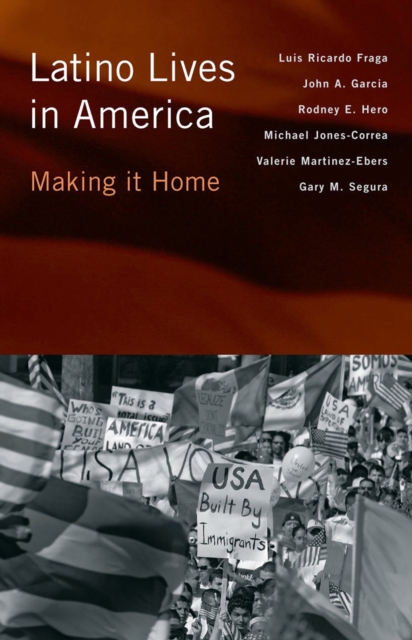
Latino Lives in America
Latinos are the largest and fastest growing ethnic group in the United States, with increased levels of political mobilization and influence. In the timely and thoroughgoingLatino Lives in America
,six prominent Latino scholars explore the profound implications of Latinos' population growth and geographic dispersion for American politics and society, tracking key changes and continuities in Latinos' attitudes, behavior, and social experiences.
Utilizing a unique set of \"narratives\" from focus group interviews, supplemented with quantitative findings from the 2006 Latino National Survey, the authors provide a snapshot of Latino life in America. The Latinos interviewed provide their thoughts regarding their sense of belonging and group identification, assimilation and transnationalism, housing, education, civic engagement, and perceptions of discrimination, as well as their experiences in new destinations, where they are trying to realize the \"Americano\" dream.
Latino Lives in Americauses these conversations and the survey data to offer both a micro and macro look at how Latinos are transforming various aspects of American politics, culture, and life and how their experiences in the United States are changing them and their families.
eBook


Razabilly
Vocals tinged with pain and desperation. The deep thuds of an upright bass. Women with short bangs and men in cuffed jeans. These elements and others are the unmistakable signatures of rockabilly, a musical genre normally associated with white male musicians of the 1950s. But in Los Angeles today, rockabilly's primary producers and consumers are Latinos and Latinas. Why are these Razabillies partaking in a visibly un-Latino subculture that's thought of as a white person's fixation everywhere else?As a Los Angeles Rockabilly insider, Nicholas F. Centino is the right person to answer this question. Pairing a decade of participant observation with interviews and historical research, Centino explores the reasons behind a Rockabilly renaissance in 1990s Los Angeles and demonstrates how, as a form of working-class leisure, this scene provides Razabillies with spaces of respite and conviviality within the alienating landscape of the urban metropolis. A nuanced account revealing how and why Los Angeles Latinas/os have turned to and transformed the music and aesthetic style of 1950s rockabilly, Razabilly offers rare insight into this musical subculture, its place in rock and roll history, and its passionate practitioners.
eBook

Stranger : the challenge of a Latino immigrant in the Trump era
Jorge Ramos, an Emmy award-winning journalist, Univision's longtime anchorman and widely considered the \"voice of the voiceless\" within the Latino community, was forcefully removed from an Iowa press conference in 2015 by then-candidate Donald Trump after trying to ask about his plans on immigration. In this personal manifesto, Ramos sets out to examine what it means to be a Latino immigrant, or just an immigrant, in present-day America. Using current research and statistics, with a journalist's nose for a story, and interweaving his own personal experience, Ramos shows us the changing face of America while also trying to find an explanation for why he, and millions of others, still feel like strangers in this country.
Book

Corazón de Dixie : Mexicanos in the U.S. South since 1910
When Latino migration to the U.S. South became increasingly visible in the 1990s, observers and advocates grasped for ways to analyze \"new\" racial dramas in the absence of historical reference points. However, as this book is the first to comprehensively document, Mexicans and Mexican Americans have a long history of migration to the U.S. South. Corazon de Dixie recounts the untold histories of Mexicanos' migrations to New Orleans, Mississippi, Arkansas, Georgia, and North Carolina as far back as 1910. It follows Mexicanos into the heart of Dixie, where they navigated the Jim Crow system, cultivated community in the cotton fields, purposefully appealed for help to the Mexican government, shaped the southern conservative imagination in the wake of the civil rights movement, and embraced their own version of suburban living at the turn of the twenty-first century. Rooted in U.S. and Mexican archival research, oral history interviews, and family photographs, Corazon de Dixie unearths not just the facts of Mexicanos' long-standing presence in the U.S. South but also their own expectations, strategies, and dreams.
eBook

Terrorizing Latina/o immigrants : race, gender, and immigration politics in the age of security
\"Immigration politics has been significantly altered by the advent of America's war on terror and the proliferation of security measures. In her cogent study, Terrorizing Latina/o Immigrants, Anna Sampaio examines how these processes are racialized and gendered and how they impose inequitable burdens on Latina/o immigrants. She interrogates the rise of securitization, restrictive legislation, and the return of large-scale immigration raids and describes how these re-articulate and re-inscribe forms of racial and gender hierarchy. Terrorizing Latina/o Immigrants demonstrates how the ascendance of America as a security state serves as a template to scrutinize, harass, and encumber immigrants while also reconfiguring citizenship. Sampaio uses intersectional analysis coupled with theoretical and empirical approaches to develop a critical framework for analyzing current immigration politics.Sampaio provides a sustained and systematic examination of policy and enforcement shifts impacting Latinas/os. Her book concludes with an examination of immigration reform under the Obama administration, contrasting the promise of hope and change with the reality of increased detentions, deportations, and continued marginalization\"-- Provided by publisher.
Book

Latina/o/x Education in Chicago
In this collection, local experts use personal narratives and
empirical data to explore the history of Mexican American and
Puerto Rican education in the Chicago Public Schools (CPS) system.
The essays focus on three themes: the historical context of
segregated and inferior schooling for Latina/o/x students; the
changing purposes and meanings of education for Latina/o/x students
from the 1950s through today; and Latina/o/x resistance to
educational reforms grounded in neoliberalism. Contributors look at
stories of student strength and resistance, the oppressive systems
forced on Mexican American women, the criminalization of Puerto
Ricans fighting for liberatory education, and other topics of
educational significance. As they show, many harmful past practices
remain the norm--or have become worse. Yet Latina/o/x communities
and students persistently engage in transformative practices
shaping new approaches to education that promise to reverberate not
only in the city but nationwide.
Insightful and enlightening, Latina/o/x Education in
Chicago brings to light the ongoing struggle for educational
equity in the Chicago Public Schools.
eBook

Nuclear Nuevo México
In the 1940s military and scientific personnel chose the Pajarito
Plateau to site Project Y of the secret Manhattan Project, where
scientists developed the atomic bomb. Nuevomexicanas/os and Tewa
people were forcibly dispossessed from their ranches and sacred
land in north-central New Mexico with inequitable or no
compensation. Contrary to previous works that suppress
Nuevomexicana/o presence throughout U.S. nuclear history,
Nuclear Nuevo México focuses on recovering the voices and
stories that have been lost or ignored in the telling of this
history. By recuperating these narratives, Myrriah Gómez tells a
new story of New Mexico, one in which the nuclear history is not
separate from the collective colonial history of Nuevo México but
instead demonstrates how earlier eras of settler colonialism laid
the foundation for nuclear colonialism in New Mexico. Gómez
examines the experiences of Nuevomexicanas/os who have been
impacted by the nuclear industrial complex, both the weapons
industry and the commercial industry. Gómez argues that Los Alamos
was created as a racist project that targeted poor and
working-class Nuevomexicana/o farming families, along with their
Pueblo neighbors, to create a nuclear empire. The resulting
imperialism has left a legacy of disease and distress throughout
New Mexico that continues today.
eBook

Making New York Dominican
Large-scale emigration from the Dominican Republic began in the early 1960s, with most Dominicans settling in New York City. Since then the growth of the city's Dominican population has been staggering, now accounting for around 7 percent of the total populace. How have Dominicans influenced New York City? And, conversely, how has the move to New York affected their lives? InMaking New York Dominican, Christian Krohn-Hansen considers these questions through an exploration of Dominican immigrants' economic and political practices and through their constructions of identity and belonging. Krohn-Hansen focuses especially on Dominicans in the small business sector, in particular the bodega and supermarket and taxi and black car industries. While studies of immigrant business and entrepreneurship have been predominantly quantitative, using survey data or public statistics, this work employs business ethnography to demonstrate how Dominican enterprises work, how people find economic openings, and how Dominicans who own small commercial ventures have formed political associations to promote and defend their interests. The study shows convincingly how Dominican businesses over the past three decades have made a substantial mark on New York neighborhoods and the city's political economy.Making New York Dominicanis not about a Dominican enclave or a parallel sociocultural universe. It is instead about connections-between Dominican New Yorkers' economic and political practices and ways of thinking and the much larger historical, political, economic, and cultural field within which they operate. Throughout, Krohn-Hansen underscores that it is crucial to analyze four sets of processes: the immigrants' forms of work, their everyday life, their modes of participation in political life, and their negotiation and building of identities.Making New York Dominicanoffers an original and significant contribution to the scholarship on immigration, the Latinization of New York, and contemporary forms of globalization.
eBook