
Catalogue Search | MBRL


Are you sure you want to remove the book from the shelf?

{{itemTitle}}
44,599
result(s) for
"Historia."
Sort by:


The culture of connectivity : a critical history of social media
This book studies the rise of social media in the first decade of the twenty-first century, up until 2012. It provides both a historical and a critical analysis of the emergence of networking services in the context of a changing ecosystem of connective media. Such history is needed to understand how the intricate constellation of platforms profoundly affects our experience of online sociality. In a short period of time, services like Facebook, YouTube and many others have come to deeply penetrate our daily habits of communication and creative production. While most sites started out as amateur-driven community platforms, half a decade later they have turned into large corporations that do not just facilitate user connectedness, but have become global information and data mining companies extracting and exploiting user connectivity. Offering a dual analytical prism to examine techno-cultural as well as socio-economic aspects of social media, the author dissects five major platforms: Facebook, Twitter, Flickr, YouTube, and Wikipedia. Each of these microsystems occupies a distinct position in the larger ecosystem of connective media, and yet, their underlying mechanisms for coding interfaces, steering users, filtering content, governance and business models rely on shared ideological principles. Reconstructing the premises on which these platforms are built, this study highlights how norms for online interaction and communication gradually changed. “Sharing,” “friending,” “liking,” “following,” “trending,” and “favoriting” have come to denote online practices imbued with specific technological and economic meanings. This process of normalization is part of a larger political and ideological battle over information control in an online world where everything is bound to become “social.”
eBook

The strait gate : thresholds and power in Western history
Exploring a chapter in the cultural history of the West not yet probed, The Strait Gate demonstrates how doors, gates, and related technologies such as the key and the lock have shaped the way we perceive and navigate the domestic and urban spaces that surround us in our everyday lives. Jutte reveals how doors have served as sites of power, exclusion, and inclusion, as well as metaphors for salvation in the course of Western history. More than any other parts of the house, doors are objects onto which we project our ideas of, and anxieties about, security, privacy, and shelter. Drawing on a wide range of archival, literary, and visual sources, as well as on research literature across various disciplines and languages, this book pays particular attention to the history of the practices that have developed over the centuries in order to handle and control doors in everyday life.
Book
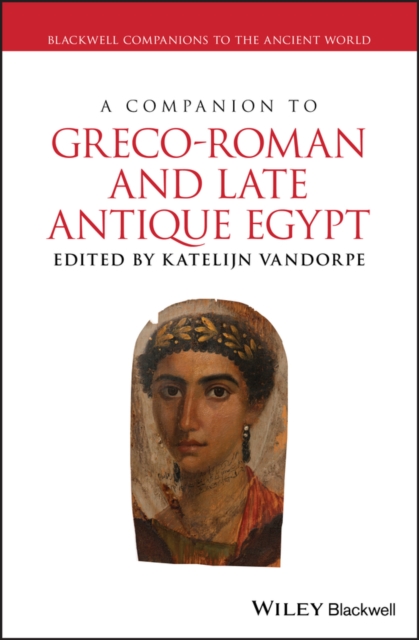
A Companion to Greco-Roman and Late Antique Egypt
An authoritative and multidisciplinary Companion to Egypt during the Greco?Roman and Late Antique period With contributions from noted authorities in the field, A Companion to Greco-Roman and Late Antique Egypt offers a comprehensive resource that covers almost 1000 years of Egyptian history, starting with the liberation of Egypt from Persian rule by Alexander the Great in 332 BC and ending in AD 642, when Arab rule started in the Nile country. The Companion takes a largely sociological perspective and includes a section on life portraits at the end of each part. The theme of identity in a multicultural environment and a chapter on the quality of life of Egypt's inhabitants clearly illustrate this objective. The authors put the emphasis on the changes that occurred in the Greco-Roman and Late Antique periods, as illustrated by such topics as: Traditional religious life challenged; Governing a country with a past: between tradition and innovation; and Creative minds in theory and praxis. This important resource: * Discusses how Egypt became part of a globalizing world in Hellenistic, Roman and Byzantine times * Explores notable innovations by the Ptolemies and Romans * Puts the focus on the longue durée development * Offers a thematic and multidisciplinary approach to the subject, bringing together scholars of different disciplines * Contains life portraits in which various aspects and themes of people's daily life in Egypt are discussed Written for academics and students of the Greco-Roman and Late Antique Egypt period, this Companion offers a guide that is useful for students in the areas of Hellenistic, Roman, Byzantine and New Testament studies.
eBook


Children and Childhood in Western Society Since 1500
Updated to incorporate recent scholarship on the subject, this new edition of Hugh Cunningham’s classic text investigates the relationship between ideas about childhood and the actual experience of being a child, and assesses how it has changed over the span of 500 years.
Through his engaging narrative Hugh Cunningham tells the story of the development of ideas from the Renaissance to the present, revealing considerable differences in the way Western societies have understood and valued childhood over time. His survey of parent/child relationships uncovers evidence of parental love, care and, in the frequent cases of child death, grief throughout the period, concluding that there was as much continuity as change in the actual relations of children and adults across these five centuries. Since the book’s first publication in 1995, the volume of historical research on children and childhood has escalated hugely and is testimony to the level of concern provoked by the dominance of the negative narrative that originated in the 1970s and 1980s. A new epilogue revisits the volume from today’s perspective, analysing why this negative narrative established dominance in Western society and considering how it has affected historical writing about children and childhood, enabling the reader to put both this volume and recent debates into context.
Supported by an updated historiographical discussion and expanded bibliography, Children and Childhood in Western Society Since 1500 remains an essential resource for students of the history of childhood, the history of the family, social history and gender history.
eBook


The power of gifts : gift-exchange in early modern England
Gifts are always with us: we use them positively to display affection and show gratitude for favours; we suspect that others give and accept them as douceurs and bribes. The gift also performed these roles in early modern English culture: and assumed a more significant role because networks of informal support and patronage were central to social and political behaviour. Favours, and their proper acknowledgement, were preoccupations of the age of Erasmus, Shakespeare, and Hobbes. As in modern society, giving and receiving was complex and full of the potential for social damage. 'Almost nothing', men of the Renaissance learned from that great classical guide to morality, Lucius Annaeus Seneca, 'is more disgraceful than the fact that we do not know how either to give or receive benefits'. This book is about those gifts and benefits - what they were, and how they were offered and received in the sixteenth and seventeenth centuries. It shows that the mode of giving, as well as what was given, was crucial to social bonding and political success. The volume moves from a general consideration of the nature of the gift to an exploration of the politics of giving. In the latter chapters some of the well-known rituals of English court life - the New Year ceremony, royal progresses, diplomatic missions - are viewed through the prism of gift-exchange. Gifts to monarchs or their ministers could focus attention on the donor, those from the crown could offer some assurance of favour. These fundamentals remained the same throughout the century and a half before the Civil War, but the attitude of individual monarchs altered specific behaviour. Elizabeth expected to be wooed with gifts and dispensed benefits largely for service rendered, James I modelled giving as the largesse of the Renaissance prince, Charles I's gift-exchanges focused on the art collecting of his coterie. And always in both politics and the law courts there was the danger that gifts would be corroded, morphing from acceptable behaviour into bribes and corruption. The Power of Gifts explores prescriptive literature, pamphlets, correspondence, legal cases, and financial records, to illuminate social attitudes and behaviour through a rich series of examples and case-studies -- Dust jacket.
Book
