
Catalogue Search | MBRL


Are you sure you want to remove the book from the shelf?

{{itemTitle}}
2,166
result(s) for
"Historical source materials"
Sort by:

Understanding the Archaeological Record
This book explores the diverse understandings of the archaeological record in both historical and contemporary perspective, while also serving as a guide to reassessing current views. Gavin Lucas argues that archaeological theory has become both too fragmented and disconnected from the particular nature of archaeological evidence. The book examines three ways of understanding the archaeological record - as historical sources, through formation theory and as material culture - then reveals ways to connect these three domains through a reconsideration of archaeological entities and archaeological practice. Ultimately, Lucas calls for a rethinking of the nature of the archaeological record and the kind of history and narratives written from it.
eBook

Dorian Unbound
A bold reimagining of the literary history of Decadence through a close examination of the transnational contexts of Oscar Wilde's classic novel The Picture of Dorian Gray.Building upon a large body of archival and critical work on Oscar Wilde's only novel, Dorian Unbound offers a new account of the importance of transnational contexts in the forging of Wilde's imagination and the wider genealogy of literary Decadence. Sean O'Toole argues that the attention critics have rightly paid to Wilde's backgrounds in Victorian Aestheticism and French Decadence has had the unintended effect of obscuring a much broader network of transnational contexts. Attention to these contexts allows us to reconsider how we read The Picture of Dorian Gray, what we believe we know about Wilde, and how we understand literary Decadence as both a persistent, highly mobile cultural mode and a precursor to global modernism. In developing a transnational framework for reading Dorian Gray, O'Toole recovers a subterranean network of nineteenth-century cultural movements. At the same time, he joins several active and vital conversations about what it might mean to expand the geographical reach of Victorian studies and to trace the globalization of literature over a longer period of time. Dorian Unbound includes chapters on the Irish Gothic, German historical romance, US magic-picture tradition, and experimental English epigrams, as well as a detailed history and a new close reading of the novel, in an effort to understand Wilde's contribution to a more dynamic idea of Decadence than has been previously known. From its rigorous account of the broad archive of texts that Wilde read and the array of cultural movements from which he drew inspiration in writing Dorian Gray to the novel's afterlives and global resonances, O'Toole paints a richer picture of the author and his famously allusive prose. This book makes a compelling case for a comparative reading of the novel in a global context. It will appeal to historians and admirers of Wilde's career as well as to scholars of nineteenth-century literature, queer and narrative theory, Irish studies, and art history.
eBook
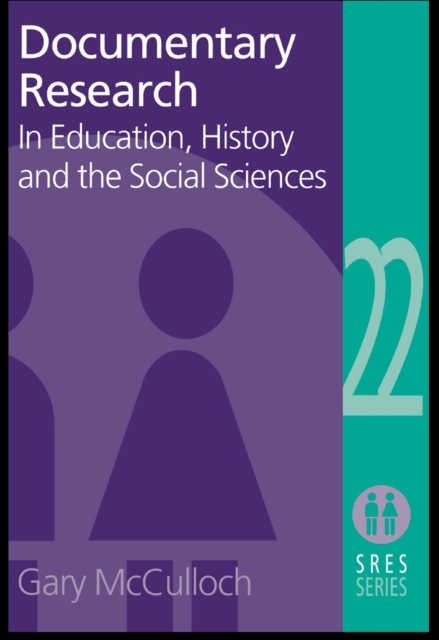
Documentary Research
Documentary sources have become increasingly neglected in education and the social sciences. This book seeks to emphasise their potential value and importance for an understanding of modern societies, while also recognising their limitations, and explores their relationship with other research strategies. This up-to-date examination of how to research and use documents analyzes texts from the past and present, considering sources ranging from personal archives to online documents and including books, reports, official documents, works of fiction and printed media. This comprehensive analysis of the use of documents in research includes sections covering: * analysing documents * legal frameworks and ethical issues * records and archives * printed media and literature * diaries, letters and autobiographies.
Gary McCulloch is Brian Simon Professor of History of Education at the Institute of Education, University of London.
eBook

Blue Song
In 2011, the centennial of Tennessee Williams's birth, events were held around the world honoring America's greatest playwright.There were festivals, conferences, and exhibitions held in places closely associated with Williams's life and career--New Orleans held major celebrations, as did New York, Key West, and Provincetown.
eBook

Archives of Times Past
Archives of Times Past: Conversations about South Africa's
Deep History explores particular sources of evidence on
southern Africa's time before the colonial era. It gathers recent
ideas about archives and archiving from scholars in southern Africa
and elsewhere, focusing on the question: 'How do we know, or think
we know, what happened in the times before European colonialism?'
Historians who specialise in researching early history have learnt
to use a wide range of materials from the past as source materials.
What are these materials? Where can we find them? Who made them?
When? Why? What are the problems with using them? The essays by
well-known historians, archaeologists and researchers engage these
questions from a range of perspectives and in illuminating ways.
Written from personal experience, they capture how these experts
encountered their archives of knowledge beyond the textbook. The
book aims to make us think critically about where ideas about the
time before the colonial era originate. It encourages us to think
about why people in South Africa often refer to this 'deep history'
when arguing about public affairs in the present. The essays are
written at a time when public discussion about the history of
southern Africa before the colonial era is taking place more openly
than at any other time in the last hundred years. They will appeal
to students, academics, educationists, teachers, archivists, and
heritage, museum practitioners and the general public.
Archives of Times Past explores particular sources of
evidence on southern Africa's time before the colonial era. It
gathers recent ideas about archives and archiving from scholars in
southern Africa and elsewhere, focusing on the question: 'How do we
know, or think we know, what happened in the times before European
colonialism?' The essays by well-known historians, archaeologists
and researchers engage these questions from a range of perspectives
and in illuminating ways. Written from personal experience, they
capture how these experts encountered their archives of knowledge
beyond the textbook. The essays are written at a time when public
discussion about the history of southern Africa before the colonial
era is taking place more openly than at any other time in the last
hundred years They will appeal to students, academics,
educationists, teachers, archivists, and heritage, museum
practitioners and the general public.
eBook
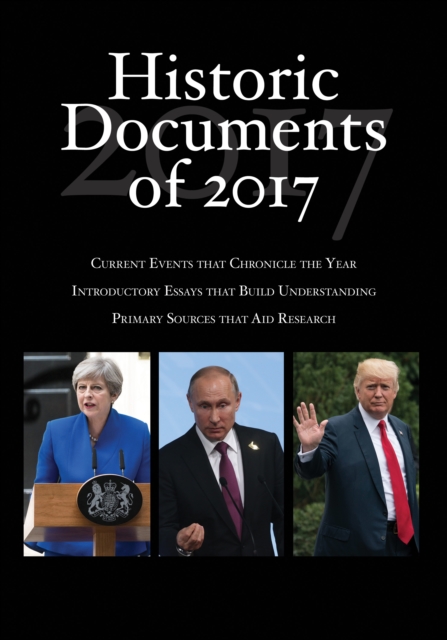
Historic Documents Of 2017
For more than 45 years, the Historic Documents series has made primary source research easy by presenting excerpts from documents on the important events of each year for the United States and the world. Each volume includes approximately 60 events with well over 100 documents from the previous year, from official or other influential reports and surveys, to speeches from leaders and opinion makers, to court cases, legislation, testimony, and much more. Historic Documents is renowned for the well-written and informative background, history, and context it provides for each document. Each volume begins with an insightful essay that sets the year's events in context, and each document or group of documents is preceded by a comprehensive introduction that provides background information on the event. Full-source citations are provided. Readers have easy access to material through a detailed, thematic table of contents, and each event includes references to related coverage and documents from the last ten editions of the series. Events covered in the 2017 Edition include: The intricacies of the new presidential administration of Donald Trump Russian involvement in the U.S. presidential election U.S. and global policies on immigration and refugees Landmark Supreme Court rulings on gerrymandering and state grant money for parochial schools, and the appointment of Neil Gorsuch Global warming and climate change agreements and policies European elections, including those in the UK, France, and Germany Outcomes of the G-20 Summit North Korea and international calls to action Volumes in this series dating back to 1972 are available as online editions on SAGE Knowledge.
eBook
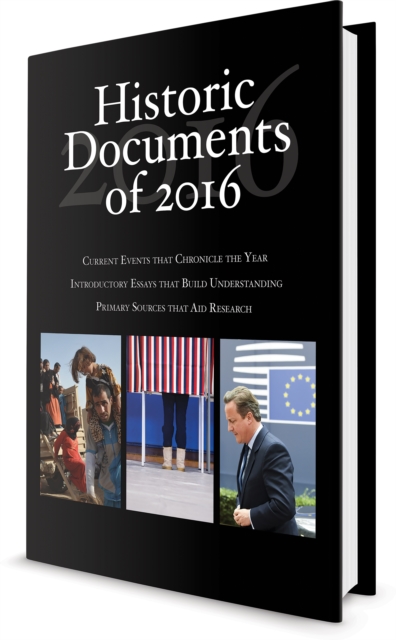
Historic Documents Of 2016
For more than 40 years, the Historic Documents series has made primary source research easy by presenting excerpts from documents on the important events of each year for the United States and the World. Each volume includes 60 to 70 events with well over 100 documents from the previous year, from official reports and surveys to speeches from leaders and opinion makers, to court cases, legislation, testimony, and much more.
eBook

Collapse of Classic Maya Civilization Related to Modest Reduction in Precipitation
The disintegration of the Classic Maya civilization in the Yucatán Peninsula and Central America was a complex process that occurred over an approximately 200-year interval and involved a catastrophic depopulation of the region. Although it is well established that the civilization collapse coincided with widespread episodes of drought, their nature and severity remain enigmatic. We present a quantitative analysis that offers a coherent interpretation of four of the most detailed paleoclimate records of the event. We conclude that the droughts occurring during the disintegration of the Maya civilization represented up to a 40% reduction in annual precipitation, probably due to a reduction in summer season tropical storm frequency and intensity.
Journal Article

Indigeneity, Capitalism, and the Management of Dispossession
Focusing mainly on Asia, this article tracks a link between the collective, inalienable land‐tenure regimes currently associated with indigeneity and attempts to prevent piecemeal dispossession of small‐scale farmers through land sale and debt. Collective landholding is sometimes imposed by local groups on their own members as they act to defend their livelihoods and communities. More often, however, it has been imposed from outside, first by paternalistic officials of the colonial period and now by a new set of experts and advocates who assume responsibility for deciding who should and who should not be exposed to the risks and opportunities of market engagement. From the perspective of their proponents, however, attempts to institutionalize collective landholdings are not impositions at all. They simply confirm a culturally distinct formation naturally present among “tribal” or “indigenous” people. Yet rural populations have repeatedly failed to conform to the assumptions embedded in schemes designed for their protection. They cross social and spatial boundaries. Some demand recognition of individualized land rights as they respond to market opportunities. Others are unable to escape the extractive relations that visions of cultural alterity and harmonious collectivity too often overlook. Meanwhile, dispossessory processes roll on unrecognized or unobserved.
Journal Article