
Catalogue Search | MBRL


Are you sure you want to remove the book from the shelf?

{{itemTitle}}
2,082
result(s) for
"Historical television programs"
Sort by:


TV antiquity
TV antiquity explores representations of ancient Greece and Rome throughout television history. The first comprehensive overview of the ‘swords and sandals’ genre on the small screen, it argues that these shows offer a distinct perspective on the ancient world. The book traces the historic development of fictional representations of antiquity from the staged black-and-white shows of the 1950s and 1960s to the most recent digital spectacles. One of its key insights is that the structure of serial television is at times better suited to exploring the complex mythic and historic plots of antiquity. Featuring a range of case studies, from popular serials like I, Claudius (1976) and Rome (2005–8) to lesser known works like The Caesars (1968) and The Eagle of the Ninth (1976), the book illustrates how broader cultural, political and economic issues have over time influenced the representation of antiquity on television.
eBook

Screening twentieth century Europe : television, history, memory
1. Introduction. A Century of Extremes and Profound Changes: Mediating European History.- 2. Memory and History as Mediated and Embodied Narratives.- 3. Historical Genres on Television: The Broader European Picture.- 4. The Meaning of Small Things: Everyday Drama and History from Below.- 5. History from Above: Historical Biopics.- 6. Grand illusions and The Great War: WW1 Narratives.- 7. Living on the Edge: The Roaring Twenties and World Crisis.- 8. Hell on Earth: WW2 War Narratives.- 9. Post-war Europe: Cold War, Welfare and Cultural Revolution.- 10. Europe 1989 and Beyond: Towards the New Millennium.- 11. Conclusion: History on Our Mind - the Forms and Functions of Mediated History.
BOOK

History by HBO
The television industry is changing, and with it, the small screen's potential to engage in debate and present valuable representations of American history.Founded in 1972, HBO has been at the forefront of these changes, leading the way for many network, cable, and streaming services into the \"post-network\" era.
eBook


Documentary, World History, and National Power in the PRC
Documentaries have recently become a favourite format for Chinese state-directed media to present an officially sanctioned view of history. Indeed, this is not confined to Chinese national history. In stark contrast to the earlier self-centred preoccupation with Chinese history, there has been an upsurge in interest in foreign history, with a view to illuminating China's role not only in world history, but also on the global stage today, and in the future.
This book examines three recent Chinese documentary television series which present the officially sanctioned view of the rise of the modern West, the reasons for the end of the Soviet Union, and the legitimisation of the present-day Chinese government via a specific reading of modern Chinese history to argue for a 'Chinese rise' in the future. With a focus on these documentaries, Gotelind Müller discusses how history is presented on screen, and explores the function of visual history for memory culture and wider society. Further, this book reveals how the presentation of Chinese and foreign history in a global framework impacts on the officially transmitted views on Self and Other, and thus provides a keen insight into how the Chinese themselves regard their 'global rise'.
Documentary, World History, and National Power in the PRC will be welcomed by students and scholars working across a number of fields, including Chinese studies, East Asian studies, media studies, television studies, history and memory studies.
eBook

Recasting history : how CBC Television has shaped Canada's past
\"This book explores Canadian history documentary and docudrama programming on CBC television since its beginnings in 1952. During this fifty-year period, television was a uniquely powerful medium --at once intimate and widely shared, reaching millions of people. CBC was the only Canadian broadcaster to consistently show history programming and has played a unique role in shaping Canadians' perceptions of their history. Analyzing the major works of Canadian history on CBC television over fifty years -- Explorations (1956-63), Images of Canada (1972-76), The National Dream (1974), The Valour and the Horror (1992), and Canada: A People's History (2000-02) -- reveals patterns and developments in content and presentation. As the author argues, these developments were not arbitrary but were impelled by a wide range of external factors: developments in broadcasting policy and regulation in Canada; television industry developments, including competition from a growing American market and for new Canadian broadcasters (such as CTV and Global) for viewers and for advertising revenue; the evolution of television itself, including the standards and financing of production and attention to ratings, technological change, and job creation; and the evolution of journalism and the role of journalists as supposed authorities. This book is both a critique of public history and a political economy of television production. The author has three major findings.\"-- Provided by publisher.
Book
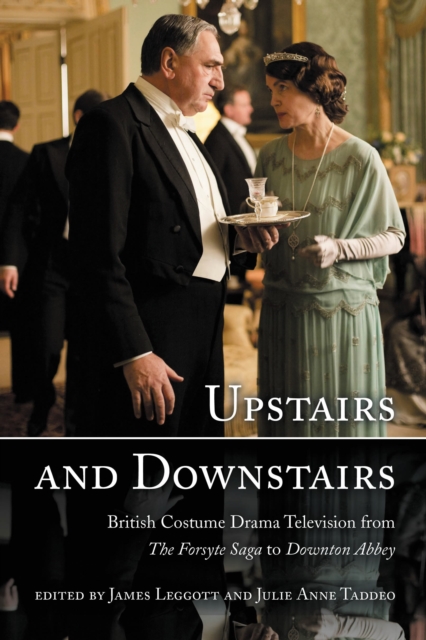
Upstairs and downstairs
The international success of Downton Abbey has led to a revived interest in period dramas, with older programs like The Forsyte Saga being rediscovered by a new generation of fans whose tastes also include grittier fare like Ripper Street. Though often criticized as a form of escapist, conservative nostalgia, these shows can also provide a lens to examine the class and gender politics of both the past and present. In Upstairs and Downstairs: British Costume Drama Television from The Forsyte Saga to Downton Abbey, James Leggott and Julie Anne Taddeo provide a collection of essays that analyze key developments in the history of period dramas from the late 1960s to the present day. Contributors explore such issues as how the genre fulfills and disrupts notions of “quality television,” the process of adaptation, the relationship between UK and U.S. television, and the connection between the period drama and wider developments in TV and popular culture. Additional essays examine how fans shape the content and reception of these dramas and how the genre has articulated or generated debates about gender, sexuality, and class. In addition to Downton Abbey and Upstairs, Downstairs, other programs discussed in this collection include Call the Midwife, Danger UXB, Mr. Selfridge, Parade’s End, Piece of Cake, and Poldark. Tracing the lineage of costume drama from landmark productions of the late 1960s and 1970s to some of the most talked-about productions of recent years, Upstairs and Downstairs will be of value to students, teachers, and researchers in the areas of film, television, Victorian studies, literature, gender studies, and British history and culture.
eBook

Inspired by true events : an illustrated guide to more than 500 history-based films
\"An up-to-date and indispensable guide for film history buffs of all kind, this book surveys more than 500 major films based on true stories and historical subject matter\"-- Provided by publisher.
Book

History on Television
In recent years non-fiction history programmes have flourished on television. This interdisciplinary study of history programming identifies and examines different genres employed by producers and tracks their commissioning, production, marketing and distribution histories. With comparative references to other European nations and North America, the authors focus on British history programming over the last two decades and analyse the relationship between the academy and media professionals. They outline and discuss often-competing discourses about how to ‘do’ history and the underlying assumptions about who watches history programmes. History on Television considers recent changes in the media landscape, which have affected to a great degree how history in general, and whose history in particular, appears onscreen. Through a number of case studies, using material from interviews by the authors with academic and media professionals, the role of the ‘professional’ historian and that of media professionals – commissioning editors and producer/directors - as mediators of historical material and interpretations is analysed, and the ways in which the ‘logics of television’ shape historical output are outlined and discussed. Building on their analysis, Ann Gray and Erin Bell ask if history on television fulfils its potential to be a form of public history through offering, as it does, a range of interpretations of the past to and originating from or including those not based in the academy. Through consideration of the representation, or absence, of the diversity of British identity – gender, ethnicity and race, social status and regional identities – the authors substantially extend the scope of existing scholarship into history on television
eBook