
Catalogue Search | MBRL


Are you sure you want to remove the book from the shelf?

{{itemTitle}}
6,174
result(s) for
"History, Middle East Studies"
Sort by:

The rise of the Ottoman Empire : studies in the history of Turkey, 13th-15th centuries
\"Paul Wittek's The Rise of the Ottoman Empire was first published by the Royal Asiatic Society in 1938 and has been out of print for more than a quarter of a century. The present reissue of the text also brings together translations of his other studies on Ottoman history; five closely interconnected writings from the founding of the state to the Fall of Constantinople. All but one of these pieces reproduces the texts of lectures or conference papers delivered by Wittek between 1936 and 1938 when he was teaching at Universitأ© Librأ© in Brussels, Belgium. The journals in which they were originally published are for the most part inaccessible except in specialist libraries, in a period when Wittek's activities as an Ottoman historian are coming under increasing study within the Anglo-Saxon world of scholarship. An introduction by Colin Heywood sets Wittek's work in its historical and historiographical context for the benefit of those students not privileged to experience it firsthand. This book is an interesting contribution to studies on Asian and Middle East history\"-- Provided by publisher.
Book


From resilience to revolution
Based on comparative historical analyses of Iran, Jordan, and Kuwait, Sean L. Yom examines the foreign interventions, coalitional choices, and state outcomes that made the political regimes of the modern Middle East. A key text for foreign policy scholars,From Resilience to Revolutionshows how outside interference can corrupt the most basic choices of governance: who to reward, who to punish, who to compensate, and who to manipulate.
As colonial rule dissolved in the 1930s and 1950s, Middle Eastern autocrats constructed new political states to solidify their reigns, with varying results. Why did equally ambitious authoritarians meet such unequal fates? Yom ties the durability of Middle Eastern regimes to their geopolitical origins. At the dawn of the postcolonial era, many autocratic states had little support from their people and struggled to overcome widespread opposition. When foreign powers intervened to bolster these regimes, they unwittingly sabotaged the prospects for long-term stability by discouraging leaders from reaching out to their people and bargaining for mass support-early coalitional decisions that created repressive institutions and planted the seeds for future unrest. Only when they were secluded from larger geopolitical machinations did Middle Eastern regimes come to grips with their weaknesses and build broader coalitions.
eBook

Geographies of liberation : the making of an Afro-Arab political imaginary
\"In this absorbing transnational history, Alex Lubin reveals the vital connections between African American political thought and the people and nations of the Middle East. Spanning the 1850s through the present, and set against a backdrop of major political and cultural shifts around the world, the book demonstrates how international geopolitics, including the ascendance of liberal internationalism, established the conditions within which blacks imagined their freedom and, conversely, the ways in which various Middle Eastern groups have understood and used the African American freedom struggle to shape their own political movements. Lubin extends the framework of the black freedom struggle beyond the familiar geographies of the Atlantic world and sheds new light on the linked political, social, and intellectual imaginings of African Americans, Palestinians, Arabs, and Israeli Jews. This history of intellectual exchange, Lubin argues, has forged political connections that extend beyond national and racial boundaries. \"-- Provided by publisher.
Book
Perspectives on the History of Ancient near Eastern Studies
The present volume collects eighteen essays exploring the history of ancient Near Eastern studies.Combining diverse approaches--synthetic and analytic, diachronic and transnational--this collection offers critical reflections on the who, why, and how of this cluster of fields.How have political contexts determined the conduct of research?.
eBook

A shadow over Palestine : the imperial life of race in America
\"Upon signing the first U.S. arms agreement with Israel in 1962, John F. Kennedy assured Golda Meir that the United States had \"a special relationship with Israel in the Middle East,\" comparable only to that of the United States with Britain. After more than five decades such a statement might seem incontrovertible--and yet its meaning has been fiercely contested from the first. A Shadow over Palestine brings a new, deeply informed, and transnational perspective to the decades and the cultural forces that have shaped sharply differing ideas of Israel's standing with the United States--right up to the violent divisions of our day. Focusing on the period from 1960 to 1985, author Keith P. Feldman reveals the centrality of Israel and Palestine in postwar U.S. imperial culture. Some representations of the region were used to manufacture \"commonsense\" racial ideologies underwriting the conviction that liberal democracy must coexist with racialized conditions of segregation, border policing, poverty, and the repression of dissent. Others animated vital critiques of these conditions, often forging robust if historically obscured border-crossing alternatives. In this rich cultural history of the period, Feldman deftly analyzes how artists, intellectuals, and organizations--from the United Nations, the Black Panther Party, and the Association of Arab American University Graduates to James Baldwin, Daniel Patrick Moynihan, Edward Said, and June Jordan--linked the unfulfilled promise of liberal democracy in the United States with the perpetuation of settler democracy in Israel and the possibility of Palestine's decolonization. In one of his last essays, published in 2003, Edward Said wrote, \"In America, Palestine and Israel are regarded as local, not foreign policy, matters.\" A Shadow over Palestine maps the jagged terrain on which this came to be, amid a wealth of robust alternatives, and the undeterred violence at home and abroad that has been unleashed as a result of this special relationship. \"-- Provided by publisher.
Book

Understanding and Teaching the Modern Middle East
Many students learn about the Middle East through a sprinkling of
information and generalizations deriving largely from media
treatments of current events. This scattershot approach can
propagate bias and misconceptions that inhibit students' abilities
to examine this vitally important part of the world.
Understanding and Teaching the Modern Middle East moves
away from the Orientalist frameworks that have dominated the West's
understanding of the region, offering a range of fresh
interpretations and approaches for teachers. The volume brings
together experts on the rich intellectual, cultural, social, and
political history of the Middle East, providing necessary
historical context to familiarize teachers with the latest
scholarship. Each chapter includes easy- to-explore sources to
supplement any curriculum, focusing on valuable and controversial
themes that may prove pedagogically challenging, including
colonization and decolonization, the 1979 Iranian revolution, and
the US-led \"war on terror.\" By presenting multiple viewpoints, the
book will function as a springboard for instructors hoping to
encourage students to negotiate the various contradictions in
historical study.
eBook

Falafel nation : cuisine and the making of national identity in Israel
\"When people discuss food in Israel, their debates ask politically charged questions: Who has the right to falafel? Whose hummus is better? But Yael Raviv's Falafel Nation moves beyond the simply territorial to divulge the role food plays in the Jewish nation. She ponders the power struggles, moral dilemmas, and religious and ideological affiliations of the different ethnic groups that make up the \"Jewish State\" and how they relate to the gastronomy of the region. How do we interpret the recent upsurge in the Israeli culinary scene--the transition from ideological asceticism to the current deluge of fine restaurants, gourmet stores, and related publications and media?Focusing on the period between the 1905 immigration wave and the Six-Day War in 1967, Raviv explores foodways from the field, factory, market, and kitchen to the table. She incorporates the role of women, ethnic groups, and different generations into the story of Zionism and offers new assertions from a secular-foodie perspective on the relationship between Jewish religion and Jewish nationalism. A study of the changes in food practices and in attitudes toward food and cooking, Falafel Nation explains how the change in the relationship between Israelis and their food mirrors the search for a definition of modern Jewish nationalism. \"-- Provided by publisher.
Book
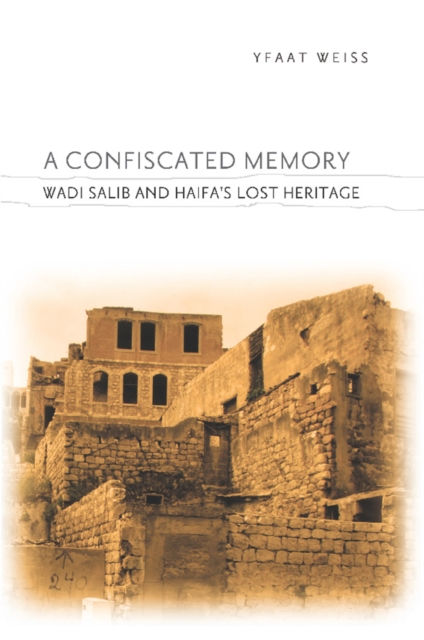
A confiscated memory
Yfaat Weiss tells the story of an Arab neighborhood in Haifa that later acquired iconic status in Israeli memory. In the summer of 1959, Jewish immigrants from Morocco rioted against local and national Israeli authorities of European origin. The protests of Wadi Salib generated for the first time a kind of political awareness of an existing ethnic discrimination among Israeli Jews. However, before that, Wadi Salib existed as an impoverished Arab neighborhood. The war of 1948 displaced its residents, even though the presence of the absentees and the Arab name still linger.
Weiss investigates the erasure of Wadi Salib's Arab heritage and its emergence as an Israeli site of memory. At the core of her quest lies the concept of property, as she merges the constraints of former Arab ownership with requirements and restrictions pertaining to urban development and the emergence of its entangled memory. Establishing an association between Wadi Salib's Arab refugees and subsequent Moroccan evacuees, Weiss allegorizes the Israeli amnesia about both eventual stories-that of the former Arab inhabitants and that of the riots of 1959, occurring at different times but in one place. Describing each in detail, Weiss uncovers a complex, multilayered, and hidden history. Through her sensitive reading of events, she offers uncommon perspective on the personal and political making of Israeli belonging.
eBook