
Catalogue Search | MBRL


Are you sure you want to remove the book from the shelf?

{{itemTitle}}
1,948
result(s) for
"History Anecdotes."
Sort by:

Bad days in history : a gleefully grim chronicle of misfortune, mayhem, and misery for every day of the year
\"Farquhar's ... entries draw from the full sweep of history to take readers through a complete year of misery, including tales of lost fortunes (like the would-be Apple investor who pulled out in 1977 and missed out on a $30 billion-dollar windfall), romance gone wrong (like the 16th-century Shah who experimented with an early form of Viagra with empire-changing results), and truly bizarre moments (like the Great Molasses Flood of 1919)\"-- Provided by publisher.
Book

Stories from a migrant city
Taking a biographical approach, the book explores the causes and consequences of moving or staying put in the context of class inequality and racisms, and looks for commonalities between people often seen as irredeemably divided.
eBook


Folklore of Lake Erie
Welcome to a very different Lake Erie-where ghost ships sail
silently, a Black Dog brings doom to sailors who see it, and sea
monsters swirl in the murky depths above a UFO base. In
Folklore of Lake Erie , Judith S. Neulander presents these
captivating tales and many more from the smallest, yet arguably the
most peculiar, of the Great Lakes in North America.
Whether you are embarking on a discovery of the vampire crypt
that lurks in the shadows while Lincoln's ghost train speeds past
on its eternal journey or reminiscing about the tall tales your
grandfather used to share, this delightful treasure trove of
folklore and local traditions from the Lake Erie region contains
legends and stories that are both astonishing and entertaining.
Endlessly captivating and easily accessible, Folklore of
Lake Erie is a distinctive compilation of eerie and enchanting
narratives from across the years that will surprise and delight
readers. Just be sure to keep an eye out for any peculiar Black
Dogs that may cross your path along the way.
eBook


This Land Was Mexican Once
The territory of Napa County, California, contains more than grapevines. The deepest roots belong to Wappo-speaking peoples, a group whose history has since been buried by the stories of Spanish colonizers, Californios (today’s Latinos), African Americans, Chinese immigrants, and Euro Americans. Napa’s history clearly is one of co-existence; yet, its schoolbooks tell a linear story that climaxes with the arrival of Euro Americans. In “This Land was Mexican Once,” Linda Heidenreich excavates Napa’s subaltern voices and histories to tell a complex, textured local history with important implications for the larger American West, as well. Heidenreich is part of a new generation of scholars who are challenging not only the old, Euro-American depiction of California, but also the linear method of historical storytelling—a method that inevitably favors the last man writing. She first maps the overlapping histories that comprise Napa’s past, then examines how the current version came to dominate—or even erase—earlier events. So while history, in Heidenreich’s words, may be “the stuff of nation-building,” it can also be “the stuff of resistance.” Chapters are interspersed with “source breaks”—raw primary sources that speak for themselves and interrupt the linear, Euro-American telling of Napa’s history. Such an inclusive approach inherently acknowledges the connections Napa’s peoples have to the rest of the region, for the linear history that marginalizes minorities is not unique to Napa. Latinos, for instance, have populated the American West for centuries, and are still shaping its future. In the end, “This Land was Mexican Once” is more than the story of Napa, it is a multidimensional model for reflecting a multicultural past.
eBook

The world : a family history of humanity
\"From the acclaimed author of The Romanovs-a magisterial history of humanity viewed through the lens of its most powerful dynasties In this sprawling and eye-opening book, best-selling historian Simon Sebag Montefiore chronicles the world's great dynasties across human history through engrossing tales of palace intrigue, glorious battle, and the real lives of people who held unfathomable power. He trains his eye on founders of humble origin, like Sargon, the Mesopotamian cupbearer sent to help defeat a rival who returned with an army to dethrone his own king, and Liu Bang, a peasant who became a rebel leader and founded the Han dynasty. Montefiore illuminates the achievements of fearsome emperors, including Yax Ehb Xook, whose Mayan city-state Tikal boasts some of the most monumental ancient architecture that exists today; Jayavarman II, who proclaimed himself \"universal king\" and whose Khmer empire in South Asia heralded a thousand years of Indic ascendancy; and Ewuare, the African emperor who built a capital city that rivaled any in Europe. He writes, too, about remarkable women rulers, like Hatshepsut, the first female pharaoh, and Maria Theresa, the only woman to rule the Habsburg empire. These families represent the breadth of human endeavor, with bloody civil wars, treacherous conspiracies, and shocking megalomania alongside flourishing culture, moving romances, and enlightened benevolence. A dazzling epic history as spellbinding as fiction, The World is testament to Montefiore's acclaimed career as our poet laureate of power\"-- Provided by publisher.
Book

Frenchtown Chronicles of Prairie du Chien
Albert Coryer, the grandson of a fur trade voyageur-turned-farmer, had a gift for storytelling.Born in 1877, he grew up in Prairie du Chien hearing tales of days gone by from his parents, grandparents, and neighbors who lived in the Frenchtown area.
eBook
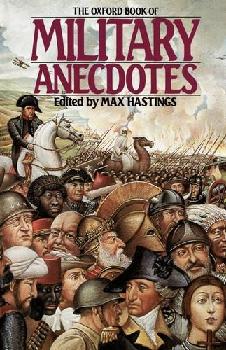
The Oxford book of military anecdotes
This collection is principally concerned with American and British conflicts with occasional forays into foreign armies - notably the Greeks, the Romans, and Napoleon's soldiers. Hastings has sought stories which illustrate the military condition through the ages, both on the battlefield and in the barracks: comic, eccentric, heroic, tragic.

America's Heroes
This book features the stories of 200 heroic individuals awarded the Medal of Honor for their distinguished military service while fighting for their country, from the Civil War to the conflicts in Iraq and Afghanistan. America's Heroes: Medal of Honor Recipients from the Civil War to Afghanistan pays tribute to Americans who have demonstrated uncommon valor in the face of great danger. The Medal of Honor recipients featured in this book all acted heroically to earn this highly coveted award, many of them by risking—or sacrificing—their lives to save the lives of others. The stories of these individuals—chosen to reflect the wide diversity of ethnic and cultural backgrounds, branches of service, and conflicts of the recipients—will broaden readers' understanding and appreciation of the Medal of Honor and the distinguished Americans who have received it. In addition to the gripping stories of these heroic Americans, this unique encyclopedia includes an introduction that chronicles the evolution in the award's significance. The Medal of Honor has changed greatly over the last 150 years, not only in the design of the physical decoration itself, but also in terms of the qualifying criteria for the award's recipients.
eBook