
Catalogue Search | MBRL


Are you sure you want to remove the book from the shelf?

{{itemTitle}}
26,243
result(s) for
"History of Asia."
Sort by:


East Asia Observed
This collection brings together themes in East Asian history, diplomacy, culture and politics written by J. E. Hoare since the early 1970s. His writings derive from his training as a historian, from his time as a Research Analyst in the British Foreign Office from 1969-2003, and from his experiences as a diplomat in the Republic of Korea (South Korea), the People's Republic of China, and the Democratic People's Republic of Korea (North Korea). The writings selected for this volume include academic papers, book reviews and some quasi-journalistic articles which reflect both historical research and analysis of current events and issues. The wide-ranging content speaks to the author's specialist fields of interest including diplomacy, biography, extraterritoriality and architecture on which he has published extensively.
eBook


Secret Trades, Porous Borders
Over the course of the half century from 1865 to 1915, the British and Dutch delineated colonial spheres, in the process creating new frontiers. This book analyzes the development of these frontiers in Insular Southeast Asia as well as the accompanying smuggling activities of the opium traders, currency runners, and human traffickers who pierced such newly drawn borders with growing success.The book presents a history of the evolution of this 3000-km frontier, and then inquires into the smuggling of contraband: who smuggled and why, what routes were favored, and how effectively the British and Dutch were able to enforce their economic, moral, and political will. Examining the history of states and smugglers playing off one another within a hidden but powerful economy of forbidden cargoes, the book also offers new insights into the modern political economies of Southeast Asia.
eBook

Lost kingdoms : Hindu-Buddhist sculpture of early Southeast Asia /
\"Numerous Hindu and Buddhist kingdoms flourished in Southeast Asia from the 5th to the 9th century, yet until recently few concrete details were known about them. Lost Kingdoms reveals newly discovered architectural and sculptural relics from this region, which provide key insights into the formerly mysterious kingdoms. The first publication to use sculpture as a lens to explore this period of Southeast Asian history, Lost Kingdoms offers a significant contribution and a fresh approach to the study of cultures in Cambodia, Thailand, Burma, and other countries\"--Distributor's website.
Book
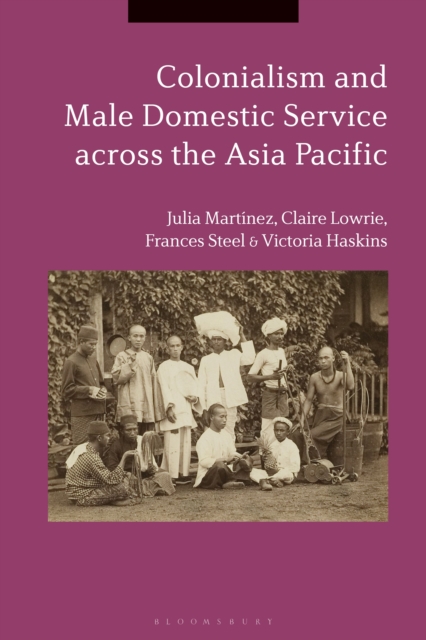
Colonialism and Male Domestic Service across the Asia Pacific
Examining the role of Asian and indigenous male servants across the Asia Pacific from the late-19th century to the 1930s, this study shows how their ubiquitous presence in these purportedly ‘humble’ jobs gave them a degree of cultural influence that has been largely overlooked in the literature on labour mobility in the age of empire. With case studies from British Hong Kong, Singapore, Northern Australia, Fiji and British Columbia, French Indochina, the American Philippines and the Dutch East Indies, the book delves into the intimate and often conflicted relationships between European and American colonists and their servants. It explores the lives of ‘houseboys’, cooks and gardeners in the colonial home, considers the bell-boys and waiters in the grand colonial hotels, and follows the stewards and cabin-boys on steamships travelling across the Indian and Pacific Oceans. This broad conception of service allows Colonialism and Male Domestic Service to illuminate trans-colonial or cross-border influences through the mobility of servants and their employers. This path-breaking study is an important book for students and scholars of colonialism, labour history and the Asia Pacific region.
eBook


Emerging Memory
This incisive volume brings together postcolonial studies, visual culture and cultural memory studies to explain how the Netherlands continues to rediscover its history of violence in colonial Indonesia. Dutch commentators have frequently claimed that the colonial past and especially the violence associated with it has been 'forgotten' in the Netherlands. Uncovering 'lost' photographs and other documents of violence has thereby become a recurring feature aimed at unmasking a hidden truth. The author argues that, rather than absent, such images have been consistently present in the Dutch public sphere and have been widely available in print, on television and now on the internet. Emerging Memory: Photographs of Colonial Atrocity in Dutch Cultural Remembrance shows that between memory and forgetting there is a haunted zone from which pasts that do not fit the stories nations live by keep on emerging and submerging while retaining their disturbing presence.
eBook

Denying the comfort women : the Japanese state's assault on historical truth
\"Run by the Japanese Imperial Military during the Asia-Pacific war, the 'comfort women' system remains hugely controversial. Whilst political leaders often contest the role of coercion, many argue that the 'comfort women' were mobilized forcibly, through processes of abduction and deception. Utilising archival research, legal testimonies and eyewitness accounts of both survivors and military and civilian personnel, this book argues its case in three ways. Part I analyses the modalities of coercion employed by the authorities and investigates the historical differences between licensed peacetime prostitution and wartime slavery. Part II then examines the failures of the Asian Women's Fund to resolve the 'comfort women' issue, whilst Part III explores the removal of 'comfort women' content from school history texts after the late 1990s and details Japan's diplomatic efforts to prevent war victims from suing the post-war state. Presenting a strong argument in opposition to the revisionist school of thought, this book ultimately concludes that a realistic settlement would see a victim-oriented solution that the survivors can accept. Written by leading Japanese, Zainichi Korean, and South Korean scholars, Denying the Comfort Women will be of huge interest to students and scholars of Japanese studies, gender studies, women's studies and Asian history\"-- Provided by publisher.
Book
Migration and Diaspora in Modern Asia
Migration is at the heart of Asian history. For centuries migrants have tracked the routes and seas of their ancestors - merchants, pilgrims, soldiers and sailors - along the Silk Road and across the Indian Ocean and the China Sea. Over the last 150 years, however, migration within Asia and beyond has been greater than at any other time in history. Sunil S. Amrith's engaging and deeply informative book crosses a vast terrain, from the Middle East to India and China, tracing the history of modern migration. Animated by the voices of Asian migrants, it tells the stories of those forced to flee from war and revolution, and those who left their homes and their families in search of a better life. These stories of Asian diasporas can be joyful or poignant, but they all speak of an engagement with new landscapes and new peoples.
eBook