
Catalogue Search | MBRL


Are you sure you want to remove the book from the shelf?

{{itemTitle}}
119,821
result(s) for
"History. Museums"
Sort by:

Museums
\"Do you like to collect things? Many people do. Some people collect art. Others collect objects from history. Some people collect cars or toys. You can collect just about anything! There are almost as many museums as there are things to collect. Take a trip back in time and learn more about these amazing places\"-- Provided by publisher.
Book

Possessors and Possessed
Possessors and Possessedanalyzes how and why museums-characteristically Western institutions-emerged in the late-nineteenth-century Ottoman Empire. Shaw argues that, rather than directly emulating post-Enlightenment museums of Western Europe, Ottoman elites produced categories of collection and modes of display appropriate to framing a new identity for the empire in the modern era. In contrast to late-nineteenth-century Euro-American museums, which utilized organizational schema based on positivist notions of progress to organize exhibits of fine arts, Ottoman museums featured military spoils and antiquities long before they turned to the \"Islamic\" collections with which they might have been more readily associated. The development of these various modes of collection reflected shifting moments in Ottoman identity production. Shaw shows how Ottoman museums were able to use collection and exhibition as devices with which to weave counter-colonial narratives of identity for the Ottoman Empire. Impressive for both the scope and the depth of its research,Possessors and Possessedlays the groundwork for future inquiries into the development of museums outside of the Euro-American milieu.
eBook


Re-Imagining the Museum
Re-Imagining the Museum presents new interpretations of museum history and contemporary museum practices.
Through a range of case studies from the UK, North America and Australia, Andrea Witcomb moves away from the idea that museums are always 'conservative' to suggest they have a long history of engaging with popular culture and addressing a variety of audiences. She argues that museums are key mediators between high and popular culture and between government, media practitioners, cultural policy-makers and museums professionals.
Analyzing links between museums and the media, looking at the role of museums in cities, and discussing the effects on museums of cultural policies, Re-Imagining the Museum presents a vital tool in the study of museum practice.
eBook

The museum : from its origins to the 21st century
\"Packed with stunning imagery and featuring the world's most celebrated cultural institutions, architectural historian and museum curator Owen Hopkins looks at the fascinating history of the museum. Visited by millions around the world every year, discover the untold story of the museum, one of mankind's most essential creations. Using examples of the greatest cultural institutions to shape the narrative, this book outlines the history of the museum movement, tracking the evolution from princely collections in Europe and the Enlightenment's classically inspired temples of curiosities, via the public museums of the late nineteenth century, on to today's global era of iconic buildings designed by the world's leading architects. Over the course of five chapters filled with stunning imagery that highlights the beauty of these venerated buildings, the origins of key institutions are revealed, including: Louvre; Metropolitan Museum of Art; British Museum; Tate Modern; Hermitage; Guggenheim; Smithsonian Institute; Acropolis Museum. Also outlined are the motivations of the architects, curators and patrons who have shaped how we experience the modern museum, a cast that includes names such as King George II, Napoleon, Henry Clay Frick, Peggy Guggenheim, Andrew Carnegie, Alfred Barr, Frank Lloyd Wright, Le Corbusier, Frank Gehry, Richard Rogers, Nicholas Serota and Zaha Hadid. By examining how these venues became intrinsic to our shared cultural experience, analysing the changing roles they play in society and questioning what the future holds in a digital age, this book is for anyone who has stood in awe at the spectacle of a museum\"--Publisher's description.
Book
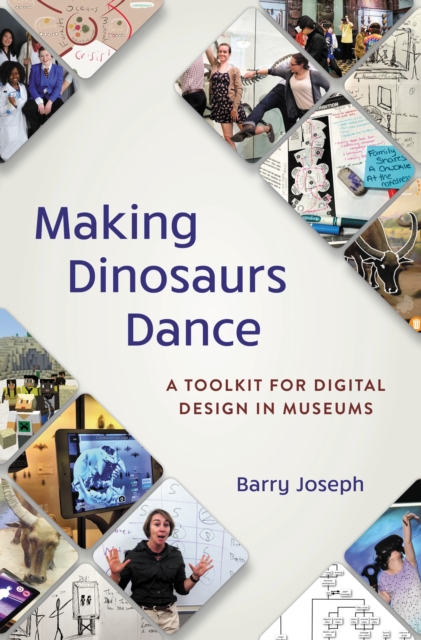
Making Dinosaurs Dance
Making Dinosaurs Dance: A Toolkit for Digital Design in Museums takes the reader behind the scenes to learn how the American Museum of Natural History innovates visitor digital engagement, highlighting design techniques used both there and at museums around the world. Based on the author's six years at the landmark institution that inspired the Night at the Museum franchise, the book introduces The Six Tools of Digital Design - user research, rapid prototyping, public piloting, iterative design, youth collaboration, and teaming up – then applies them through case studies across a range of topics: Combining digital experience design with physical museum assets in a guided format, featuring Crime Scene Neanderthal (CSN), a youth co-designed and facilitated in-Hall experience that invited museum visitors to use a mobile app and other tools to investigate a science-based mystery. Game-based learning, featuring three case: a tabletop games (Pterosaurs: The Card Game), mobile games (Playing with Dinos), and commercial off-the-shelf games (Minecraft). Mobile augmented reality games, featuring MicroRangers, which used AR to invite visitors to shrink to microscopic size and explore the Museum to combat threats to global biodiversity.XR experience design, featuring case studies about 360 videos on paleontology and virtual reality projects about ocean life. Science visualizations, featuring Galactic Golf, an astro-visualization that addressed the topics of mass and gravity through a round of mixed reality Martian golf; interactive science visualizations that invited visitors to hold CT-scans of bat skulls in their hand; and Finding Flamingos, a youth program focused on how Conservation Biologists protect endangered flamingos through GIS mapping and predictions software. In addition, the book explores related topics at institutions in Greece and France, and from Washington, D.C. to California.
eBook

The museum book : a guide to strange and wonderful collections
Presents the history of museums and some of the fascinating things that are displayed in them.
Book

Made in Newark
What does it mean to turn the public library or museum into a civic forum?Made in Newarkdescribes a turbulent industrial city at the dawn of the twentieth century and the ways it inspired the library's outspoken director, John Cotton Dana, to collaborate with industrialists, social workers, educators, and New Women.This is the story of experimental exhibitions in the library and the founding of the Newark Museum Associationùa project in which cultural literacy was intertwined with civics and consumption. Local artisans demonstrated crafts, connecting the cultural institution to the department store, school, and factory, all of which invoked the ideal of municipal patriotism. Today, as cultural institutions reappraise their relevance,Made in Newarkexplores precedents for contemporary debates over the ways the library and museum engage communities, define heritage in a multicultural era, and add value to the economy.
eBook

Interpreting immigration at museums and historic sites
\"Interpreting Immigration at Museums and Historic Sites includes strategies for the design, implementation, marketing and sustaining of programs that help visitors use the lens of history to address contemporary immigration issues and provides case studies, immigration program designs, audience building strategies, among others. The title considers the questions: How can museums use their collections and key stories as starting points for audience engagement around immigration past and present? How can museums move beyond the \"we are a nation of immigrants\" narrative - a narrative that does not resonate for all audiences? How can museums make opportunities for safe, open dialogue on immigration accessible to all stakeholders including both new immigrants and receiving communities? Interpreting Immigration includes strategies for the design, implementation, marketing and sustaining of programs that help visitors use the lens of history to address contemporary immigration issues\"-- Provided by publisher.
Book

The Museum Is Open
Museum science, museum analysis, museum history, and museum theory - all this expanding terminology underscores the growing scholarly interest in museums.A recurring assertion is that as an institution, the museum has largely functioned as a venue for the formation of specifically national identities.
eBook