
Catalogue Search | MBRL


Are you sure you want to remove the book from the shelf?

{{itemTitle}}
456
result(s) for
"Hoaxes History."
Sort by:

A history of ambition in 50 hoaxes
What do the Trojan Horse, Piltdown Man, Keely Motor Company, and Ponzi Scheme have in common? They were all famous hoaxes, carefully designed and bolstered with false evidence.
Book

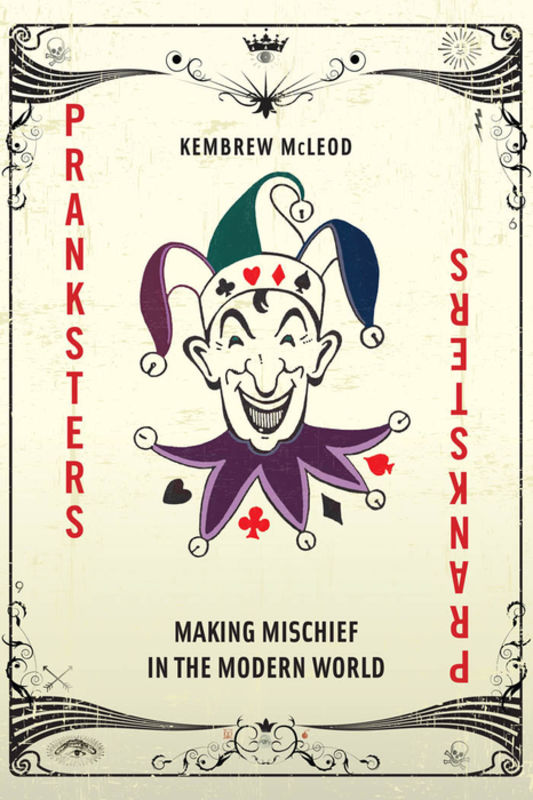
Pranksters
From Benjamin Franklin's newspaper hoax that faked the death of his rival to Abbie Hoffman's attempt to levitate the Pentagon, pranksters, hoaxers, and con artists have caused confusion, disorder, and laughter in Western society for centuries. Profiling the most notorious mischief makers from the 1600s to the present day,Prankstersexplores how pranks are part of a long tradition of speaking truth to power and social critique.Invoking such historical and contemporary figures as P.T. Barnum, Jonathan Swift, WITCH, The Yes Men, and Stephen Colbert, Kembrew McLeod shows how staged spectacles that balance the serious and humorous can spark important public conversations. In some instances, tricksters have incited social change (and unfortunate prank blowback) by manipulating various forms of media, from newspapers to YouTube. For example, in the 1960s, self-proclaimed professional hoaxer Alan Abel lampooned America's hypocritical sexual mores by using conservative rhetoric to fool the news media into covering a satirical organization that advocated clothing naked animals. In the 1990s, Sub Pop Records then-receptionist Megan Jasper satirized the commodification of alternative music culture by pranking theNew York Timesinto reporting on her fake lexicon of grunge speak. Throughout this book, McLeod shows how pranks interrupt the daily flow of approved information and news, using humor to underscore larger, pointed truths.Written in an accessible, story-driven style,Prankstersreveals how mischief makers have left their shocking, entertaining, and educational mark on modern political and social life.
eBook


Hoax
Did a collector with a knack for making sensational discoveries really find the first document ever printed in America? Did Adolf Hitler actually pen a revealing multivolume set of diaries? Has Jesus of Nazareth's burial cloth survived the ages? Can the shocking true account of Abraham Lincoln's assassination be found in lost pages from his murderer's diary? Napoleon famously observed that \"history is a set of lies agreed upon,\" and Edward Steers Jr. investigates six of the most amazing frauds ever to gain wide acceptance in this engrossing book. Hoax examines the legitimacy of the Shroud of Turin, perhaps the most hotly debated relic in all of Christianity, and the fossils purported to confirm humanity's \"missing link,\" the Piltdown Man. Steers also discusses two remarkable forgeries, the Hitler diaries and the \"Oath of a Freeman,\" and famous conspiracy theories alleging that Franklin D. Roosevelt had prior knowledge of the planned attack on Pearl Harbor and that the details of Lincoln's assassination are recorded in missing pages from John Wilkes Booth's journal. The controversies that Steers presents show that there are two major factors involved in the success of a hoax or forgery -- greed and the desire to believe. Though all of the counterfeits and conspiracies featured in Hoax have been scientifically debunked, some remain fixed in many people's minds as truth. As Steers points out, the success of these frauds highlights a disturbing fact: If true history fails to entertain the public, it is likely to be ignored or forgotten.
eBook


Improving History Literacy among Adolescences: Towards Hoax Prevention through KCBS (Kumpulan Cerita Buku Sejarah)
Teenagers tend to find difficulties in filtering hoax due to a lack of literacy skills. They view that learning history through a book is boring. Instead, teenagers prefer to read information online. This study aims to improve history literacy among adolescences in order to prevent the spread out of hoax through KCBS (Kumpulan Buku Cerita Sejarah/the collection of historical narratives). The method used is qualitative with a descriptive approach. The result of this study is improved history literacy of the adolescences which enabling them to filter information gathered from blogs and websites as well as the use of Facebook as a source of information and the development of positive characters. One of many ways to improve history literacy is through literacy movement in which students are imperatively encouraged to read history books that are followed by summarizing a certain topic into the KCBS (Kumpulan Cerita Buku Sejarah). Rewriting historical narratives is hoped to improve the students' literacy skills so that in the near future they will understand the danger of spreading out a hoax and will better respond to prevent the widespread.
Journal Article

The big con : great hoaxes, frauds, grifts, and swindles in American history
\" This book examines a broad range of infamous scams, cons, swindles, and hoaxes throughout American history--and considers why human gullibility continues in an age of easy access to information. Explores figures such as \"Yellow Kid\" Weil, Charles Ponzi, Orson Welles, and Frank Abagnale, among others Provides insight into human nature--gullibility being one aspect of it--throughout the ages, addresses the power of rumor and legend, and identifies the social conditions that have allowed some scams and hoaxes to flourish Presents information that can serve academic research projects as well as fascinate and entertain general readers Features the original stories behind the Hollywood movies The Sting, Catch Me If You Can, Argo, and American Hustle\"-- Provided by publisher.
Book


Lie for me
To understand lying, we naturally focus on small scale lies involving one speaker, one listener, one assertion. This methodology confers artificial plausibility upon the requirement that liars intend to deceive. For it excludes principal-agent conflicts that emerge from linguistic division of labor.When an employee lies for her boss, she need not inherit his motive to deceive. She displays loyalty even if her lie does not deceive. Focus on a single lie in isolation also blinds us to tactical deceptions such as telling a lie which is intended to be caught to advance another lie. Many of these complexities arise from situations that approximate common knowledge without quite crystallizing into this uniform transparency.
Journal Article